Every recruiter knows the feeling. You've identified the right candidate, they're available, and the role is a strong match. But before you can get them in front of your client, there's a CV to reformat. It takes 20, maybe 30 minutes, longer if the original is a dense PDF or a template that fights you at every field. By the time you send it, a competitor submitted half an hour ago.
That placement? Gone.
This scenario plays out across recruitment agencies every day, and it points to one of the most persistent and under appreciated recruitment bottlenecks agencies face: the time lost to manual CV formatting. It is not a minor inconvenience. It is a structural problem that costs agencies placements, erodes recruiter morale, damages candidate experience, and limits how fast a team can scale, without the operational dashboard ever flagging it as a risk.
This article breaks down exactly how CV formatting creates recruitment bottlenecks, what it costs in real operational and commercial terms, and why the agencies consistently winning on speed have made recruitment workflow automation a core part of how they work.
What Are Recruitment Bottlenecks, and Why Does CV Formatting Rank So High?
A recruitment bottleneck is any point in the hiring process where progress slows, stalls, or stops, creating delays between identifying a candidate and delivering them to a client. In a well-run agency, these delays are minimised. In most agencies, they are embedded in the daily routine without anyone fully quantifying the cumulative commercial cost. The most common recruitment bottlenecks agencies encounter share a defining characteristic: they consume recruiter time without generating direct placement value. CV reformatting sits at the top of this list, not because it is difficult, but because it is high-frequency, unavoidable in manual workflows, and acutely time-sensitive.
What Causes Recruitment Bottlenecks in Agencies?
Research across the HR technology sector, confirmed by Allsorter's analysis across hundreds of agencies globally, indicates that recruiters lose approximately 14 hours per week to manual, automatable tasks (Allsorter research, 2026). More than a third of that total is consumed by a single activity: CV reformatting alone accounts for up to 6 hours per recruiter per week.

Those 14 hours are not lost to complexity, strategic challenge, or candidate scarcity. They are lost to formatting, scheduling, re-entering data, and administrative tasks that generate friction without generating value. And within that block, CV reformatting is the single largest, most immediately solvable time sink in agency recruitment.

How Manual CV Formatting Slows Down Candidate Submissions
To understand why CV formatting is such a significant recruitment bottleneck, it helps to examine what the manual process actually requires. For each CV, a recruiter or administrator must typically: copy relevant candidate information into an agency-branded Word template; reorder sections to match house style; adjust fonts, spacing, and margins; remove or anonymise identifying details if required; add role-specific context; and check the output before submission.
Across the industry, the average time for this process is approximately 30 minutes per CV (Allsorter customer data, 2026). That is an optimistic estimate, complex documents, scanned PDFs, or heavily designed templates regularly push this to 45 minutes or more.
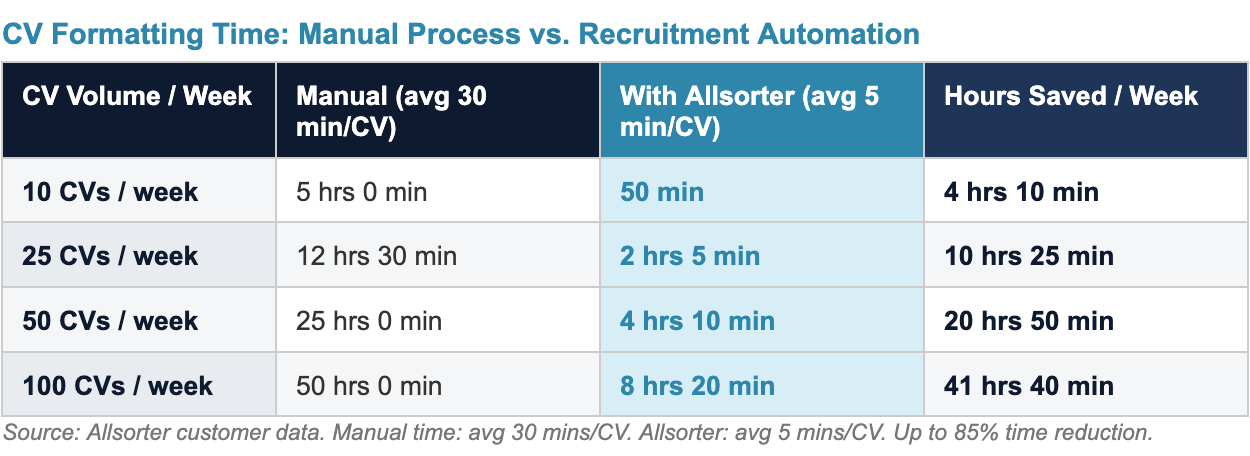
At 50 CVs per week, a realistic volume for a busy recruiter or small team, the manual approach consumes 25 hours. With recruitment automation tools, the same volume takes just over four hours. That is not a marginal efficiency gain. It is the equivalent of recovering more than half a full-time productive consultant's week, without a single additional hire.
The submission delay created by manual formatting has a direct commercial consequence. Recruitment is a speed-sensitive business. The first credible, well-formatted CV on a client's desk has a structurally higher probability of generating an interview. An agency consistently 30 to 60 minutes behind a competitor in every submission cycle is not just losing time, it is losing placements.
Where Recruiter Time Actually Goes: The Full Picture
The CV formatting bottleneck does not exist in isolation. It is part of a broader pattern of administrative work consuming recruiter capacity across the working week. When you map where time actually goes, the scale of the opportunity becomes difficult to ignore.
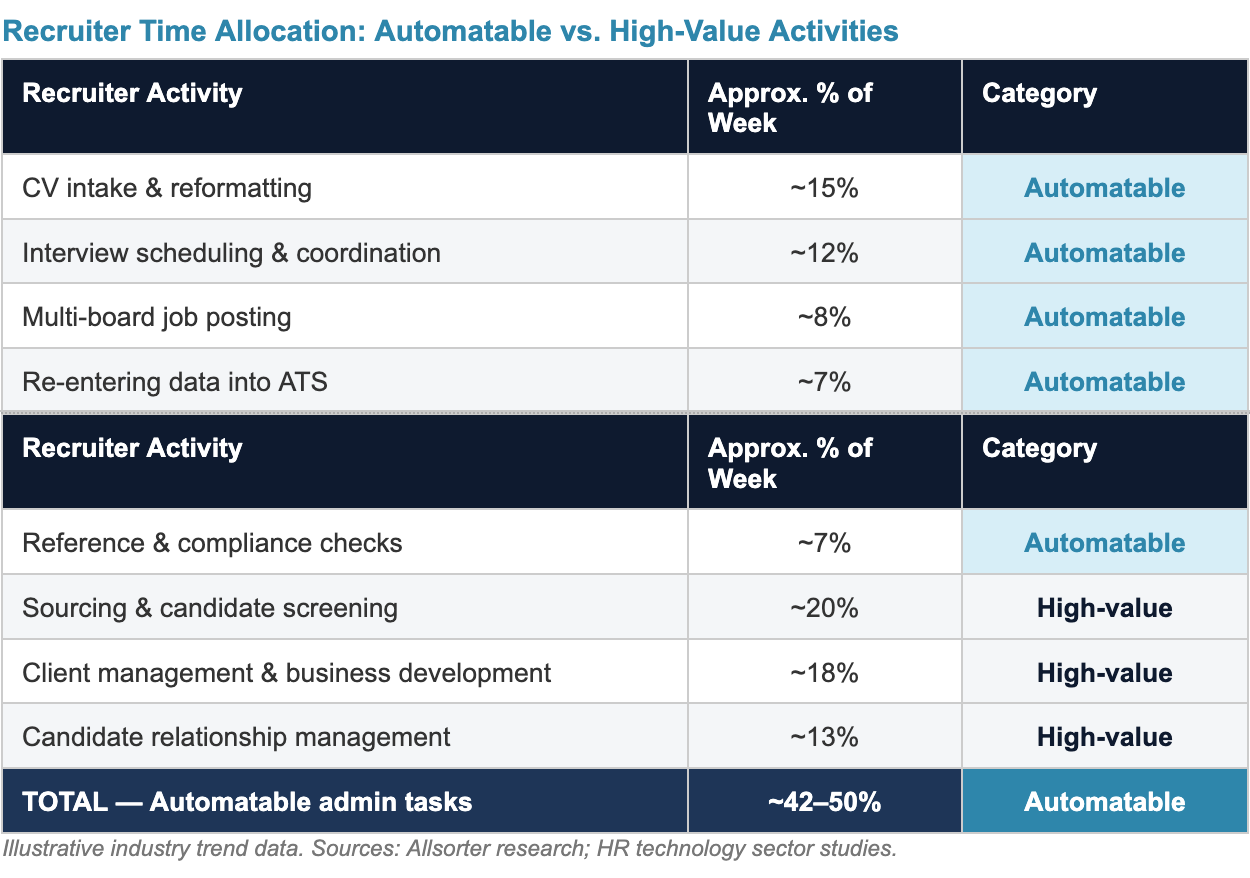
Between 42% and 50% of a recruiter's working week is consumed by tasks that, in 2026, can be automated using recruitment automation software. CV reformatting alone accounts for approximately 15% of the working week, more than any other single automatable activity.
Contrast this with sourcing and screening, client management, and candidate relationship-building, the activities that drive placements and generate revenue. These high-value tasks collectively account for roughly 50% of the week. That near-equal balance between value-generating and value-draining work is the recruitment bottleneck, expressed in time. The strategic question is not whether this can be changed. It is whether you are changing it.

The Hidden Cost of Slow Candidate Presentation
Lost Placements
The most direct cost of slow CV formatting is the placement that does not happen. In competitive multi-agency recruitment, the difference between winning and losing an assignment frequently comes down to hours, sometimes less. An agency that submits a formatted, branded, client-ready CV within 20 minutes of identifying a strong match operates in a fundamentally different competitive position from one whose formatting process adds several hours to that timeline.
This is especially pronounced in time-sensitive sectors, technology, financial services, healthcare, where the window between identifying a candidate and losing them to another offer or another agency can close within hours, not days. The recruitment bottleneck at the formatting stage is not an internal inefficiency. It is a placement risk that compounds with every assignment.
Recruiter Morale and Retention
The cost that rarely appears on operational dashboards is what sustained administrative burden does to the people doing the work. High-performing recruiters join the industry to build relationships, develop client partnerships, and place candidates. When a meaningful share of their day is spent reformatting Word documents, the best consultants are the first to disengage, and ultimately the first to leave.
Allsorter's analysis across hundreds of agencies consistently identifies manual CV reformatting as the most frequently cited source of recruiter frustration. The cost of recruiter turnover, typically six to twelve months of salary equivalent when you account for lost billings, rehiring, and ramp time (Allsorter research, 2026), materially dwarfs the cost of the automation tools that would have addressed the problem.

Candidate Experience
There is a third casualty of slow CV formatting that is rarely discussed: the candidate. Strong candidates, those with genuine options in a competitive market, are not willing to wait indefinitely. Industry data indicates that 70% of job seekers lose interest in a role if they do not hear back within one week of an interview (Allsorter, 2022). When a recruiter's internal formatting process adds days to what should be a same-day submission, candidates disengage, accept other offers, or go directly to clients.
The recruitment bottleneck at the formatting stage creates a downstream effect on candidate experience that ultimately reflects on the agency's market reputation, one of the most valuable and hardest-to-rebuild assets in the business.
Why Speed Is a Structural Competitive Advantage in Recruitment
Speed in recruitment is not simply about moving quickly for its own sake. It is about compression, reducing the time between candidate identification and client decision so that fewer things can go wrong in between. A candidate can accept another offer. A client can lose confidence and expand the search. A competitor can submit a stronger shortlist first. Every hour of delay is a new variable that works against the placement.
Agencies using Allsorter, including Randstad, Michael Page, and Addison Group, report that formatting tasks previously taking 30 minutes or more now average five minutes per CV (Allsorter customer data, 2026). At volume, this creates a compounding competitive advantage. The agency that submits first, consistently, becomes the agency clients trust to move fastest. That reputation compounds into more assignments, stronger relationships, and higher placement volumes — not because of any single submission, but because of a systematic operational advantage that repeats itself in every hiring cycle.
Top recruitment firms using Allsorter report up to 6× ROI from process efficiency gains and an 8% boost in interview rates, outcomes that flow directly from the time recovered at the formatting stage (Allsorter customer data, 2026).

How Recruitment Automation Removes CV Formatting Bottlenecks
CV formatting is one of the most solvable recruitment bottlenecks agencies face. Unlike sourcing quality or client relationship-building, where outcomes depend on judgment, experience, and relationship capital, formatting is a rule-based, repeatable task. It has a defined input (a candidate's original CV) and a defined output (a branded, client-ready document in agency template). That structure makes it an ideal candidate for AI-powered recruitment workflow automation.
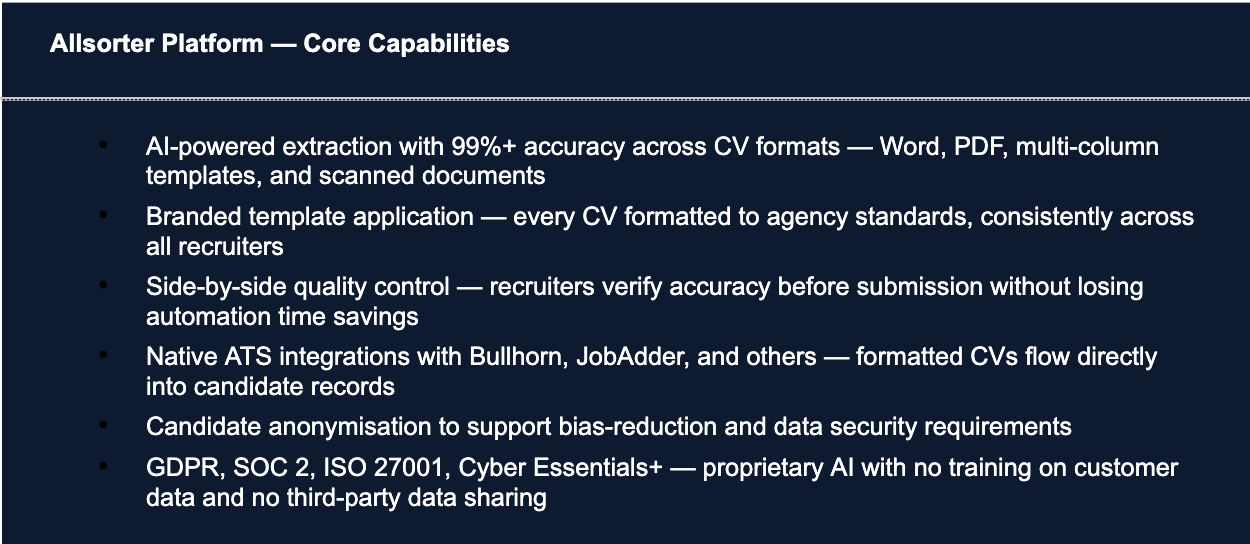
Allsorter is purpose-built for this use case. The platform uses AI to extract candidate data from any source format, Word documents, PDFs, multi-column templates, scanned documents, image-heavy layouts, and applies agency-branded templates automatically, producing client-ready CVs in under a minute. A side-by-side editing interface means recruiters retain full quality control and can verify accuracy before submission, without losing the time savings that automation delivers. Formatted CVs flow directly into Bullhorn, JobAdder, and other ATS systems, eliminating duplicate data entry from the workflow entirely.
The implementation case is straightforward. At 50 CVs per week, recovering more than 20 hours of recruiter capacity from formatting automation and redirecting those hours to sourcing, client development, or candidate engagement does not simply improve productivity figures. It changes what the agency can achieve with the same team, and does so in a way that is measurable from week one.
What Agency Leaders Should Do Now
The starting point is diagnosis, not procurement. Before evaluating any recruitment automation tool, map where your team's time actually goes. Track formatting hours across a single representative week, multiply by your team size and loaded billing rate, and calculate the annual cost of the bottleneck. The figure that emerges almost always represents the clearest, most defensible ROI case in your business, and it makes the investment decision straightforward.
For most agencies, the answer leads to the same place: CV formatting is the highest-volume, most time-consuming, most immediately solvable recruitment bottleneck in the workflow. It does not require a full technology overhaul to address. A focused Tier 1 automation investment, one that integrates natively with your existing ATS and achieves adoption from day one, delivers measurable impact within weeks, not quarters.
The agencies that have solved this problem do not describe it as a technology decision. They describe it as a competitive one. Their recruiters submit faster. Their clients receive shortlists sooner. They win assignments that slower agencies lose, and that advantage compounds with every placement cycle.
Conclusion: The Bottleneck Is Solvable
Manual CV formatting is one of the most persistent recruitment bottlenecks agencies face, and one of the most solvable. It consumes up to 6 hours of recruiter time per week, creates delays at the most critical point in the placement cycle, and gives faster-moving competitors a structural advantage in every multi-agency assignment.
Recruitment agencies that remove this bottleneck do not just save time. They submit candidates earlier, build stronger client reputations for speed and reliability, and create the capacity to handle higher volumes without increasing headcount. The competitive advantage compounds with every placement cycle, every client relationship, and every repeat assignment won on the basis of speed and consistency.
The question is not whether manual CV formatting is costing your agency placements. It almost certainly is. The question is how many more you could be winning, and how quickly you can start.
