The average recruiter spends more than a third of their working week on tasks that have nothing to do with placing candidates. CV reformatting, multi-board job posting, ATS data entry, and chasing interview confirmations consume hours that should go toward closing mandates and building client relationships. For agencies competing in a market where speed determines who wins the placement, this is a structural disadvantage. The right recruiter productivity tools can recover that time, and the agencies that deploy them systematically are the ones pulling ahead.
The Hidden Arithmetic of Recruiter Time Loss
Most agencies track billings, placements, and time-to-fill. Far fewer track how their recruiters actually spend their hours. Research cited across the HR technology sector suggests that recruitment professionals lose an average of approximately 14 hours per week to automatable tasks, more than a third of the working week consumed by activity that generates no direct placement value. CV reformatting alone accounts for a significant share of that loss: according to Allsorter's research across hundreds of agencies, manual CV formatting averages 30 minutes per profile. For a team of ten recruiters each handling 20 or more submissions per week, that single task is the equivalent of a full-time employee consumed entirely by administrative overhead.
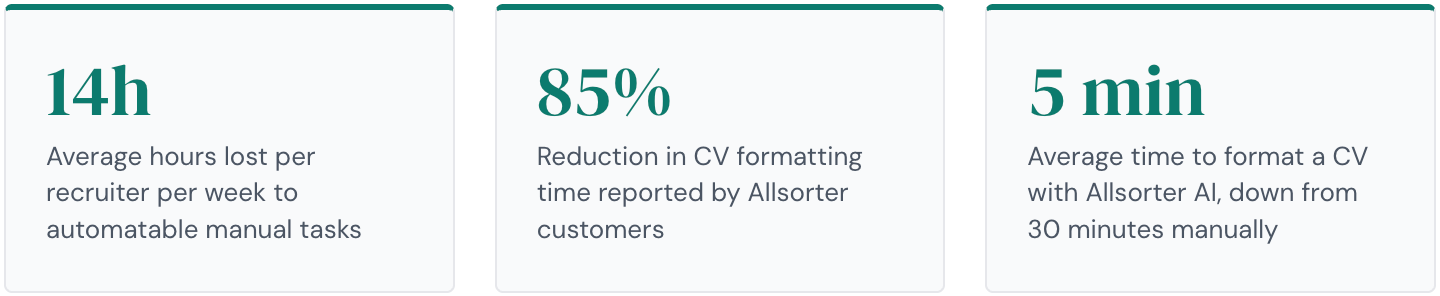
The problem is compounded by the nature of the work. CV formatting demands concentration and accuracy: an incorrectly formatted profile damages client confidence and can directly cost a placement, so recruiters cannot cut corners. They can only eliminate the task through smarter recruitment workflow automation. Beyond CV formatting, additional time is lost to manual job posting, re-keying candidate data into the ATS, and building submission summaries from scratch. These are individually small tasks that cumulatively represent the hidden cost most agencies have never formally measured.
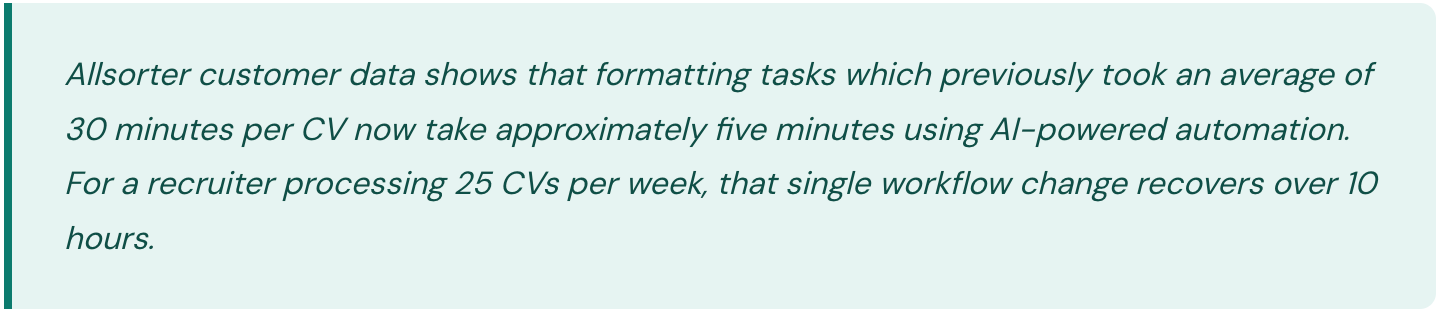
Time lost to administration is not simply time that goes unspent. It comes directly at the expense of higher-value activity: business development, candidate engagement, and client work. Agencies that resolve this burden gain capacity, and in a competitive market, capacity translates directly into faster placements and stronger revenue.
Why Standard Recruitment Technology Often Underdelivers
Most agencies already operate an ATS, a CRM, and a portfolio of job board subscriptions. Yet widespread adoption of these tools has not eliminated recruiter time loss at scale. The most common failure mode is adoption without integration. A scheduling tool is deployed, but it operates outside the ATS workflow. CV data is extracted from incoming applications, but reformatting still happens manually because the extraction output does not connect to a branded template. Each tool solves a fragment of the problem while leaving the surrounding workflow unchanged. Recruiters adapt by working around the tools rather than through them, and the time savings projected at implementation never materialise.
A second failure mode is selecting recruiter productivity tools based on feature lists rather than workflow fit. A sourcing platform that generates excellent candidate lists delivers limited value if the recruiter still spends 30 minutes manually reformatting each profile before submission. The upstream gain is absorbed by the downstream bottleneck. Effective recruitment workflow automation requires identifying the full sequence of steps between candidate identification and client submission, and ensuring that each step meaningfully compresses the time cost of the next.
The Bottleneck Audit: Where to Start
Before selecting any new recruitment technology, agency leaders should conduct a bottleneck audit: a structured review of where recruiter time actually goes across the full placement cycle. Track time per task, frequency per week, and the downstream impact of each delay. In most agencies, this exercise reliably surfaces the same four high-impact targets: CV formatting and submission preparation, interview scheduling and confirmation, multi-board job posting, and ATS data entry. These four areas consistently account for the majority of recoverable time and represent the strongest ROI targets for investment in recruiter productivity tools.
A Three-Tier Model for Smarter Recruitment Workflow Automation
Not all automation delivers equal return, and attempting to transform an entire workflow simultaneously is a reliable route to failed implementation. A staged model that prioritises by impact, complexity, and implementation risk produces more consistent results. The framework below organises recruitment workflow automation into three tiers, each building on the last.
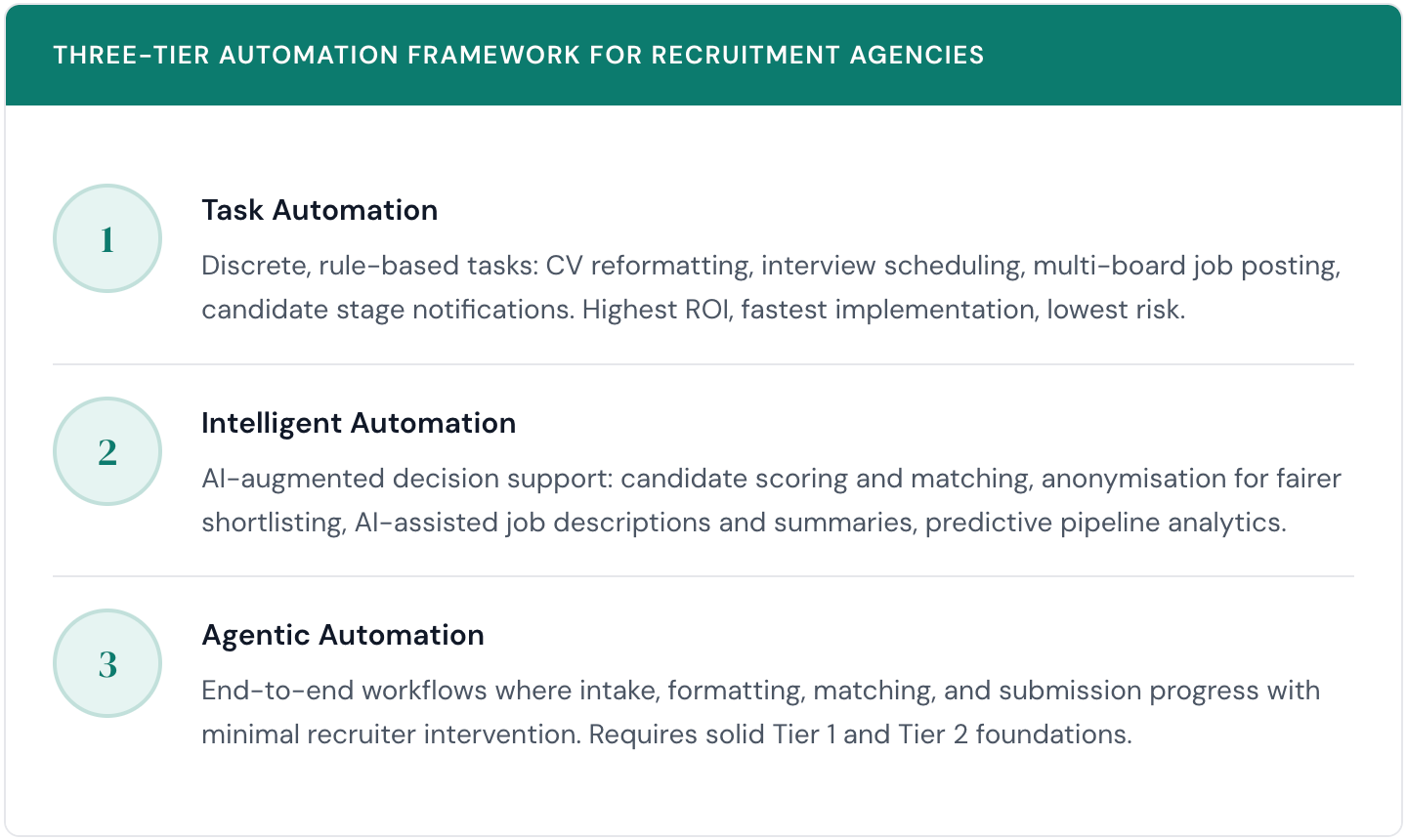
Tier One targets discrete, rule-based tasks where automation delivers the clearest and fastest return. This is where recruiter productivity tools generate the most immediate impact: CV reformatting sits squarely here, as do interview scheduling, multi-board job posting, and automated stage notifications. These tasks require no AI judgment, only well-configured software, and they consistently deliver the highest return on investment across agency sizes and recruitment specialisms. Agencies that resolve their Tier One tasks systematically report recovering 10 to 15 hours per recruiter per week, time that returns directly to revenue-generating activity.
Allsorter is purpose-built for the CV formatting bottleneck within Tier One. The platform uses AI in recruitment to extract candidate data, apply agency-branded templates automatically, remove personal identifiers to prevent candidate poaching, and produce client-ready submissions in a fraction of the manual time required. Agencies including Randstad, Adecco, Manpower, and Addison Group use Allsorter and have validated that formatting tasks previously requiring 30 minutes or more are completed in an average of five minutes. For high-volume teams, this single automation can recover the equivalent of a full working day per recruiter per week.
Tier Two introduces AI-augmented decision support: candidate scoring and matching algorithms, bias-reduction tools that anonymise profiles for fairer shortlisting, AI-assisted generation of job descriptions and candidate summaries, and predictive pipeline analytics. The impact here is qualitative as well as quantitative. Better shortlists, fewer placement failures, and stronger client confidence compound over time into improved agency reputation and revenue stability. Tier Three, the emerging frontier of agentic automation, builds end-to-end workflows where intake, formatting, matching, and submission progress with minimal recruiter intervention per step. The critical insight for planning purposes is that Tier Three is only viable once Tier One and Tier Two foundations are firmly in place.
The Strategic Case: Speed, Retention, and Revenue
The financial case for investing in recruiter productivity tools is straightforward to model. A consultant recovering 10 hours per week through recruitment automation tools gains the equivalent of 25 percent more available billing time without any increase in headcount. Across a team of ten, that represents 100 additional productive hours per week available for business development, candidate engagement, and faster shortlist preparation.
There is also a retention dimension that agency leaders often underestimate. Skilled professionals who spend a disproportionate share of their week on repetitive administrative tasks are significantly more likely to disengage and leave. Industry estimates commonly place recruiter replacement cost at six to twelve months of billing contribution when lost placements, rehiring, and ramp time are factored in. Investing in AI in recruitment that reduces admin load is therefore as much a retention decision as a productivity one. Speed compounds this further: in competitive mandates where multiple agencies work the same brief, the agency presenting qualified, client-ready candidates first holds a structural advantage. CV formatting bottlenecks directly constrain that speed, and removing them changes the agency's competitive position in every active mandate.
Practical Steps for Sequencing Your Investment in Recruiter Productivity Tools
For agencies looking to recover time systematically, the starting point is diagnostic. Spend one week tracking where recruiter hours actually go across the full placement cycle: log task category, duration, and frequency. Most teams discover that three or four categories account for the majority of recoverable time, and that CV formatting sits at or near the top of the list in virtually every agency that conducts the exercise. Once the highest-cost bottlenecks are identified, prioritise recruitment workflow automation in sequence: begin with CV formatting and submission preparation before advancing to scheduling and multi-board job posting. Each layer should integrate into the existing ATS rather than sit alongside it, because integration discipline is what converts tool adoption into sustainable time recovery.
Recruiter productivity tools should be evaluated on output quality, not only speed. A CV reformatted rapidly but containing parsing errors creates rework that erodes the time saved upstream. Allsorter addresses this through a dual-view editor showing the original and parsed version side by side, enabling rapid quality checking without disrupting the automated workflow. Finally, involve the recruiting team in tool selection. Adoption rates are substantially higher when consultants have meaningful input into workflow design, and change management is the variable that most reliably determines whether an automation investment delivers its projected return.
Recoverable Time Is a Competitive Asset
The hours the typical recruiter loses each week to administrative tasks are not a fixed cost of running a recruitment agency. They are recoverable through recruiter productivity tools that are proven in production environments, integrate with existing ATS platforms, and deliver measurable return within weeks of deployment. Recruitment workflow automation works best as part of a deliberate redesign, not layered onto an unchanged process. CV formatting is the near-universal starting point: it is the single largest avoidable time cost in the typical workflow, it is fully automatable using AI in recruitment today, and removing it returns time directly to revenue-generating activity. In a market where speed and candidate quality determine who wins mandates, recoverable time is a competitive asset. The agencies that treat it as one will consistently outperform those that do not.