The question is no longer whether to adopt AI in your recruitment workflows. It is whether your agency is doing so responsibly. The distinction matters commercially, legally, and operationally, and the gap between agencies on either side of it is widening faster than most agency owners recognise.
Recruitment has always operated at the intersection of human judgement and operational process. The strongest agencies have long understood that their competitive edge lies not in raw volume but in the quality of decisions made on behalf of clients and candidates, and in the integrity of the workflows that underpin those decisions.
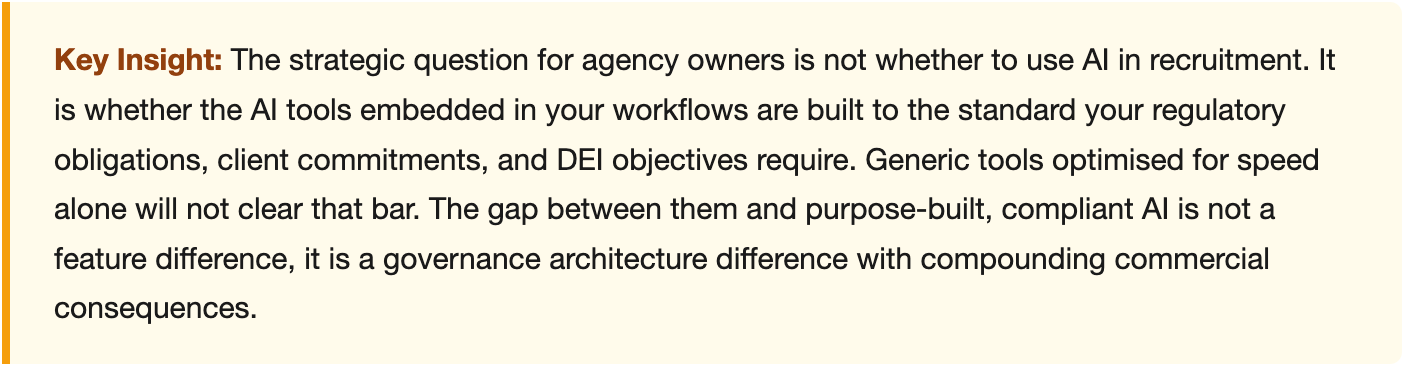
Both are now under structural pressure. Regulators governing AI in recruitment are tightening accountability requirements across the EU, UK, and US simultaneously. At the same time, the proliferation of generic AI tools built on third-party infrastructure is introducing compliance exposures and data quality risks that many agencies are not yet equipped to assess, let alone manage.
This article examines what responsible AI in recruitment agencies means in operational terms, across data governance, bias reduction, candidate data integrity, and regulatory compliance, and how agency leaders can build recruitment automation workflows that are faster, fairer, and built to withstand regulatory and client scrutiny.
Why the Regulatory and Commercial Environment Is Shifting
The responsible AI imperative is not driven by a single regulatory development. It is the product of three converging forces, each independently significant, collectively decisive.
The Legislative Shift: EU AI Act, ICO, and EEOC
The EU AI Act, which entered its phased implementation period in 2024, formally classifies AI systems used in employment and recruitment as high-risk applications. For agencies operating in or sourcing candidates across EU markets, this classification carries concrete obligations: transparency toward candidates about the use of automated systems, documentation requirements for how AI influences shortlisting or selection, and mandatory human oversight at key decision points. The Act places responsibility on the deployer, the agency, not the tool vendor.
In the UK, the Information Commissioner's Office has published evolving guidance on AI-assisted decision-making in HR and recruitment contexts. The ICO's position emphasises that candidates subject to automated processing have rights under UK GDPR to meaningful explanation and, in some circumstances, to request human review of decisions that affect them. Agencies that cannot document how their AI tools influence candidate outcomes are carrying undisclosed compliance exposure.
In the US, the Equal Employment Opportunity Commission has clarified that employer liability for discriminatory outcomes produced by AI hiring tools extends to organisations that deploy those tools, irrespective of whether the tool was built in-house or supplied by a third-party vendor. The principle across all three jurisdictions is consistent: regulatory accountability follows the agency, not the technology provider.
The Enterprise Procurement Shift
Independently of legislative change, enterprise client procurement standards have raised the floor on what they require from recruitment partners. Technology stack audits, data processing reviews, and requests for ISO 27001 certification are now standard expectations at major corporates rather than exceptional ones. Multiple industry observers across the HR technology and staffing sectors have noted this shift accelerating through 2024 and 2025.
Agencies that cannot evidence their compliance posture are increasingly disqualified from enterprise accounts before a commercial conversation begins, not by competitive failure, but by administrative ineligibility. This creates a structural asymmetry: agencies that have invested in defensible recruitment technology infrastructure are accumulating enterprise-ready credibility, while those that have not are accumulating compliance debt that becomes progressively more expensive to resolve.
AI Governance Must Start With Bias, Not Just Efficiency
Discussions about responsible AI in recruitment frequently centre on operational efficiency, time saved, tasks automated, costs reduced. That framing is incomplete. Recruitment is a process that directly shapes people's economic participation and career trajectories. The AI tools embedded in that process carry consequential fairness implications that deserve the same strategic weight as any operational metric.
The Labour Market Research on Hiring Bias Is Unambiguous
The evidence base on discrimination in hiring is among the most replicated in social science. Field experiments using matched CV pairs, identical in qualification but varying by inferred characteristics of the applicant, have consistently found that candidates whose names signal a particular ethnic background, gender, or nationality receive materially fewer callbacks. This effect has been documented across the UK, US, Europe, and Australia over more than two decades of research, including studies published in leading economics and sociology journals.
Employment gaps, disproportionately common among women returning from caregiving breaks, are treated more harshly in unstructured evaluation settings than in criteria-based processes. Age signals embedded in career chronology, graduation year, early role dates, shape assessments before a recruiter has consciously evaluated a candidate's current capability. These are not fringe findings. They are baseline conditions in the labour market that any responsible approach to AI in recruitment must account for.
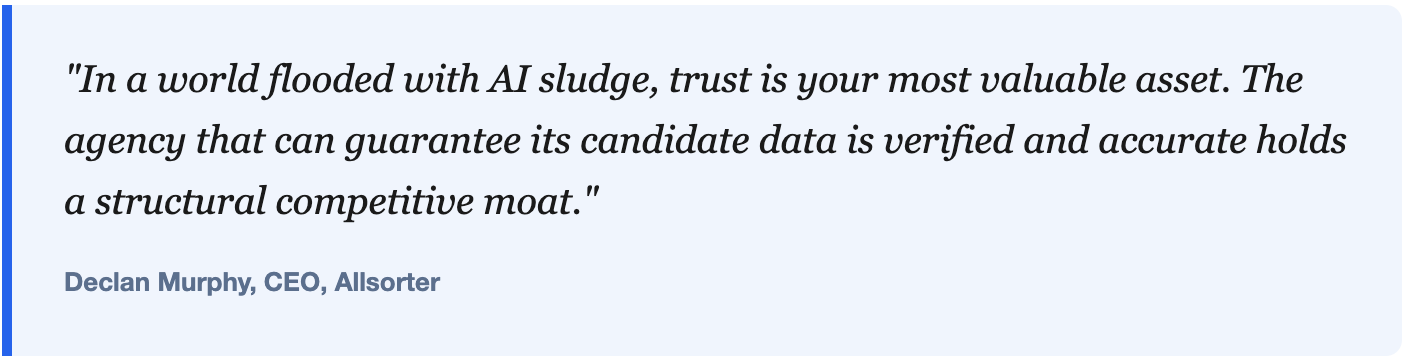
Allsorter's own research found that US employees are 93.6% more likely to have a male CEO, a figure that reflects systemic bias compounding at scale across hiring decisions made over time, and a stark illustration of why structural fairness cannot be left to good intentions alone.
How AI Can Amplify, or Reduce, Bias at Scale
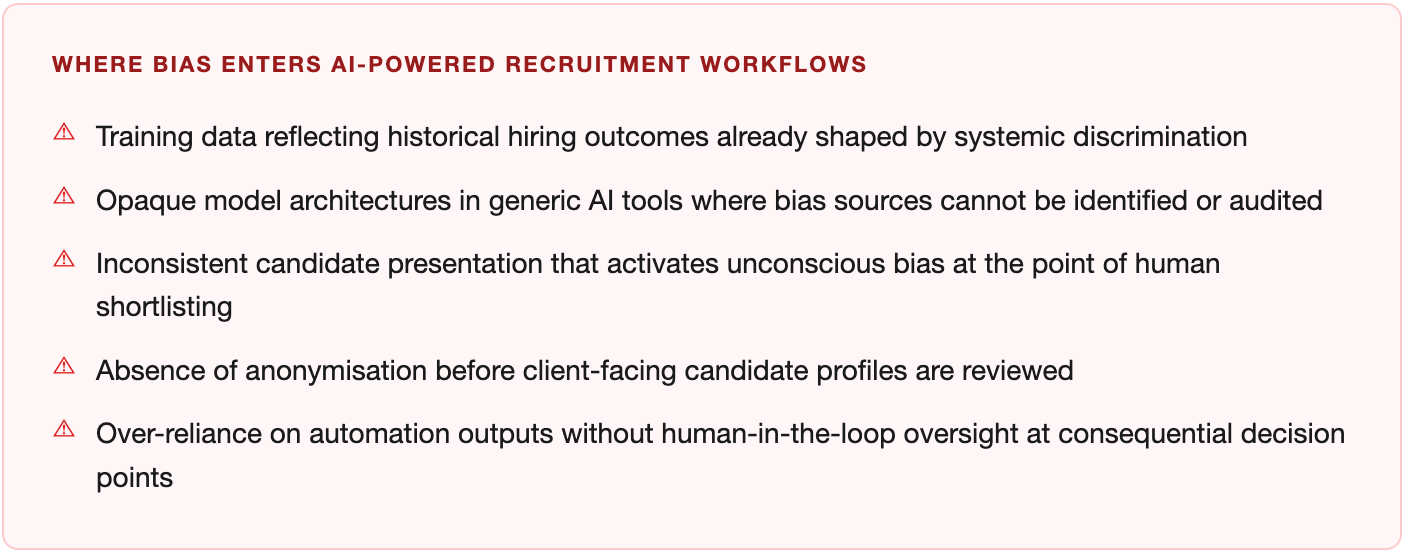
AI tools built on general-purpose large language models trained on historical hiring data risk encoding the biases already present in that data, and reproducing them at a scale and speed no human process could replicate. The problem is compounded by opacity: when bias operates through an automated system, it is harder to detect, harder to challenge, and harder to document as a root cause when outcomes are questioned.
The inverse is also true. Well-designed recruitment workflow automation that applies consistent structural logic to every candidate profile, regardless of name, layout, or presentation quality, removes the surface variation that activates unconscious bias at the point of human review. Anonymisation tools that strip names, photos, age indicators, and contact details from client-facing profiles reduce bias surface area further, consistently at scale. This is not a theoretical benefit. Research in organisational behaviour consistently shows that structured, criteria-based evaluation produces fairer shortlisting outcomes than unstructured review, and automation that enforces that structure operationalises the finding at volume.
The New Risks AI Introduces Alongside New Efficiency
The adoption of AI across recruitment workflows has accelerated markedly over the past three years. Automation is now in common use across candidate sourcing, initial screening, interview scheduling, and candidate submission. The direction is broadly correct: removing repetitive, low-judgement tasks from recruiter workloads does recover capacity for higher-value activity. But this proliferation has introduced a new risk category that recruitment technology decisions must now account for.
The GDPR Compliance Gap in Generic AI Tools
A significant share of AI tools currently marketed to recruitment agencies are built on general-purpose AI infrastructure, the same model foundations that power consumer-facing applications. When candidate personally identifiable information passes through a third-party AI service, it enters infrastructure controlled by an external provider. Depending on service terms, that data may be retained, processed for model improvement, or accessible to personnel outside the contractual relationship.
Under GDPR, recruitment agencies operating as data controllers bear legal responsibility for data processed on their behalf by technology vendors acting as data processors. Processing EU candidate data through a system without explicit data processing agreements, documented data residency guarantees, and enforceable retention and deletion policies constitutes a potential breach of Article 28 obligations, and the agency, not the vendor, carries the regulatory exposure. Under ISO 27001 frameworks, data custody chains must be demonstrable and auditable end to end. Many generic AI tools fail both tests simultaneously.
The AI Sludge Problem: Volume Without Quality
A second risk emerged at scale from 2024 onwards: the systematic degradation of candidate data quality driven by AI-generated CVs and automated mass-application tooling. Generative AI makes it straightforward to produce polished, keyword-optimised profiles that clear basic ATS screening but contain exaggerated, inconsistent, or outright unverifiable claims.
Widely reported industry trends indicate that major global staffing organisations are now routinely identifying significant volumes of incoming applications where stated employment history or qualifications cannot be verified against public records. The problem compounds across three dimensions that any responsible ATS automation strategy must directly address:
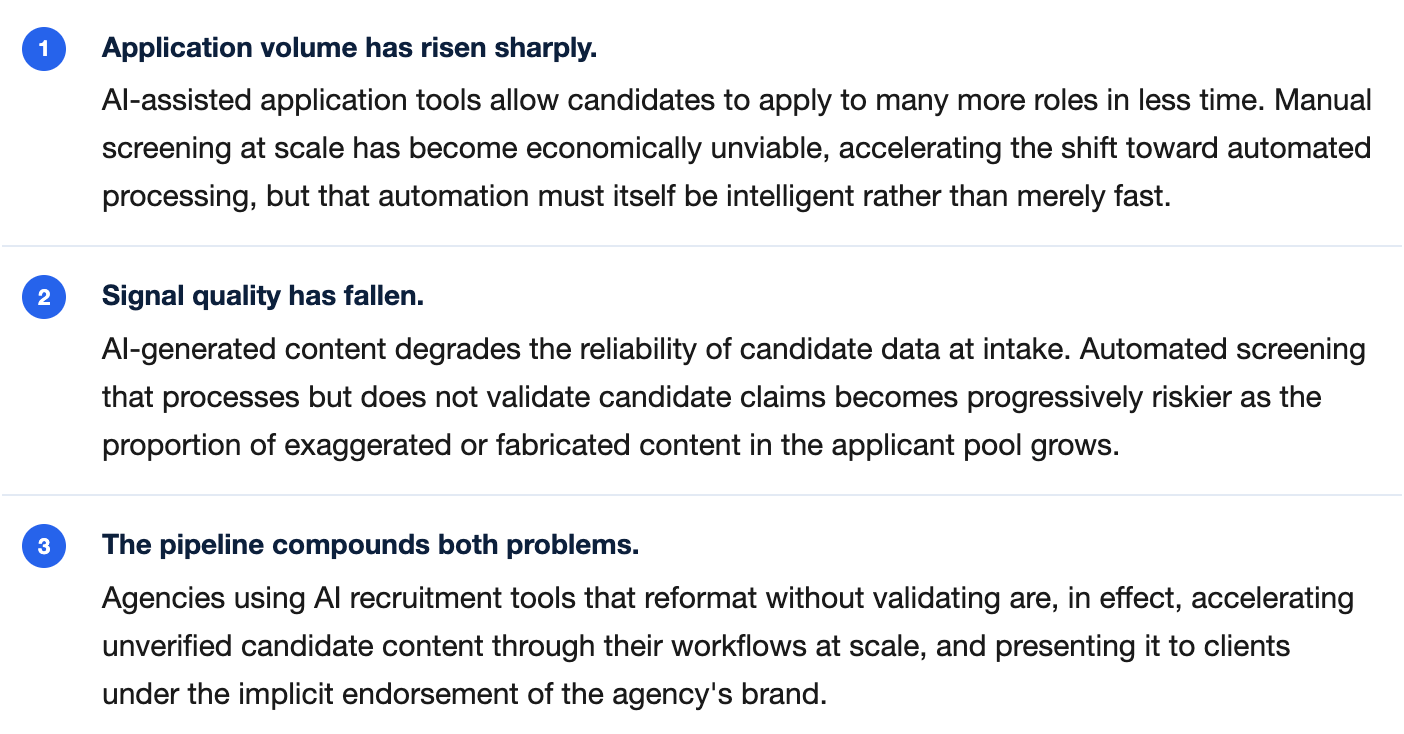
The commercial consequence is not abstract. A single placement driven by an unverified candidate claim can damage a client relationship built over years. At the aggregate level, a recruitment automation stack that prioritises speed over data integrity is a source of compounding risk that remains invisible until a failure makes it visible.
What Responsible AI in Recruitment Actually Means in Practice
The phrase "responsible AI" appears frequently in vendor marketing but is rarely given operational content. For an agency owner making recruitment technology decisions, its value depends entirely on what it means in practice. In the context of AI-powered recruitment workflows, it has three concrete, measurable dimensions.
1. Data Sovereignty: Where Does Candidate Data Go?
Responsible AI governance in recruitment begins with a deceptively simple question: when a candidate's CV is processed by your tools, where does that data go and who controls it?
Recruitment agencies are data controllers under GDPR. They bear legal responsibility for data processed on their behalf, including data processed by technology vendors classified as data processors under Article 28. Any AI tool that routes candidate PII through external model infrastructure, without explicit data processing agreements, documented data residency, and enforceable retention and deletion policies, represents a compliance exposure that cannot be contractually transferred to the vendor.
The defensible standard is a closed-loop system: candidate data processed exclusively within infrastructure the agency controls or has documented, auditable agreements governing. In the event of a data subject access request, a client audit, or a regulatory inquiry, an agency operating to this standard can produce, at the level of individual candidate records, a complete account of how data was collected, processed, stored, and transmitted. This is what GDPR Article 30 record-keeping obligations and ISO 27001 audit requirements practically demand.
2. Structural Bias Reduction Through Consistent Processing
Responsible AI in recruitment means applying the same structured processing logic to every candidate profile, regardless of name, origin, or document quality. This is a meaningfully higher standard than simply avoiding discriminatory decision criteria. It means designing consistency into the process architecture itself, so that fairness is a property of the system, not a function of individual recruiter behaviour on a given day.
Structured automation removes the surface-level variation, inconsistent formatting, variable section ordering, differences in visual presentation, that activates unconscious bias before qualifications have been assessed. Anonymisation features that remove names, photos, age signals, and contact details from client-facing submissions reduce this surface area further, applied uniformly rather than selectively. Research in organisational behaviour consistently shows that structured, anonymised evaluation produces fairer shortlisting distributions. AI that enforces that structure at scale is one of the most practically effective DEI tools available to a recruitment agency.
3. Candidate Data Validation and Trust Infrastructure
In a market where AI-generated candidate content is proliferating, the verifiability of the data an agency presents to clients has become a genuine competitive differentiator. Responsible AI means building validation into the workflow, not simply processing and presenting candidate data, but actively cross-checking it for internal consistency and plausibility.
Trust scoring, flagging inconsistencies between stated job titles, listed employers, claimed qualifications, and verifiable data points, is no longer an advanced capability. It is a baseline expectation for any agency that wants to protect its placement record and its client relationships in a market where AI-generated exaggeration is routine. Embedding validation in the workflow is what separates agencies that are genuinely managing data quality from those that are inadvertently laundering it.
An AI Governance Framework: Evaluating Your Current Stack
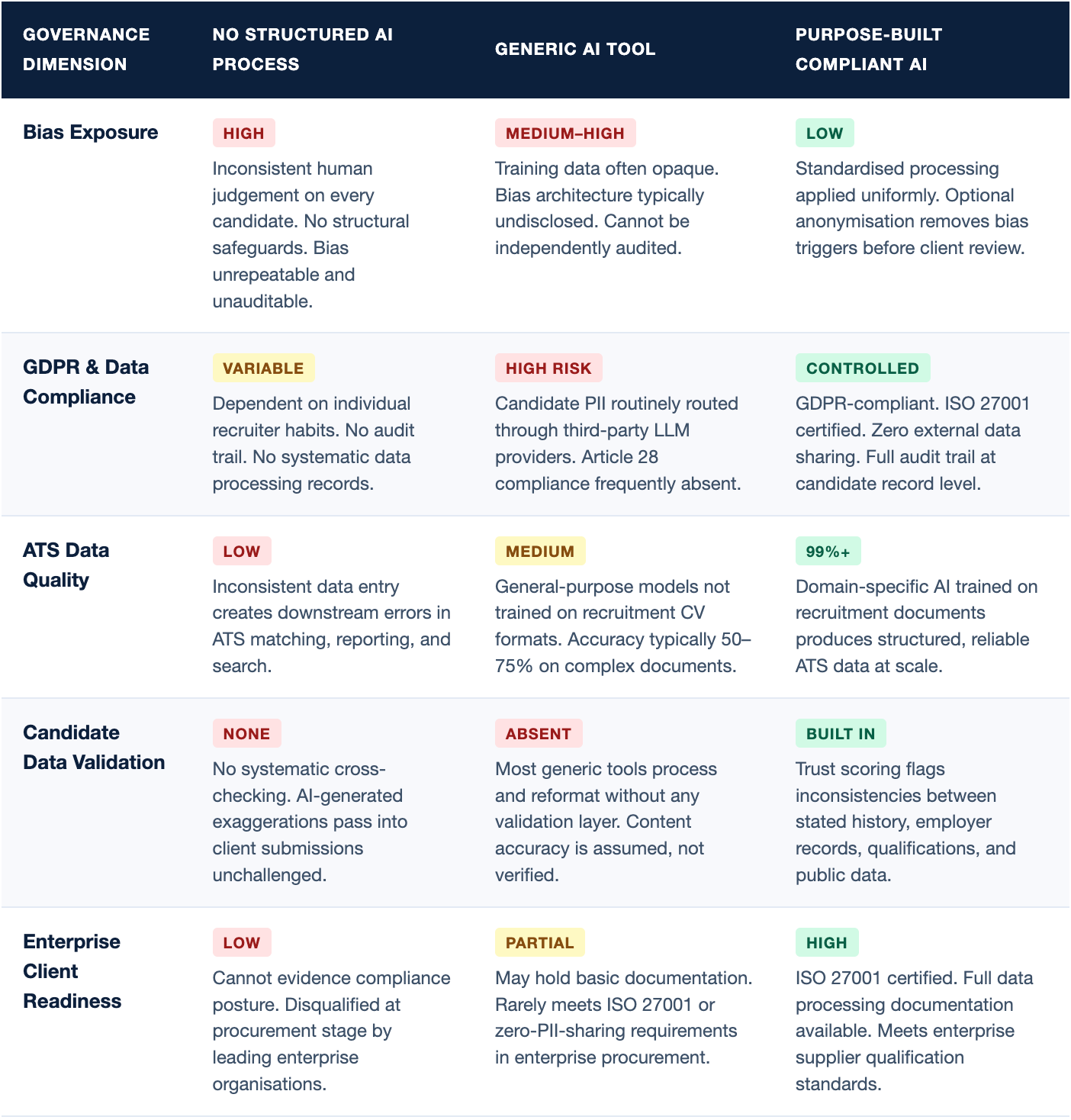
The following framework is designed to help agency owners assess their current recruitment technology stack against a responsible AI standard across five governance dimensions. The comparison reflects three distinct approaches observable in the market. The gaps between them are not incremental, they are structural.
Compliance as a Commercial Differentiator
The case for responsible AI adoption in recruitment agencies does not rest solely on ethical grounds, though those grounds are independent and substantial. It is equally a commercial argument, driven by compounding advantages that accrue to agencies that resolve the governance question early.
The Compliance Asymmetry Is Structural, Not Cyclical
Agencies investing in compliant AI infrastructure now are building a durable advantage. The mechanism is structural: as enterprise procurement requirements tighten and regulatory enforcement matures, the cost of resolving compliance debt increases non-linearly. An agency that has documented its data processing agreements, certified its AI tools, and built audit capability into its workflows finds that compliance opens commercial doors. An agency that has deferred those decisions finds them progressively more expensive to address, and finds enterprise opportunities foreclosed in the interim.
This is the compliance asymmetry: both the cost of compliance and the return on compliance are front-loaded. Agencies that act early benefit disproportionately; those that wait bear disproportionate catch-up costs.
Candidate Trust Is a Commercial Asset
The AI sludge phenomenon has materially altered the relationship between agencies and candidates. Candidates are increasingly aware that their data may be processed by automated systems, and in some jurisdictions, they have explicit GDPR and EU AI Act rights to understand how. Agencies that handle candidate data transparently and can offer clear assurances about how it is processed are better positioned to attract and retain strong talent.
In competitive talent markets, candidate experience begins at the moment a CV is submitted. A recruitment workflow that handles that submission with demonstrable care and rigour signals something meaningful about the agency, before a recruiter has spoken to the candidate.
Scalability and Risk Do Not Have to Move Together
Unstructured processes and generic AI tools scale badly on compliance and data integrity dimensions. As submission volume grows, unlogged data handling events accumulate, bias exposure compounds, and unverified candidate data accrues in client relationships, quietly, until it isn't quiet. Purpose-built, compliant recruitment automation decouples this relationship. Efficiency gains, compliance coverage, and data quality improvements scale in parallel rather than in tension. That is the operational value proposition of getting the governance architecture right.
Building a Responsible AI Recruitment Workflow: Eight Steps
Translating responsible AI principles into operational decisions requires a structured audit of current workflows and a clear evaluation framework for any new or existing recruitment technology. The following steps address the most common governance gaps in agency AI adoption in 2026.
Responsible AI Governance Checklist for Recruitment Agencies
- Audit data routing across all AI tools in use. For each tool that processes candidate data, confirm whether candidate PII is shared with third-party AI model providers, under what service terms, and with what data residency guarantees. If you cannot answer this question about a tool in your stack, the answer is a compliance exposure.
- Verify GDPR Article 28 compliance with all AI vendors. Agencies acting as data controllers must have documented, enforceable data processing agreements with vendors acting as processors. Verbal assurances and generic privacy policies do not satisfy Article 28 requirements.
- Distinguish between GDPR compliance and ISO 27001 certification. These are not equivalent standards and enterprise procurement teams may require both. GDPR compliance governs how candidate data is processed and protected; ISO 27001 certification evidences the information security management system within which that processing takes place.
- Implement candidate anonymisation as a standard pre-submission step. Removing names, photographs, age indicators, and contact details from client-facing candidate profiles before shortlisting review is both a DEI measure and a bias risk control. It should be a default setting, not an optional one.
- Require trust scoring and data validation in your AI recruitment tools. Any tool that processes candidate CVs at scale should include a mechanism to flag inconsistencies between stated employment history, listed employers, claimed qualifications, and verifiable data. This is a baseline requirement in a market where AI-generated exaggeration is routine, not an edge case.
- Build candidate-level audit trails into your data workflow. The ability to evidence, for any individual candidate record, how data was collected, processed, stored, accessed, and transmitted is a GDPR requirement and an increasingly standard enterprise client expectation. It should not require manual reconstruction after the fact.
- Evaluate AI tools on domain fit, not general AI capability. Purpose-built recruitment AI trained specifically on recruitment document formats and workflows consistently outperforms general-purpose AI on both extraction accuracy and compliance architecture. A tool's general AI capability is not a reliable proxy for its fitness in a recruitment context.
- Align your governance posture with your growth trajectory. If your agency is building toward enterprise accounts, EU-regulated markets, or high-volume staffing contracts, your recruitment technology stack must meet the compliance and data governance standards those relationships will require at contract stage, not as a future-state target, but as a current operational reality.
The Compounding Advantage of Getting This Right Early
The regulatory environment around responsible AI in recruitment agencies is tightening across multiple jurisdictions simultaneously. The EU AI Act's employment provisions, GDPR enforcement activity targeting automated decision-making, ICO guidance in the UK, and EEOC developments in the US are each moving toward greater accountability. Taken together, they are establishing a new baseline standard for how AI may be used in hiring processes, and what documentation agencies must be able to produce when that use is scrutinised.
Enterprise clients are amplifying this dynamic from the commercial side. Supplier qualification processes at leading organisations now include technology stack reviews, data processing audits, and requests for certification evidence as standard rather than exceptional requirements. Agencies that have not invested in defensible recruitment technology infrastructure are beginning to encounter commercial consequences that will intensify as these expectations normalise.
Within this environment, responsible AI is not aspirational language. It is the minimum operational standard for AI-powered recruitment in 2026. Agencies that meet it, with compliant data architecture, structural bias reduction, validated candidate data, and documented governance, find that compliance, efficiency, and data quality form a self-reinforcing system. Each investment in one dimension strengthens the others.
Those agencies attract stronger talent, win enterprise accounts that require compliance evidence, deliver more accurate candidate data to clients, and build DEI outcomes grounded in structural consistency rather than individual intention. The advantage is real, it is measurable, and it compounds over time.
The ethical case, the operational case, and the commercial case for responsible AI in recruitment are not in tension. They are the same case, and the agencies that act on it earliest benefit most.
See How Responsible AI Fits Your Recruitment Workflow
Allsorter is GDPR compliant and ISO 27001 certified, built on a proprietary Vertical Language Model with zero data sharing with external AI providers and zero data breaches to date. Trusted by Randstad, Adecco, Manpower, Michael Page, Addison Group, and 400+ agencies globally.