Bullhorn is the ATS backbone for thousands of staffing agencies worldwide, providing pipeline management, job order tracking, and candidate workflow infrastructure that most recruiters depend on every working day. Yet for many agencies, Bullhorn remains a record-keeping system rather than a genuine submission accelerator. Recruiters log into it, update it, and export from it. What they are not doing is using the Bullhorn automation workflow to eliminate the most time-consuming steps between candidate intake and client submission. In a market where agencies compete on the same talent pool and the same live briefs, that gap is precisely where placements are won and lost.
Knowing how to automate Bullhorn workflows effectively is no longer optional for agencies serious about faster shortlisting and stronger candidate presentation. This article maps where the Bullhorn automation workflow breaks down in practice, identifies the four highest-impact stages where recruitment workflow automation pays off, and explains how integrating purpose-built recruitment automation tools into Bullhorn's ecosystem compresses the time from candidate identification to a polished, client-ready submission.
Why Bullhorn Alone Cannot Win on Submission Speed
Bullhorn is a powerful platform, but its native functionality centres on pipeline management and candidate tracking rather than submission acceleration. The ATS records what happens in a recruitment workflow. It does not, by default, eliminate the manual effort required to make each step happen faster. A recruiter using Bullhorn without a connected automation layer still manually reformats CVs before client submission, still switches between Bullhorn and email to chase interview confirmations, and still corrects parsing errors in candidate records that arrived in non-standard formats. These are not edge-case problems. They are the daily friction points that govern how many candidates get submitted in a given week and how professionally those submissions land.
The core issue is design scope rather than platform capability. Bullhorn was built as an integration platform as much as a standalone ATS. Its open API and Marketplace partner ecosystem exist precisely because the most impactful Bullhorn automation workflow improvements come from connecting specialist recruitment automation tools into Bullhorn, not from expecting the ATS to do everything. Agencies that understand this distinction run faster submission cycles, stronger candidate presentation, and better time-to-fill metrics than those treating Bullhorn as a closed system. That gap widens as recruitment technology advances, and it is not recoverable through effort alone.

The practical cost of this gap is measurable at the desk level. Allsorter's research across hundreds of recruitment agencies confirms that CV reformatting into agency-branded templates is the single most time-intensive and least strategically valuable task in the candidate submission workflow. For a recruiter processing 20 to 30 candidates per week inside Bullhorn, manual formatting can consume an entire working day of capacity before a single branded submission has reached a client. That is recoverable time sitting inside an unchanged workflow, and it represents the clearest starting point for any serious Bullhorn automation strategy.
The Four Bullhorn Workflow Stages Where Automation Delivers the Most
Building an effective Bullhorn automation workflow requires mapping the candidate journey from first contact to placed and identifying precisely where manual effort is heaviest relative to the value it contributes. Across agencies of varying sizes and specialisms, four stages consistently emerge as the highest-priority targets for recruitment workflow automation inside Bullhorn.
Stage One: Candidate Data Capture and ATS Accuracy
Incoming CVs reach Bullhorn through job board integrations, direct applications, email forwarding, and LinkedIn. Bullhorn's native parsing extracts candidate data into structured records, but parsing fidelity varies significantly by document format. Recruiters handling multi-column layouts, image-heavy PDFs, or non-standard CV structures will recognise the manual correction burden that follows a failed parse. When candidate records contain errors at the point of entry, every downstream process inherits those errors: shortlisting judgments, AI matching algorithms, and the formatted submission the client eventually receives. Connecting a high-accuracy AI extraction layer to Bullhorn at the data capture stage eliminates that rework and ensures the records driving the rest of the workflow are trustworthy from the start.
Stage Two: CV Formatting and Branded Candidate Presentation
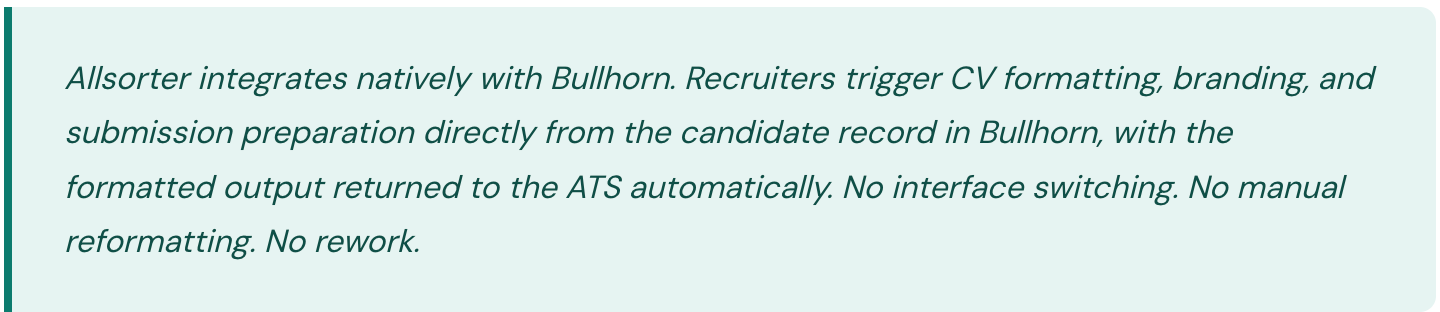
This is the single largest time sink in the Bullhorn workflow for most agencies and the point where automating Bullhorn delivers the most immediate commercial return. Every CV submitted to a client needs to conform to the agency's branded template, have personal contact details removed to protect against candidate poaching, and present experience in a consistent, professional format. Done manually, this averages 30 minutes per candidate. Done through an AI-powered reformatting tool integrated into Bullhorn, the same output takes approximately five minutes. Allsorter integrates natively with Bullhorn to automate this step: extracting candidate data from the ATS record, applying the agency's branded Word template, removing identifying information, and returning a client-ready CV without the recruiter leaving the interface.
Stage Three: Interview Scheduling and Coordination
Once a shortlist has been submitted and a client has responded, interview coordination becomes the next significant source of recruiter time loss inside Bullhorn. Chasing confirmations, managing reschedule requests, and sending reminders are tasks Bullhorn can log and track, but they require active recruiter intervention to execute at each step. Integrating scheduling tools that connect with Bullhorn's calendar and communication layer allows candidates and clients to self-book from pre-defined availability windows, with confirmations and reminders triggered automatically at each stage. The recruiter's role shifts from coordination management to exception management, which is a meaningfully different and more productive use of their working time.
Stage Four: Pipeline Progression and Post-Submission Automation
The final layer of ATS automation within a Bullhorn workflow is stage progression: advancing candidates through interview, offer, and placement stages with automated communications and task triggers at each transition. Bullhorn's native workflow automation rules allow agencies to configure email sequences, activity reminders, and status updates that fire when a candidate record moves between pipeline stages. Agencies that invest in configuring these rules systematically spend significantly less recruiter time on pipeline administration and more on the relationship and negotiation work that determines whether offers convert into placements and placements convert into repeat business.
Sequencing Your Bullhorn Automation Workflow: A Practical Framework
The operational challenge for most agencies is not identifying which Bullhorn automation workflows to target. The harder problem is sequencing the implementation without disrupting live recruitment activity across active desks. The framework below provides a logical, low-disruption order for building faster, more automated submission workflows within the Bullhorn ecosystem, with each step designed to deliver measurable return before the next begins.
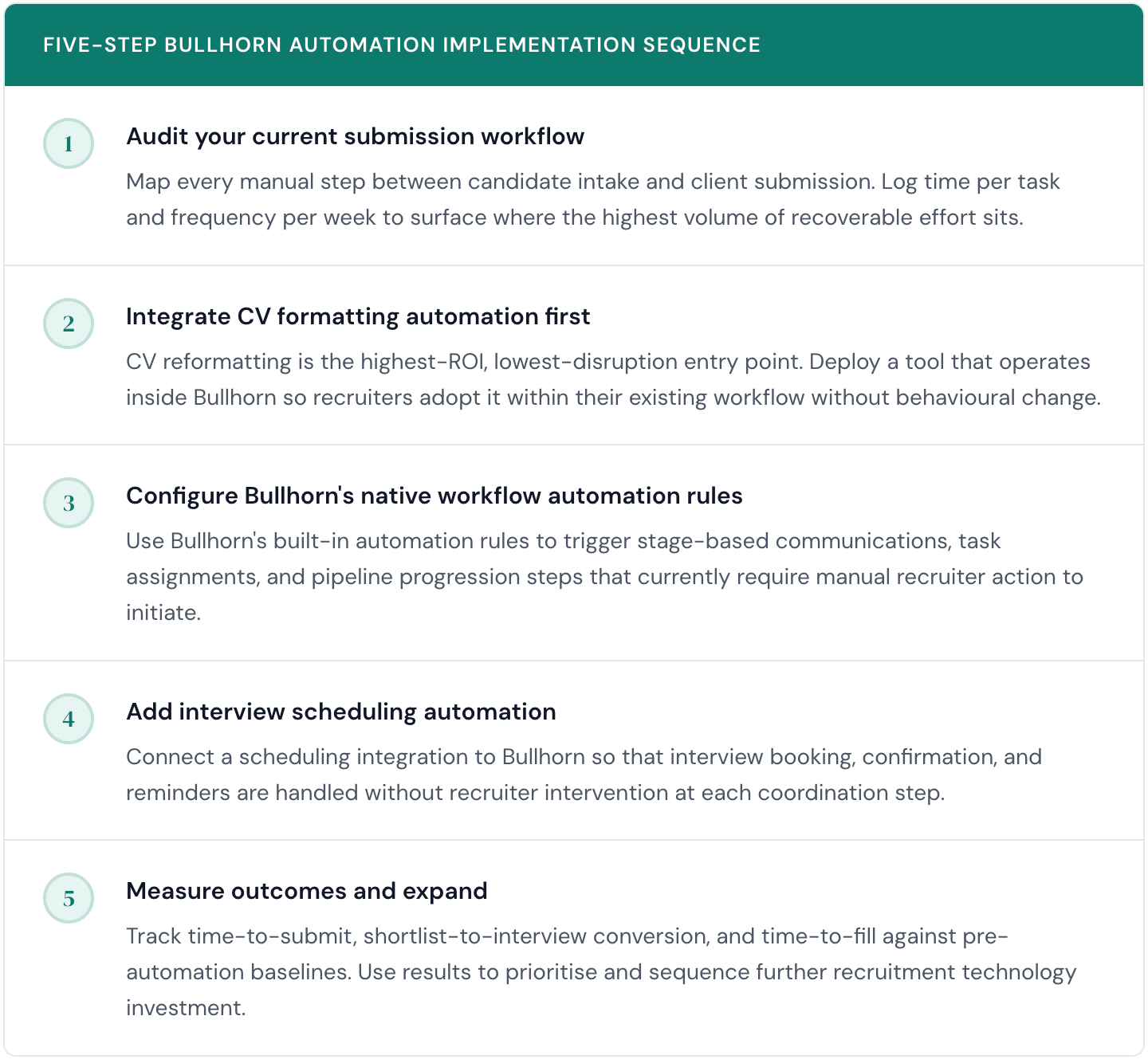
The sequencing logic is important. Starting with CV formatting automation produces the fastest measurable return precisely because it targets the highest-frequency bottleneck in the Bullhorn workflow without requiring changes to any other part of the ATS configuration. Recruiters adopt it quickly because the personal time-saving is immediate and obvious. That adoption builds the data quality and operational confidence needed to layer in more complex Bullhorn workflow automation at stages three and four without the adoption risk that typically accompanies broader ATS change programmes.
The Strategic Case: What a Faster Bullhorn Submission Workflow Actually Changes
Reducing the gap between candidate identification and client submission is not a productivity metric. In competitive mandates where two or three agencies are briefed simultaneously on the same role, the agency presenting a polished, branded shortlist first holds a structural advantage that is genuinely difficult to overcome with quality alone. The first submission sets the client's evaluation frame. Candidates reviewed and advanced before a competing agency's shortlist arrives have already shaped the hiring conversation. A slower, equally capable agency is not competing on a level field. Speed changes the geometry of the mandate.
The financial model is direct and measurable. A recruiter whose Bullhorn automation workflow eliminates 30 minutes of CV formatting per candidate, across 20 candidates per week, recovers approximately 10 hours of productive capacity every week. Applied to additional searches, business development, or deeper candidate engagement, that recovered time translates into more placements without any increase in headcount or overhead cost. For an agency running a team of ten consultants with an equivalent productivity gain, the aggregate impact on annual billing is material by any reasonable commercial calculation.
Submission quality is a third dimension that recruitment technology strategies frequently overlook. Manually formatted CVs are inconsistent in layout, variable in how candidate information is sequenced, and prone to errors introduced under time pressure. Formatted submissions produced through an AI-powered tool integrated into the Bullhorn workflow are consistent, brand-compliant, and accurate to the underlying candidate record every time. That consistency has a compounding effect on client relationships: clients who receive well-presented, structured shortlists from an agency repeatedly begin to associate that quality with the agency's brand rather than with individual recruiter effort. It becomes a structural differentiator rather than an individual achievement.
From ATS Record-Keeping to Competitive Advantage: The Bullhorn Automation Workflow
Bullhorn provides the operational infrastructure most agencies already depend on. The real question is whether that infrastructure is configured to compress the candidate-to-client journey or simply to record it. Agencies running the fastest shortlisting cycles have built a connected Bullhorn automation workflow, starting with the highest-ROI bottleneck and expanding systematically from there. CV formatting is the near-universal entry point: it is the most frequent time cost in the Bullhorn workflow, fully automatable using AI in recruitment today, and measurable in productivity gains within days of deployment. Bullhorn is not the ceiling of what a modern recruitment technology stack can achieve. It is the foundation. Build on it intentionally.