The question for recruitment technology leaders in 2026 is not whether to adopt AI in recruitment. It is whether the AI in your stack makes recruiters more effective, or quietly erodes the conditions under which good recruiting happens. Intelligent human-in-the-loop recruitment AI resolves this tension by assigning machine intelligence to the tasks where volume and speed matter most, while keeping human judgment at every decision point that changes outcomes. For technology leads inside recruitment agencies, this distinction is foundational to every platform evaluation, integration decision, and ATS automation choice that follows.
The Structural Data Problem Inside Every CV
Every recruiter receives CVs that look processable on the surface. Structurally, they are not. Inconsistent date formats, fragmented job titles, nested tables that break ATS parsers, design-heavy layouts that obscure content, scanned documents with no machine-readable text, and narrative skill descriptions buried in prose rather than mapped to structured fields: these are not edge cases. They are the standard condition of candidate data in most agency pipelines.
When unstructured data enters an ATS without being properly extracted first, every subsequent step in the recruitment workflow degrades. Search and match functions operate on structured fields. When those fields are populated with errors or left blank because the parser could not resolve the document, shortlisting becomes noisier, match quality falls, and compliance records carry forward inaccuracies that are difficult to audit and expensive to correct. Most agencies treat this as a minor inconvenience. In practice, it is a systemic performance drag that affects time-to-fill, submission quality, and client confidence simultaneously.

Why Rule-Based Parsers Create a False Sense of Automation
Traditional CV parsing tools built on pattern-matching rules work adequately for well-formatted documents in a narrow range of templates. They fail, often silently, when confronted with the real diversity of candidate documents in a busy agency pipeline. Widely reported industry benchmarks suggest rule-based tools frequently operate at significantly below the accuracy levels needed for reliable ATS automation. This creates a specific problem that is worse than obvious failure: the ATS record appears complete. The field looks populated. The error is invisible until a recruiter searches for a candidate who should have surfaced and did not, or until a client flags an inaccuracy in a submitted profile.
Agencies that have replaced rule-based parsers with AI-powered extraction engines trained on large and diverse document sets report a measurably different recruitment workflow experience. When the extraction layer is reliable, every subsequent recruitment technology investment performs closer to its design intent. ATS automation tools, matching algorithms, and analytics dashboards all depend on clean structured data as their input. This is the foundational argument for treating extraction accuracy as an infrastructure decision rather than a feature comparison.

The Human-in-the-Loop Architecture: A Practical Framework
Intelligent human-in-the-loop recruitment AI is a design pattern, not a product category. It describes an operating model in which the division of labour between machine and human is deliberate, clearly defined, and enforced at the workflow level. The goal is not to limit what AI can do. It is to ensure that human judgment is preserved at every decision point where it changes outcomes. For recruitment agencies operating under competitive pressure, this distinction determines whether automation serves the recruiter or gradually displaces the judgment that makes placements succeed.
In practice, the framework assigns AI to volume, structure, consistency, and speed: data extraction from diverse CV formats, template application, branded candidate presentation, identifier removal, ATS field population, and compliance record structuring. Humans retain control over judgment and relationships: candidate assessment, culture fit evaluation, shortlist construction, offer negotiation, and counter-offer management. The framework below illustrates how this division operates, including the review points that convert AI output into trusted data.
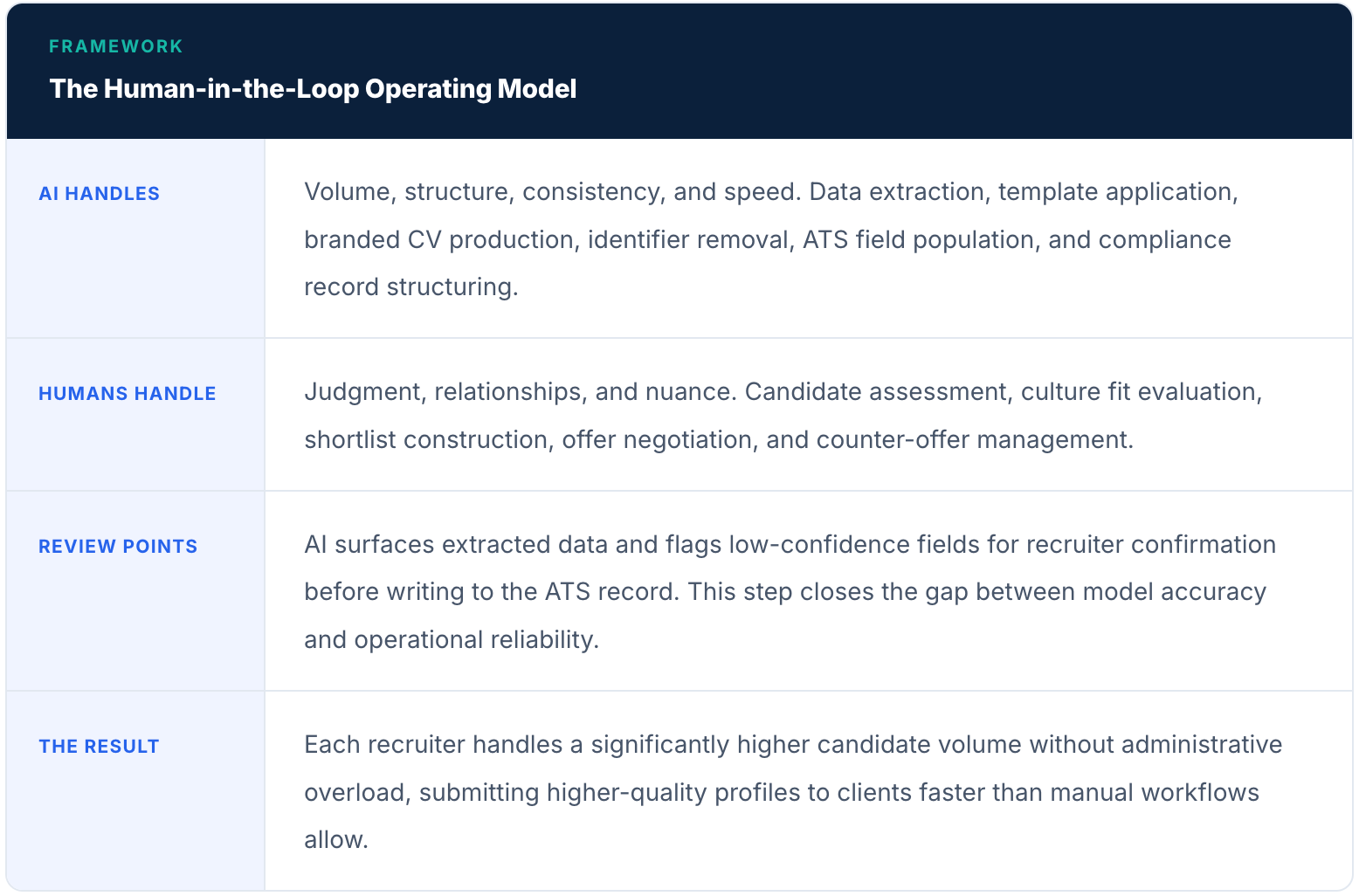
The review point step is where most recruitment automation tools underinvest. A system that populates the ATS without a human confirmation step may be faster in throughput but sacrifices the accuracy premium that makes the output trustworthy. The most effective implementations of intelligent human-in-the-loop recruitment AI treat that confirmation step as a designed feature of the workflow, not a fallback for when the system is uncertain.
Structured Candidate Data as Competitive Infrastructure
Agencies that build clean, consistently structured, searchable candidate databases in their ATS are developing an asset that compounds in value. When extraction is reliable at intake, previous placements become searchable talent pools, engagement timelines are trackable, and skills mapping is possible at scale. The ATS shifts from a passive filing system into an active intelligence resource that informs sourcing, shortlisting, and business development decisions.
This asymmetry is growing more significant as AI-generated CVs proliferate. Inbound data quality is deteriorating in predictable ways: skills sections optimised for keywords rather than accuracy, experience descriptions that are inflated or ambiguous, and formatting designed to pass ATS screening rather than communicate genuine capability. Agencies with robust AI extraction and human verification workflows in place are better positioned to detect these signals and protect the integrity of their candidate records. In a market where data quality is declining broadly, verified and structured records become a genuine competitive differentiator.

Where Recruiter Judgment Cannot Be Automated
The case for AI in recruitment is strongest when made alongside an honest account of where it falls short. Recruitment is a judgment business. The activities that determine whether a placement succeeds require a recruiter to read a room, interpret an implicit client preference, understand why a candidate is really considering leaving their current role, or sense that an offer is about to be declined. These cannot be automated, and applying automation to them produces outputs that lack the contextual intelligence that determines placement quality.
Poorly designed recruitment automation creates a specific failure mode worth naming precisely: it removes human oversight from the data layer, degrading the inputs that human judgment subsequently operates on. A recruiter whose shortlist was built from an ATS search running on unreliable extraction data is exercising judgment on a compromised foundation. They may make the right call from the options in front of them and still deliver a weaker shortlist than the candidate pool warranted, because the candidate pool they could see was incomplete.

Evaluating Your Extraction Layer: What to Ask Before You Buy
In most vendor evaluations, the extraction layer receives far less scrutiny than it deserves. Attention concentrates on matching algorithms and dashboards because those are more visible in demos. Extraction accuracy is harder to surface because demo documents are always well-formatted. Yet for any agency seriously evaluating AI in recruitment, extraction accuracy sets the ceiling for everything else in the stack. The criteria below are more useful in practice than feature comparisons.
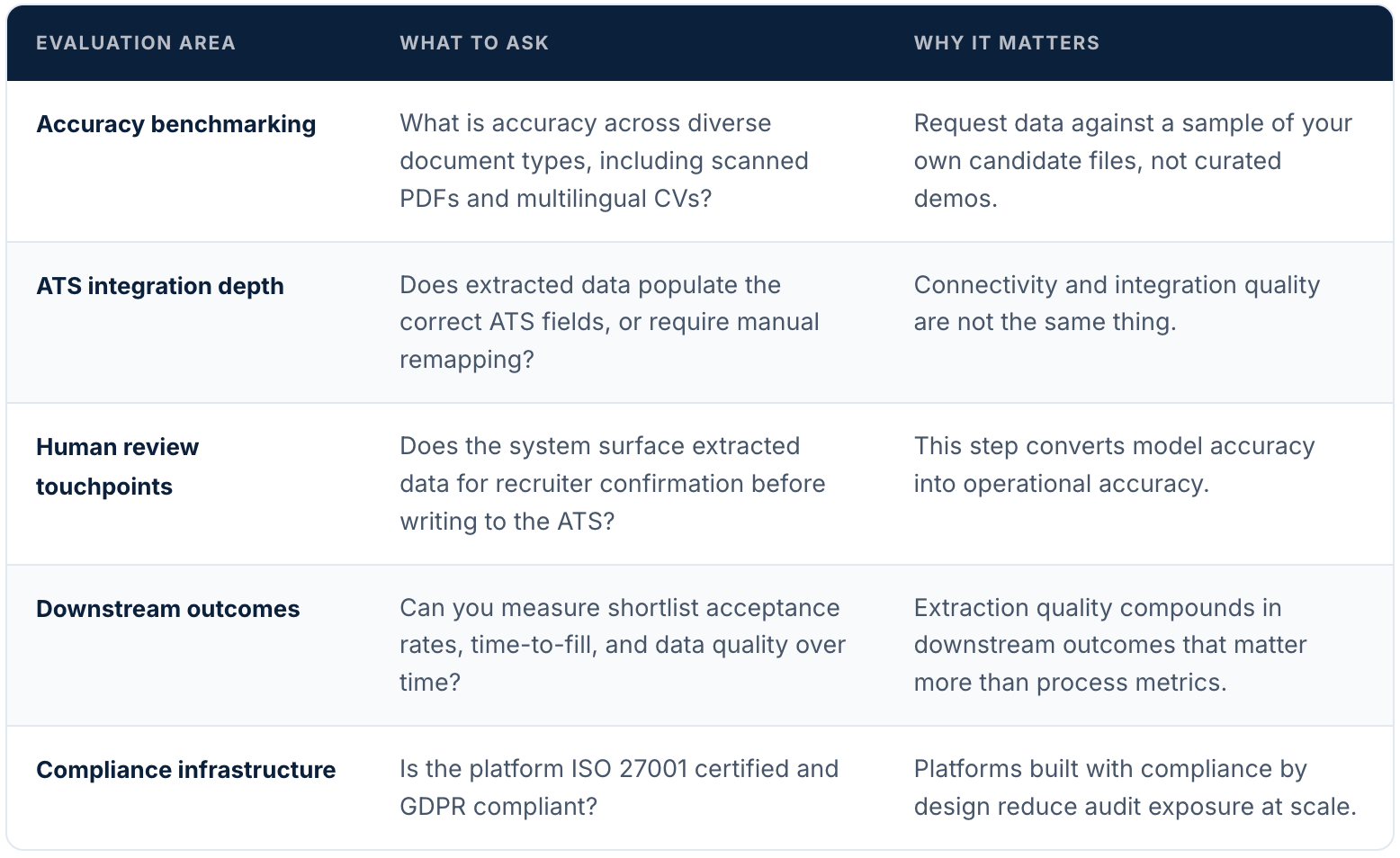
Each of these criteria addresses a different layer of the same question: whether the extraction layer in a given recruitment technology stack is reliable enough to serve as the foundation for the decisions built on top of it. Accuracy benchmarking reveals the real-world performance gap between demo conditions and production pipelines. ATS integration depth determines whether structured data flows correctly into the fields that search and match depend on. Human review touchpoints are the mechanism through which intelligent human-in-the-loop recruitment AI delivers its reliability premium over fully automated extraction. And compliance infrastructure is increasingly non-negotiable for agencies operating across multiple jurisdictions.
Speed, Quality, and Placement Velocity: The Competitive Case
The recruitment agencies best positioned over the next three to five years are not those accumulating the most tools. They are those that have built the right division of labour between AI and human judgment, supported by data infrastructure that makes both more effective. Intelligent human-in-the-loop recruitment AI, implemented at the extraction layer and maintained through deliberate human review processes, does not reduce recruiter value. It concentrates it. Formatting tasks that previously consumed 30 minutes per CV take five. Submission quality improves because extraction errors no longer propagate through to client-facing documents. Candidate-to-market cycles shorten because administrative steps in the recruitment workflow are handled at machine speed without sacrificing accuracy.
The competitive logic is direct. An agency that presents a shortlist two days faster than its competitors, with consistently formatted and accurate submissions, wins placements others lose to speed. That advantage does not come from better recruiting instincts alone. It comes from an infrastructure decision made at the recruitment technology layer. The question is not whether to automate candidate data extraction. It is whether the extraction layer in place is accurate enough, integrated deeply enough, and structured around enough human oversight to be the foundation the rest of the recruitment workflow deserves.