Choosing the wrong resume parser costs far more than a monthly subscription fee. It costs recruiter hours, ATS data quality, and client trust that compounds negatively with every placement. This guide breaks down what separates purpose-built recruitment parsing tools from generic resume parser alternatives, so agency owners can make a decision that works in their favour at scale.
Most agency owners underestimate how much their resume parser shapes downstream performance. Parsing accuracy is not a technical footnote. It sits at the start of every recruitment workflow, and errors introduced at that stage, missed skills, misread dates, broken formatting, compound through every subsequent step: screening, shortlisting, ATS record quality, and client submission.
The market for resume parser software has matured considerably. There are now meaningful differences between how tools handle complex file formats, how deeply they integrate with ATS platforms, how they manage candidate data under GDPR, and how they perform at volume. Evaluating resume parser alternatives requires more than a feature checklist. It requires understanding what failure looks like and what it costs your agency over time.
This article provides a structured comparison of the leading resume parser tools available to recruitment agencies in 2026, the criteria that should drive the evaluation, and the questions worth asking before you commit.
Why Resume Parsing Accuracy Is a Business-Critical Decision
A resume parser does one job: it takes unstructured candidate data and converts it into structured, usable information inside your ATS or CRM. Done well, this process is invisible and automatic. Done poorly, it creates downstream problems that are substantially more expensive than the cost of the tool itself.
The common failure modes of weak parsing include misclassified job titles, truncated employment histories, dropped qualifications, and failed field mapping into ATS records. Each failure requires a recruiter to intervene manually, adding time and introducing inconsistency. At volume, weak parsing creates a correction backlog that consumes recruiter capacity week after week, silently reducing the time available for placement activity.
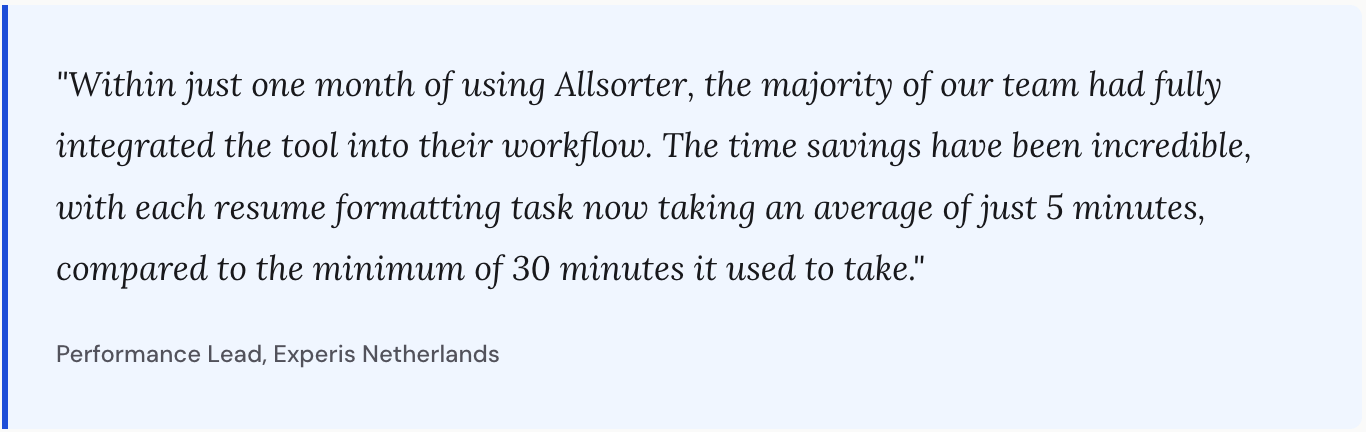
Allsorter's research across agency customers indicates that CV reformatting and data correction tasks account for up to six hours per recruiter per week at agencies still relying on manual or low-accuracy processes. Agencies that resolve this at a technology level recapture that time for the work that drives revenue.
There is a second, increasingly significant dimension to this decision. Since 2024, the volume of AI-generated CVs has grown sharply. Candidates can now produce polished, keyword-optimised documents that pass standard ATS screening but contain exaggerated or unverifiable claims. A parser that extracts information without validating it is not merely slow at catching errors: it is actively accelerating unverified candidate data through your pipeline and into client submissions. This is a risk that compounds at scale.
What Separates a Good Resume Parser from a Great One
The fundamental parsing task, extracting text from a document and mapping it to structured fields, is now standard across all tools in the market. The differentiators lie in how tools handle edge cases, how they perform at volume, and how well they integrate into a broader intelligent recruitment workflow.
File Format Handling at Volume
Candidates submit CVs in every conceivable format: clean DOCX files, scanned PDFs, image-based PDFs, LinkedIn exports, and job board templates with irregular structure. The gap between parsers widens significantly on complex inputs. Tools built on lightweight engines perform adequately on standard text-based files but show meaningful accuracy degradation on image-based PDFs and heavily formatted documents, which are precisely the formats most common from experienced candidates with polished CVs.
Purpose-built recruitment parsers using hybrid AI extraction models, combining rule-based parsing with machine learning trained specifically on recruitment documents, handle this range reliably. General-purpose parsers built on third-party engines show accuracy degradation on complex inputs that industry research in HR technology consistently places materially below the performance of domain-specific tools.
ATS Integration Depth
The quality of ATS integration is as important as parsing accuracy itself. A parser that extracts data correctly but maps it poorly into ATS fields, or requires manual exports and re-imports, eliminates the efficiency benefit entirely. Recruiter-controlled integrations, where parsed data flows directly into Bullhorn, JobAdder, Vincere, or Salesforce without additional steps, are the standard any serious evaluation should require. IT-dependent integrations that add setup friction are a reliable indicator of lower sustained adoption.
Compliance Architecture and Data Sovereignty
Candidate CVs contain personally identifiable information. Under GDPR, agencies bear data controller responsibility for how that information is processed, including processing carried out on their behalf by technology vendors. Any parsing tool that routes candidate data through third-party AI infrastructure, without explicit data processing agreements and verifiable data residency guarantees, creates compliance exposure that cannot be contractually transferred to the vendor.
The EU AI Act's employment provisions, now in phased implementation, add a further regulatory layer that applies to AI tools influencing candidate selection workflows. Agencies evaluating recruitment technology in 2026 need to factor both GDPR and AI Act obligations into the decision, not treat compliance as an afterthought once a tool is already deployed.
The Five-Dimension Evaluation Framework for Resume Parser Alternatives
When comparing resume parser alternatives, assess each tool across five operational dimensions. Each maps directly to a measurable cost or risk that affects placement performance.
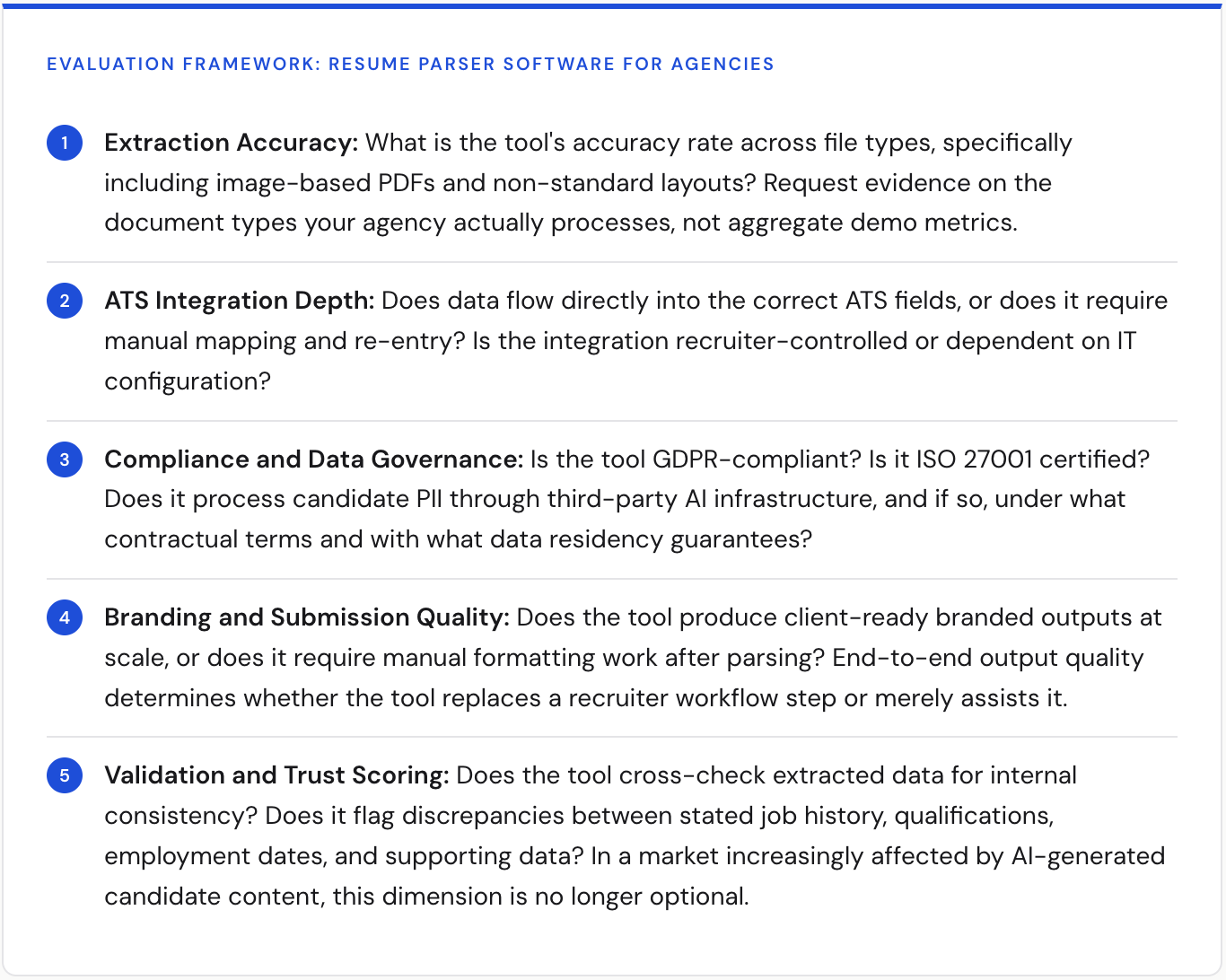
These five dimensions distinguish tools that solve a narrow technical problem from tools that improve placement outcomes end to end. The decision is not which parser extracts data fastest. It is which parser produces the most reliable, client-ready candidate records with the least recruiter intervention at your volume of operation.
Resume Parser Alternatives Compared: Four Tools Assessed
The following profiles cover the main resume parser alternatives currently in use across recruitment agencies. Each is assessed against the five-dimension framework above.
Allsorter
Purpose-built for recruitment agencies
Allsorter uses a proprietary Vertical Language Model built specifically for recruitment CV formats, rather than a general-purpose AI engine. This architecture handles the full range of input types, including image-based PDFs and scanned documents, at 99%+ accuracy. The platform goes beyond parsing to provide complete automated CV formatting: extracted data is applied to agency-specific branded Word templates, producing client-ready candidate profiles without additional manual work.
Recruiters work in a dual-view editor showing the original document alongside the formatted output, with section-by-section editing, real-time error flagging, and AI-assisted content tools including role-tailored summary generation and bullet rewriting tied to specific job specifications. This is a recruiter-facing workflow, not a backend processing step.
Allsorter integrates natively with Bullhorn, JobAdder, Vincere, Tracker, Mercury, and Salesforce-based ATS platforms. Candidate data flows directly into connected systems with per-template export logic. No re-entry, no IT dependency, no data passing through third-party AI infrastructure. Allsorter is GDPR-compliant, ISO 27001 certified, SOC 2 compliant, and Cyber Essentials+ certified, with zero data breaches to date and no use of customer data for model training.
Additional capabilities include one-click anonymisation for client-facing submissions, candidate data validation and trust scoring, and team-level usage reporting for governance and oversight.
Best for: High-volume agencies, enterprise teams, multi-client branding environments, and any agency with GDPR or ISO compliance obligations at contract stage.
HireAra
Lightweight formatting tool
HireAra is a CV formatting tool positioned around speed and ease of use, with self-serve onboarding and public pricing tiers. Now part of the Access Group ecosystem, its parsing engine is based on Affinda with Apryse for PDF-to-DOCX conversion. This combination performs well on standard text-based files but shows accuracy limitations on complex or image-based PDFs.
The platform offers branded template application, AI-generated summaries, and ATS integrations including Bullhorn and Vincere. The editing interface is visually oriented rather than section-based, with less support for content-level editing, error detection, or job-specification-tied content tools. Candidate validation workflows and data cross-checking are not available.
HireAra is a strong choice for small teams that want fast, low-friction formatting with minimal setup. It is less well-suited to high-volume or enterprise environments where extraction accuracy on complex formats, deep ATS integration, and documented compliance posture are evaluation requirements.
Best for: Small teams prioritising fast onboarding and simple formatting. Not suited to enterprise workflows requiring deep ATS integration, validated data, or ISO-level compliance documentation.
DaXtra Styler
Backend automation within the DaXtra ecosystem
DaXtra Styler is the CV presentation layer within the broader DaXtra product suite, which also includes DaXtra Capture and DaXtra Search. As a standalone capability, it operates primarily as a backend template overlay and anonymisation tool. There is no recruiter-facing editing interface, no AI-powered content enhancement, and no inline error checking or quality review tools prior to export.
Integration is dependent on other DaXtra products rather than direct ATS connections, making it effectively inaccessible as a standalone resume parser alternative. Pricing is at enterprise scale with no public free trial and likely requires IT or vendor implementation engagement.
Best for: Agencies already embedded in the DaXtra ecosystem who need consistent template output. Not a viable standalone option for agencies evaluating independent resume parser alternatives.
ATS-Native Parsers
Built into your existing ATS platform
Most modern ATS platforms, including Bullhorn, JobAdder, and Vincere, include native parsing functionality that extracts candidate data from uploaded CVs and populates record fields automatically. For basic field population, this reduces data entry friction and is already available within your existing technology investment.
Where ATS-native parsers consistently underperform is output quality. They extract to database fields but do not produce formatted, client-ready candidate profiles. Running parsing and presentation layers separately introduces duplication and additional recruiter time. Industry research in HR technology consistently indicates that general parsing engines perform materially below purpose-built, domain-specific AI tools on complex input formats. Agencies presenting formatted CVs to clients will require a complementary tool regardless.
Best for: Basic record population where branded output quality is not a priority. Insufficient as a standalone solution for agencies that present formatted candidate profiles to clients.
Resume Parser Feature Comparison at a Glance
The table below maps each tool across the five evaluation dimensions. Treat it as a starting framework. Hands-on evaluation using your actual file types and ATS environment remains essential before any final decision.
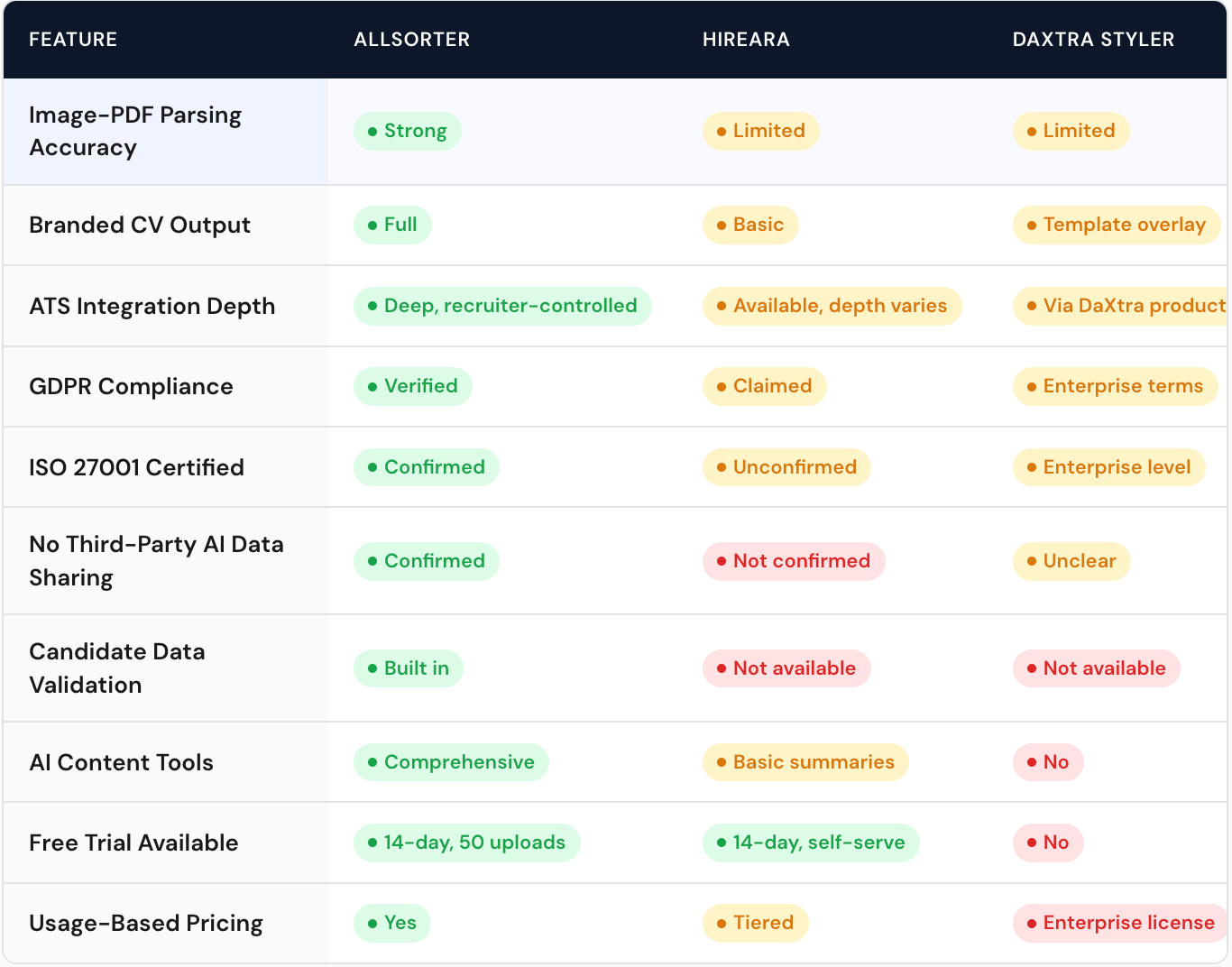
Compliance statuses for third-party tools reflect publicly available information at time of publication. Verify directly with vendors before making procurement decisions.

How to Choose the Right Resume Parser for Your Agency's Needs
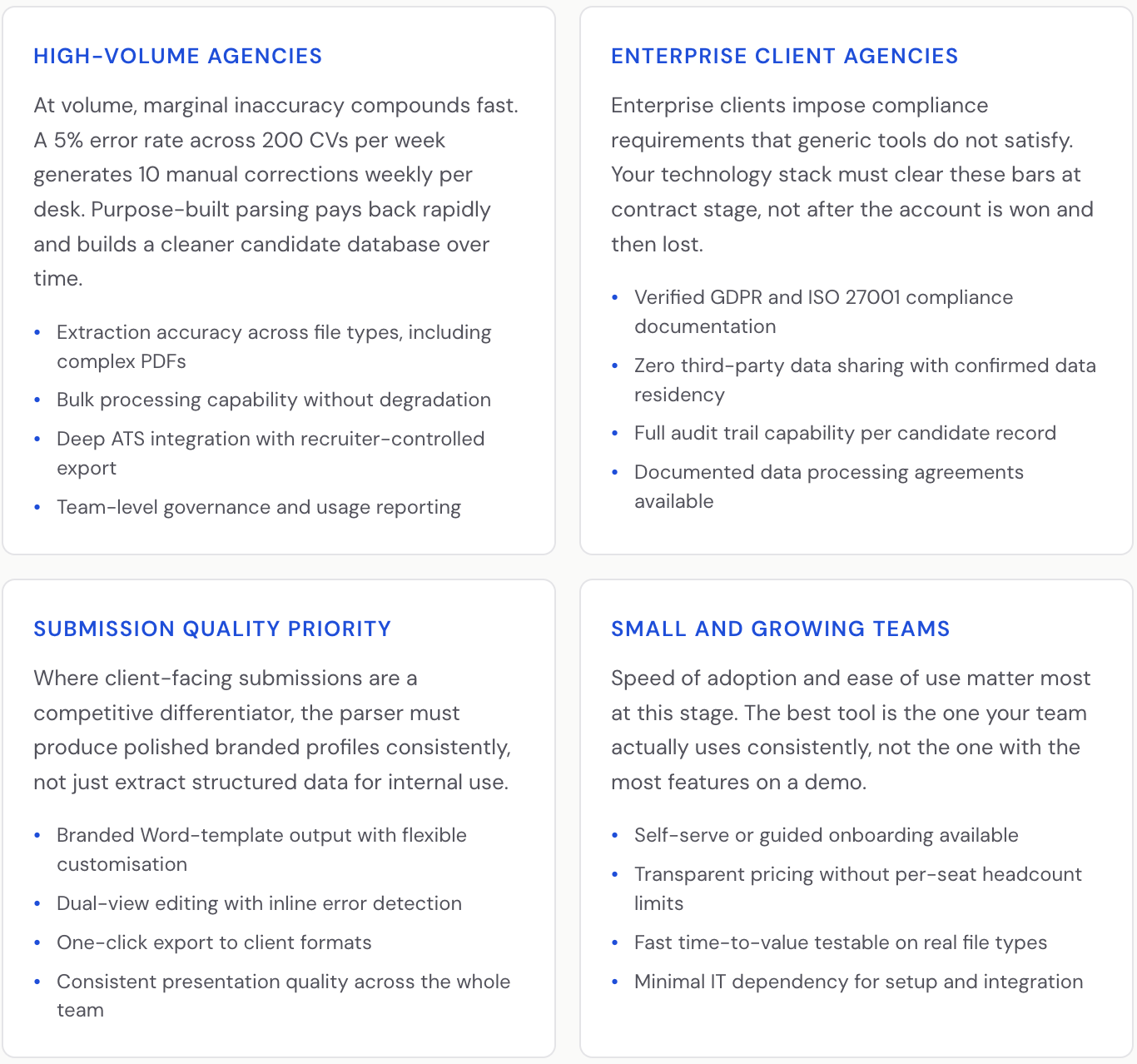
The right choice among resume parser alternatives depends on where your agency's operational pressure is concentrated. The evaluation criteria shift materially by size, client mix, and compliance obligations.
The Resume Parser Decision That Compounds Over Time
Resume parser software is a decision that compounds in both directions. A well-chosen tool reduces recruiter administration week after week, improves ATS data quality progressively, builds a compliance posture that supports enterprise growth, and, critically in 2026, provides the validation layer that protects your agency from presenting AI-generated candidate inaccuracies as agency-endorsed submissions. A poorly chosen tool generates correction overhead that grows with volume, compliance exposure that accumulates quietly, and submission inconsistency that erodes client confidence over time.
The agencies making the right call on resume parser alternatives are those that evaluate tools not on what they demonstrate in a controlled demo, but on how they perform on actual file types, inside the actual ATS, at actual volume, and under actual compliance obligations. The gap between purpose-built recruitment workflow automation and generic parsing tools is not a feature difference. It is a compounding performance difference that becomes more significant with every placement.
Parsing accuracy on complex inputs, ATS integration depth, data sovereignty, branded output quality, and candidate data validation are the dimensions that determine whether a tool creates compounding value or compounding cost. Evaluate accordingly.