Most recruiters have access to automation tools. Fewer work inside genuinely intelligent recruitment workflows. The difference between the two is not a matter of software. It is a matter of how that software is connected, sequenced, and applied to the moments that actually consume your day.
Ask most recruiters to describe their workflow and they will describe the version that should exist: sourcing, screening, submitting, placing. Ask them to account for where their time actually goes and a different picture emerges. CV reformatting. Data re-entry. Chasing interview confirmations. Correcting ATS records that parsed the wrong job title. The gap between the workflow as designed and the workflow as lived is where recruiter capacity quietly disappears.
Intelligent recruitment workflow automation is not a category of software. It is a way of redesigning how work moves through your day, so that the tasks requiring no judgement are handled by machines and the tasks requiring real human capability are handled by you. Recruiters who work inside this kind of workflow are not just more efficient. They bill more, submit faster, and spend their time on the work that actually builds careers and client relationships.
This article examines what intelligent recruitment workflows look like in practice, why they outperform patchwork automation, and what you can do to get more from the tools your agency already has or should be asking for.
The Admin That Is Quietly Costing You Placements
Recruitment is a relationship business. The best recruiters know this. But behind every client call and candidate conversation lies an operational reality that most agencies have normalised: a substantial portion of every recruiter's week is consumed by tasks that generate no placement value whatsoever.
Allsorter's research across agency customers indicates that CV reformatting alone accounts for up to six hours per recruiter per week. Add manual job posting across multiple boards, data re-entry into ATS systems, and chasing interview confirmations, and the total rises significantly. That is not a time management issue. That is a workflow design issue. Every hour spent copying, pasting, and reformatting is an hour not spent on a sourcing call, a client visit, or a submission that moves a placement forward.
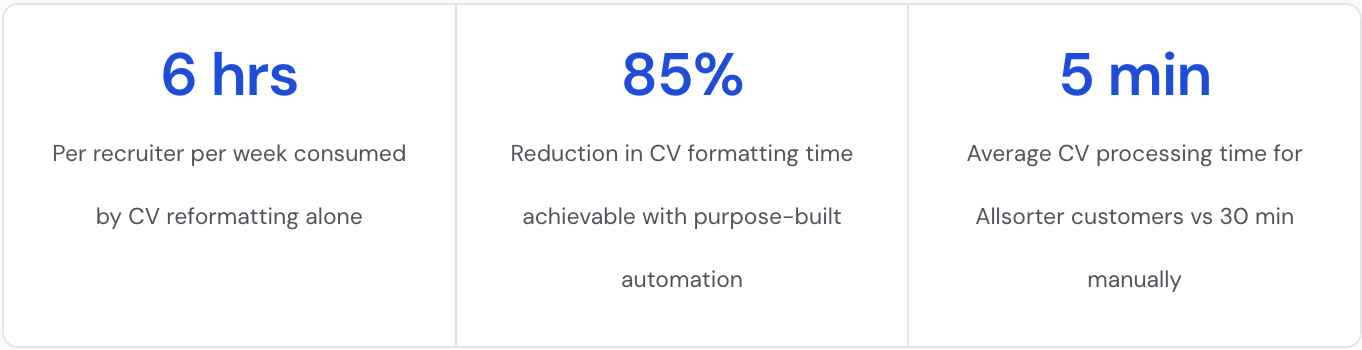
Source: Allsorter customer data, 2025-2026.
There is also a less visible cost. Recruiters who spend a material share of their working week on repetitive administration are among the most likely to disengage. The work is dull, it does not use their skills, and it accumulates. Intelligent recruitment workflow automation addresses this directly. It does not just free up hours. It changes the character of the job.

The Three Tiers of Recruitment Workflow Automation
Understanding what an intelligent recruitment workflow looks like requires a clear framework for what automation actually means in this context. Not all recruitment automation tools are equivalent, and investing in the wrong tier at the wrong stage is one of the most common reasons agencies fail to see measurable return from their technology spend.
Recruitment workflow automation operates across three distinct tiers. Most agencies in 2026 operate predominantly at Tier One, with growing adoption of Tier Two. The tiers are sequential in a meaningful way: getting the most from Tier Two requires Tier One to be resolved first. The structured data and disciplined ATS integration that makes intelligent automation possible is built almost entirely at Tier One.
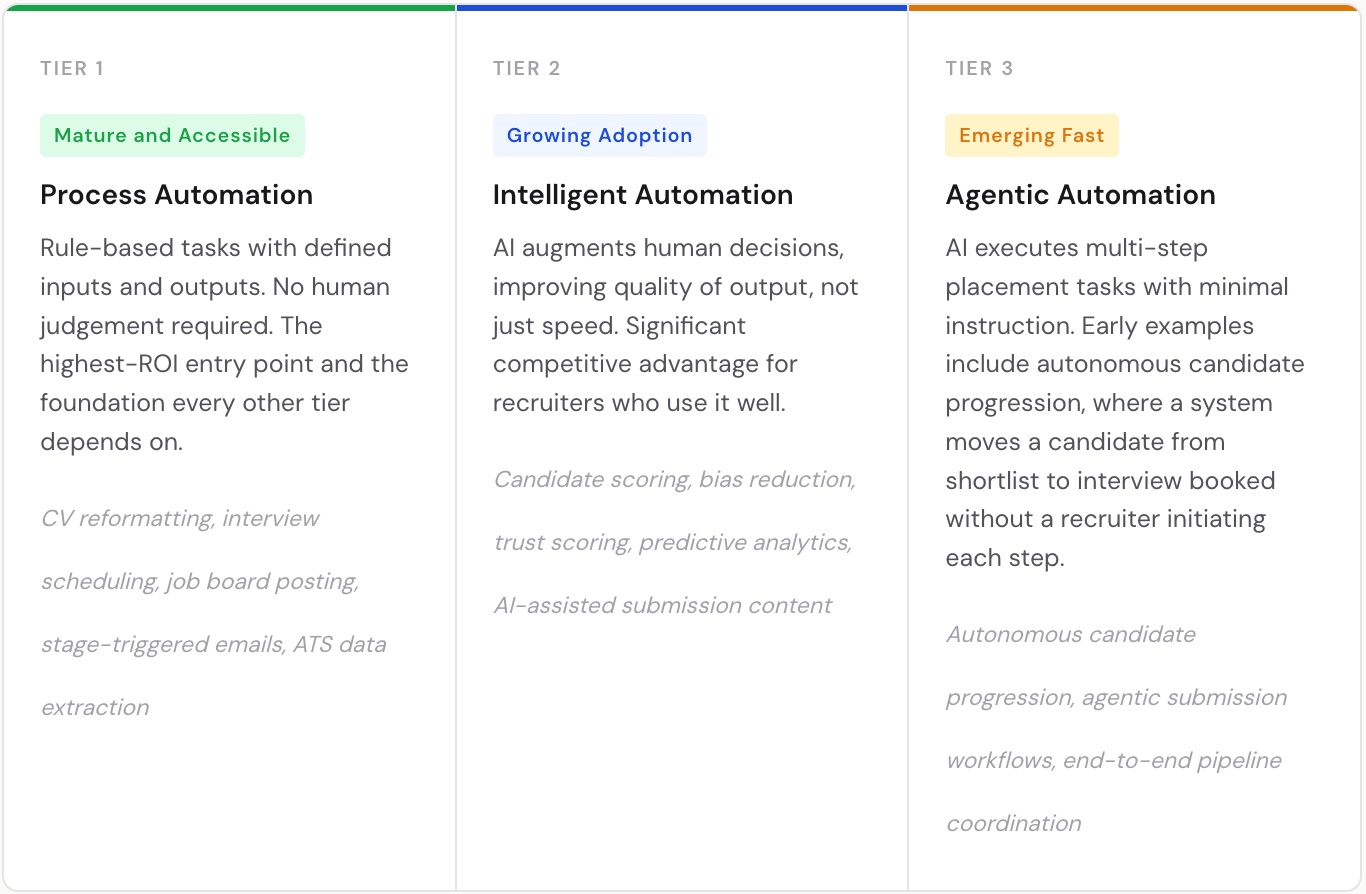
For most recruiters in 2026, the highest-leverage question is not which Tier Three tools to adopt. It is whether Tier One is genuinely solved. If you are still reformatting CVs manually, posting jobs board by board, or re-entering data that your ATS parser got wrong, that is where the attention should go first.
What an Intelligent Recruitment Workflow Looks Like End to End
The following maps the candidate journey from application to submission in a workflow where automation has been applied thoughtfully across the tiers. The critical thing to notice is not what is automated. It is what is not: the moments that require real recruiter judgement are preserved and, because everything else is handled, they receive the attention they deserve.
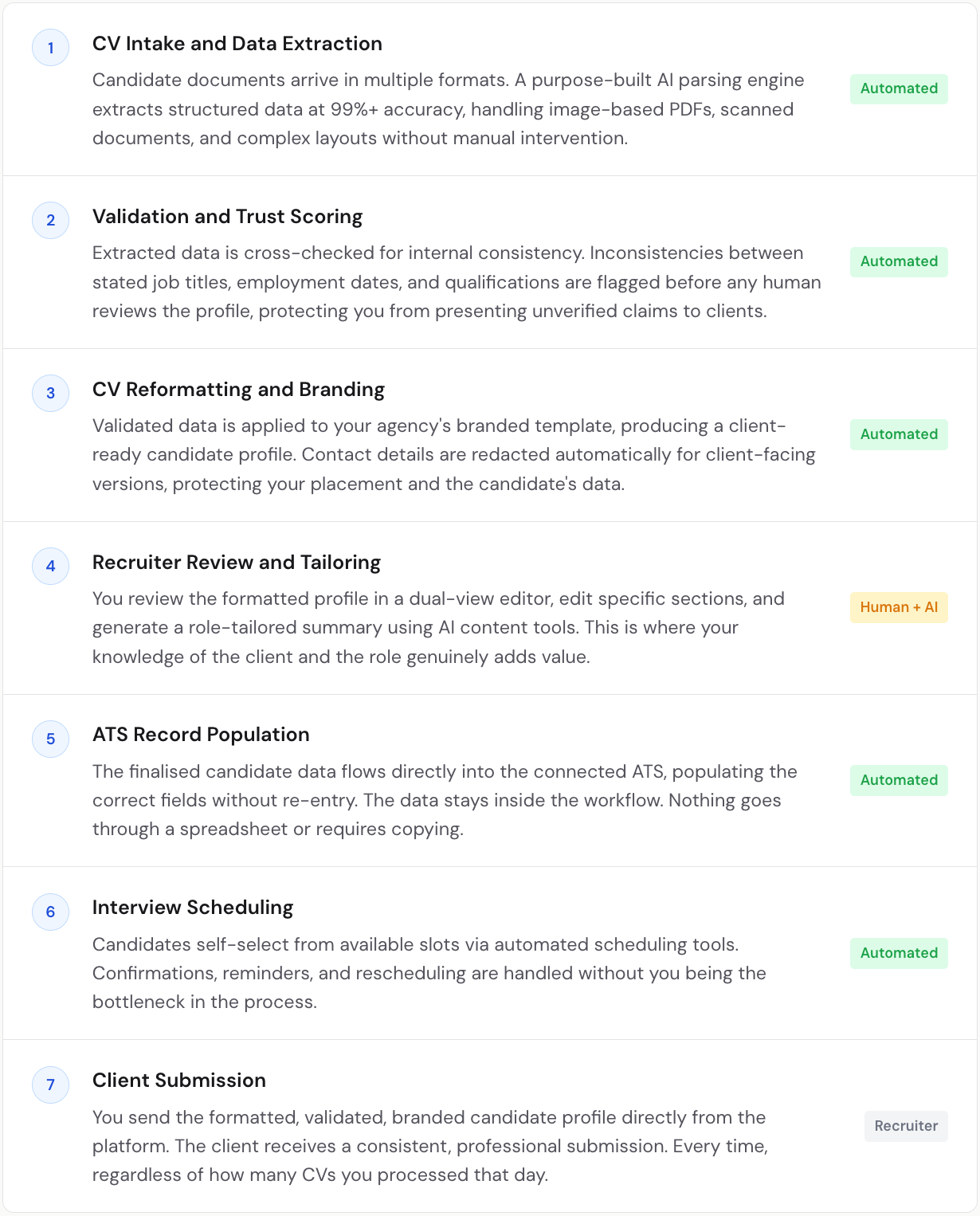
Notice what is absent from this workflow: no reformatting sessions in Word, no copy-pasting between systems, no chasing candidates for updated CVs, no correcting ATS fields that parsed incorrectly. Each of those manual steps has been replaced by a system that handles it consistently, faster, and without error. What remains is the work only you can do.
Why Intelligent Recruitment Workflow Automation Wins
The performance advantage of an intelligent workflow is not simply that individual tasks happen faster. It is that eliminating multiple friction points across every placement, every week, creates a compounding difference in what you can achieve within the same working hours.
You Submit Faster and Win More Placements
In competitive hiring markets, speed to submission is a commercial differentiator. Agencies that have automated their CV reformatting and submission workflows report that formatting tasks which previously averaged 30 minutes per CV take approximately five minutes with purpose-built automation. At volume, that recovery of time translates directly into more submissions, faster decisions, and more placements won before competitors reach the same candidates.
Your Submissions Reflect Your Standard, Not Your Workload
Manual workflows produce inconsistent output. When you are processing ten CVs at the end of a busy Friday, the quality of your submissions is different from a quiet Tuesday morning. Intelligent automation applies the same structured logic to every candidate profile regardless of the day or the volume. Clients evaluate agencies on the quality of their presentations as much as the quality of their candidates. Consistency is something they notice, even when they do not say so.
Your ATS Becomes an Asset Rather Than a Liability
The ATS is only as useful as the data inside it. If your ATS was populated by a low-accuracy parser or by manual entry prone to error, its candidate search, matching, and reporting functions are unreliable. High-accuracy extraction that flows cleanly into ATS records builds a progressively more valuable candidate database. Every placement you make using clean, structured data compounds the value of your database for the next one.
You Do the Work You Were Hired to Do
The connection between administrative burden and recruiter performance is underappreciated. Recruiters who spend significant working time on tasks they know a machine could do are less energised, less focused on client relationships, and less likely to stay. Intelligent workflow automation is not just an efficiency measure. It changes the quality of your working day.
What Intelligent Workflow Automation Means for Your Billing Capacity
The capacity impact of intelligent recruitment workflow automation is most clearly understood at the individual recruiter level. This is not an abstract operational metric. It is a direct function of how many hours you have available for revenue-generating activity.
At 30 minutes per CV, a recruiter processing 40 CVs a week spends 20 hours on a single low-value task. Automating that step to five minutes per CV recovers 17.5 hours per week. Redirected toward sourcing, client development, and submissions, that recovered time has a direct and measurable effect on billings.
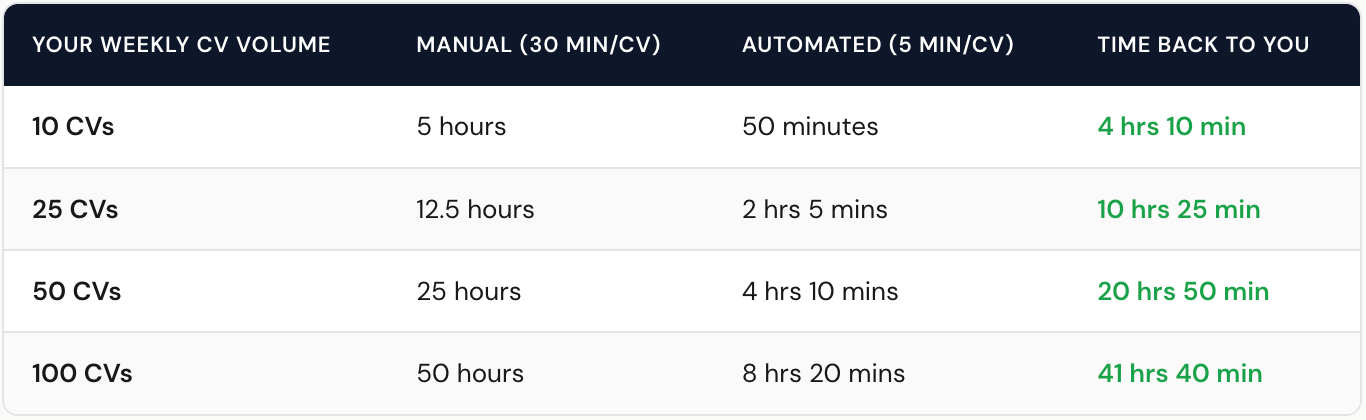
Based on Allsorter customer data. Manual: avg 30 min/CV. Automated: avg 5 min/CV.
These figures reflect one automated step only. When interview scheduling, ATS data entry, and pipeline communications are also automated, the compounding capacity gains are substantial. More importantly, the recovered time goes to work that only a recruiter can do: understanding what a client actually needs, reading a candidate's motivation, making the call that moves a placement forward.
How to Get More from Your Recruitment Workflow
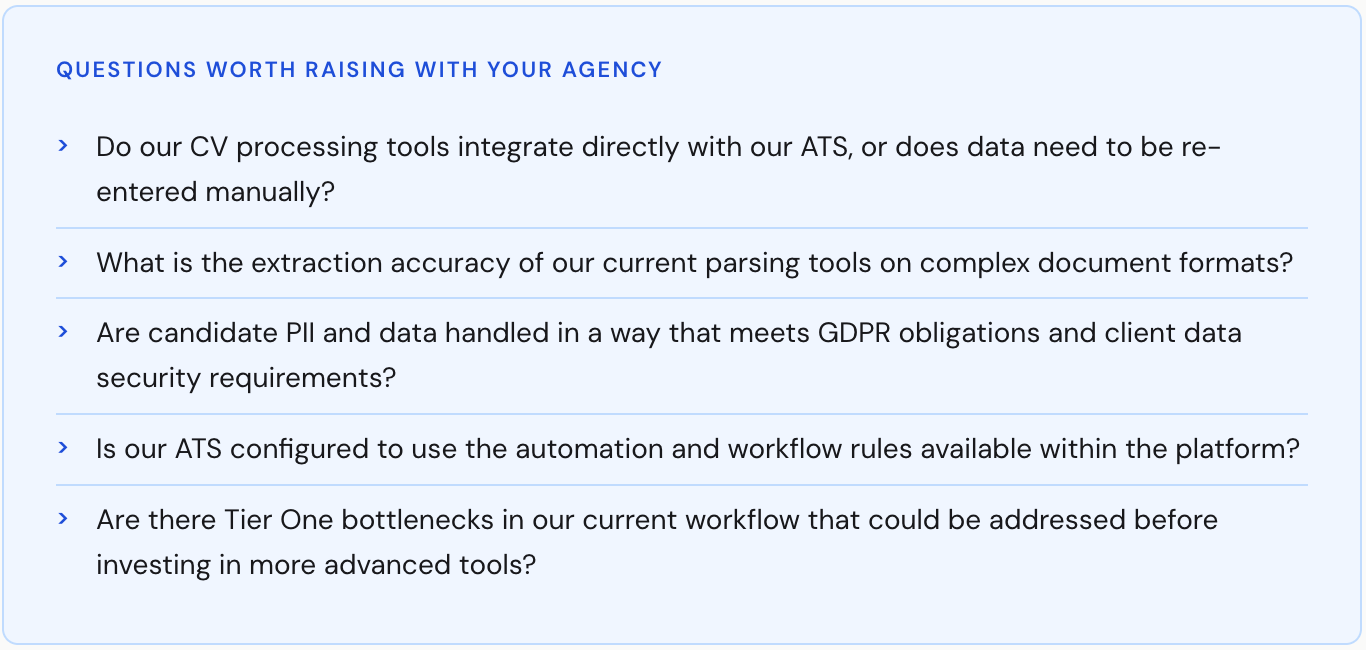
For most recruiters, the highest-value question is not which new tool to request. It is whether the tools already available to them are being used to their full capability, and where the remaining manual steps in their day could be eliminated. The following practical steps are framed around what an individual recruiter can do, and what they can reasonably advocate for within their agency.
Track Where Your Hours Actually Go This Week
Before focusing on any specific tool, spend a week logging where time actually goes. Most recruiters who do this are surprised by the result. CV formatting, data correction, and scheduling coordination consistently emerge as the highest-frequency manual tasks with the lowest strategic value. Identifying your two or three biggest time drains is the prerequisite for any useful conversation about automation.
Understand What Your Current Tools Can Already Do
Many recruiters are operating well below the capability of tools already in their stack. ATS platforms like Bullhorn, JobAdder, Vincere, and Salesforce have automation features, integrations, and workflow rules that are often configured minimally or not at all. Before advocating for new technology, it is worth understanding what the existing stack can do when it is properly configured.
Make the Case for ATS Integration on Any New Tool
When your agency evaluates new recruitment automation tools, the single most important question is whether they integrate cleanly with your ATS. A tool that requires you to operate in a separate interface, or re-enter data manually after using it, will not save you time in practice. Integration quality determines whether a tool becomes part of your day or becomes something you work around. This is worth advocating for firmly.
Ask About Data Quality, Not Just Speed
Extraction accuracy matters more than most recruiters realise. A parsing tool that achieves 60% accuracy on complex CV formats means you are manually correcting the other 40%. Over a week of high volume, that correction work can consume hours. When evaluating or advocating for AI in recruitment tools, ask specifically about accuracy rates on the document types you actually process: multi-column PDFs, international CVs, graphic-heavy layouts.
The Recruiters Who Win Are the Ones Who Do Less of the Wrong Work
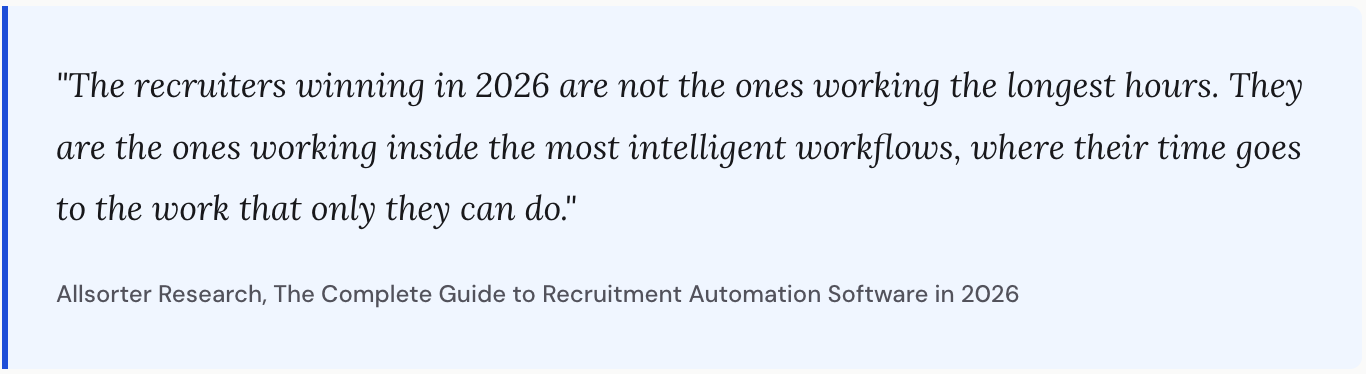
The recruitment market of 2026 does not reward effort spent in the wrong place. Application volumes are up. Candidate data quality is declining as AI-generated CVs proliferate. Client expectations around submission speed and presentation quality are higher than they have ever been. The recruiters who will perform best in this environment are not those who work harder at the manual tasks. They are the ones whose workflows have eliminated those tasks.
Intelligent recruitment workflow automation is the structural response to those pressures. Not a collection of disconnected tools. A coherent architecture in which every task requiring no judgement is handled by machines, every piece of candidate data is clean and validated at the point of entry, and your time is available for the work that drives your billings: relationships, judgement, and the conversations that actually move placements forward.
The recruiters building this into their day now are not just more productive today. They are compounding the advantage with every placement, every week. And the gap between them and recruiters still working inside manual workflows will not close easily, because the advantage is structural, not tactical. Your time is finite. Where it goes determines what you can achieve.