Most agency owners know their recruiters are too busy with the wrong work. They can feel it in missed response windows, in shortlists that go out late, in consultants who are consistently active but not consistently placing. The problem is rarely a lack of effort. It is a structural imbalance, too much recruiter time consumed by tasks that require no judgment, and too little left for the work that wins and retains clients. In 2026, the cost of that imbalance is no longer a quiet inefficiency. It is a compounding competitive liability.
The recruitment environment driving that liability has shifted sharply. Recruitment automation software has moved from a productivity tool to a strategic necessity as application volumes reach record highs and candidate data quality deteriorates. This shift was named publicly by Allsorter CEO Declan Murphy, whose platform processes over 200,000 CVs per month across 400+ agencies globally, and confirmed by New York Times journalist Sarah Kessler in June 2025: the market is now contending with 'AI sludge', a wave of mass-generated, frequently inaccurate applications flooding hiring pipelines across every sector. Client expectations have escalated in the opposite direction, with enterprise hiring managers now expecting first shortlists within 24 to 48 hours of a brief.
These forces are compounding. And they cannot be resolved by hiring more recruiters. The agencies building a genuine competitive edge in this environment are doing so through intelligent recruitment workflow automation, not as a technology experiment, but as a core operational strategy. This article examines why, where the edge is being created, and how to build it.
What Is Recruitment Automation Software, and Why Does It Matter in 2026?
Recruitment automation software refers to any technology that executes tasks in a recruitment workflow without requiring manual human input at each step. The category spans rule-based process tools, CV formatting, job board posting, interview scheduling, through to AI-powered systems that score candidates, reduce bias, and autonomously progress pipeline stages. In 2026, the pressure on agency operations makes investment in this category not just beneficial but structurally necessary for agencies intending to compete at scale.
The Structural Forces Reshaping Recruitment Agency Economics
Understanding why recruitment automation software has moved from optional to strategically essential requires a clear-eyed analysis of the forces currently reshaping agency economics. These are not market-cycle pressures that abate when conditions improve. They are structural reconfigurations of how agency economics work, and they reward automation investment whether the market is tight or loose.
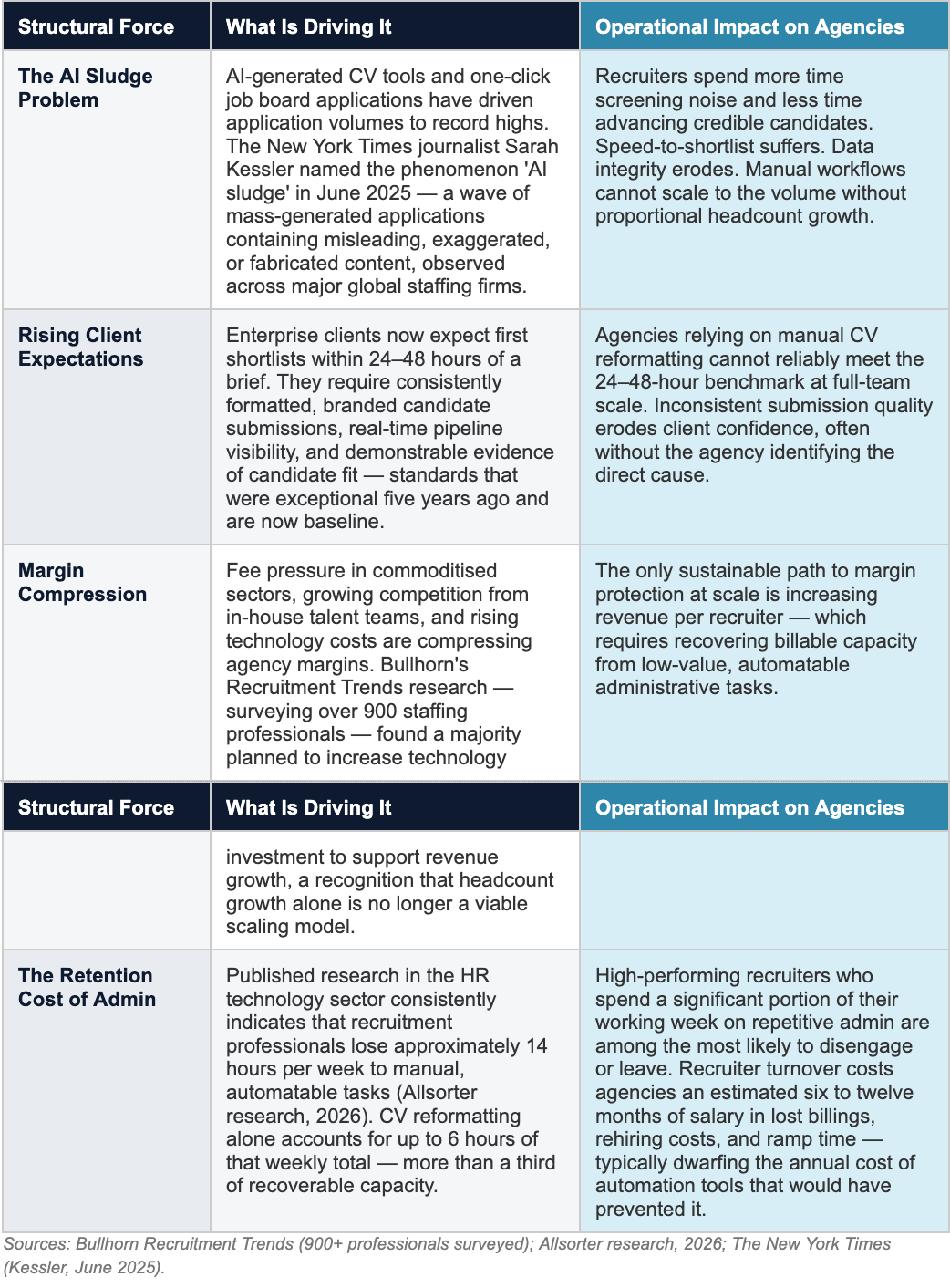
None of these forces acts in isolation. Their compounding interaction, more volume, lower quality, higher client expectations, thinner margins, and rising churn risk, defines the operating environment for every agency in 2026. Recruiting more consultants adds cost immediately and revenue only after a ramp period that industry research consistently places at three to six months. Asking existing recruiters to work harder into an already admin-heavy week produces diminishing returns and accelerates the turnover risk. The only lever that simultaneously reduces cost, expands capacity, and improves output quality is automation.
Where Recruitment Automation Creates a Measurable Competitive Edge
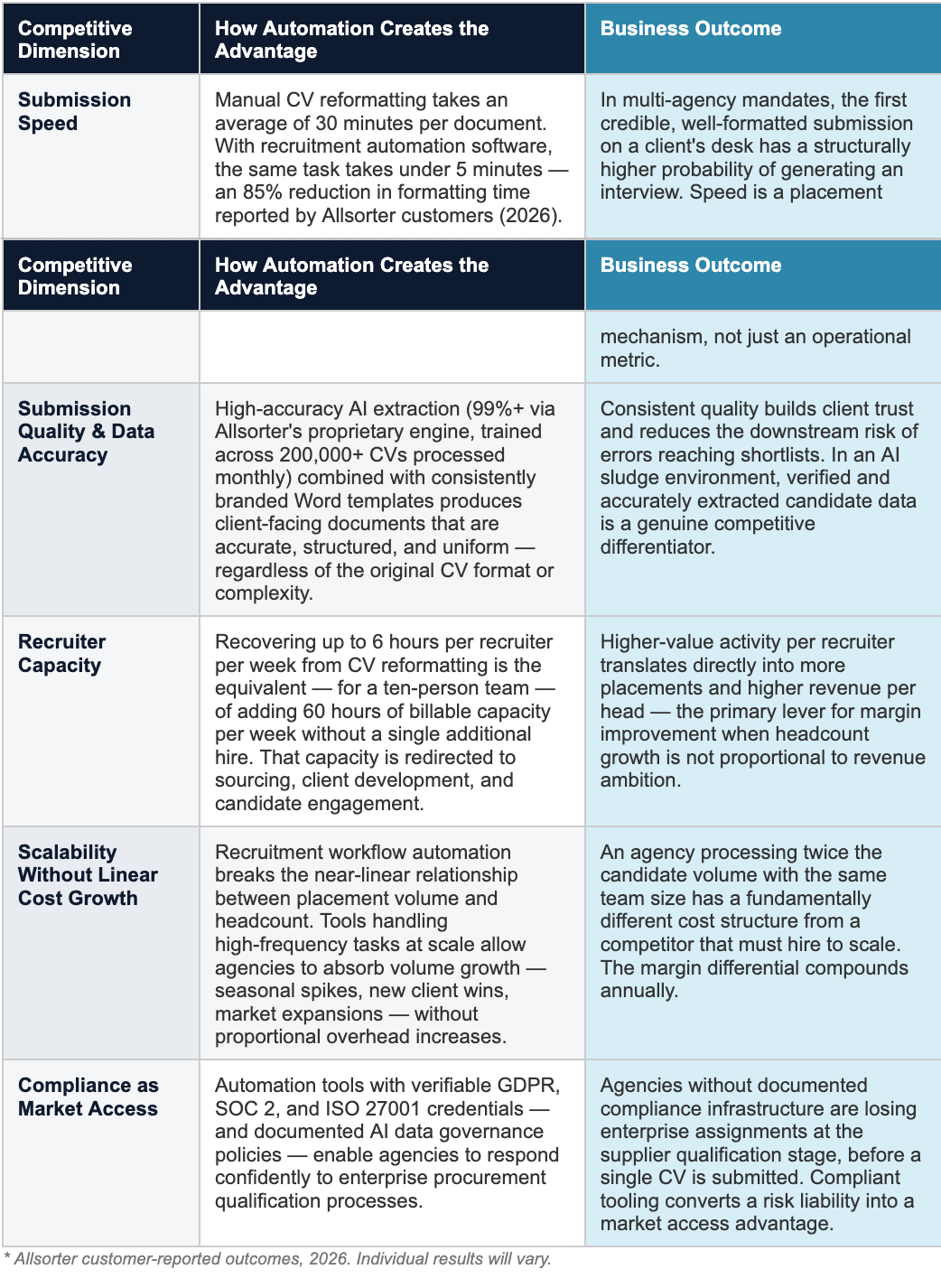
The competitive advantages generated by well-implemented recruitment automation are concrete and quantifiable. They operate across five distinct dimensions, each connecting directly to the commercial metrics agency owners track: placements, revenue per head, client retention, and margin.
Speed as a Placement Mechanism
The speed advantage deserves particular attention because it is often framed as a convenience. It is not. In a competitive market where top candidates are typically off the market within days, not weeks, and where clients are simultaneously briefing multiple agencies, submission speed is a direct determinant of placement rate. Industry data indicates that 70% of job seekers lose interest in a role if they don't hear back within one week of an interview (Allsorter, 2022). The average time-to-hire across industries sits at approximately 41 days, a figure that reflects the cumulative effect of administrative delays at every pipeline stage (Allsorter, 2022; widely cited across HR technology research).
Automation at the CV processing, formatting, and scheduling layers directly attacks that number. An agency whose recruiters spend 5 minutes reformatting a CV rather than 30 minutes recovers time at the point in the workflow where every hour matters most: between application and first client contact.


Trust as a Competitive Moat
In an environment saturated with AI-generated candidate profiles, the verifiability of the data an agency presents to clients is becoming a genuine competitive differentiator. Agencies that submit consistently accurate, structured, professionally formatted candidate profiles are offering something measurably scarce in the current market.
As Declan Murphy has argued publicly: in a world full of AI sludge, trust is an agency's most valuable asset. The CV reformatting workflow, extracting candidate data accurately, structuring it consistently, presenting it under the agency's brand, is not merely an administrative task. Executed with the right recruitment technology, it is the foundation of a client-facing submission quality that competitors relying on manual processes cannot consistently replicate.

The Margin Multiplier: Revenue Per Head
The most direct financial benefit of Tier 1 recruitment automation is capacity expansion without proportional cost growth. Published research in the HR technology sector, confirmed across Allsorter's customer base, indicates that recruiters lose approximately 14 hours per week to manual, automatable tasks (Allsorter research, 2026). CV reformatting alone accounts for up to 6 of those hours.
Recovering that capacity and redirecting it to candidate development, client management, and business development represents a business capable of growing revenue without growing its fixed cost base, which is the operating model that makes margin expansion possible. For a team of ten recruiters, 60 hours per week of recovered capacity is the structural equivalent of adding more than one full-time billing resource, without the associated salary cost. Allsorter customers report up to 6× ROI from process efficiency gains and an 8% boost in interview rates, reflecting the compounding effect of both speed and quality improvements (Allsorter customer data, 2026).

Strategic Implications: What This Means for How Agencies Compete
The agencies building durable competitive advantages through recruitment workflow automation share a common strategic posture: they treat automation as infrastructure, not as a point solution. They are not buying a tool to solve one problem. They are building a layered stack of capabilities that compound in value as they mature and integrate.
The Three-Tier Automation Model
The most useful framework for thinking about recruitment technology investment is a three-tier model. Tier 1 covers process automation, rule-based, high-frequency tasks like CV reformatting, job board posting, and interview scheduling. These are the highest-ROI, lowest-disruption investments and where the vast majority of agencies should begin. Tier 2 covers AI in recruitment to augment recruiter judgment, candidate scoring, bias reduction, and predictive pipeline analytics. Tier 3 covers agentic automation, AI executing multi-step recruitment workflows with minimal human instruction, which is maturing rapidly but is not yet widely deployed at agency scale.
The critical strategic insight is that Tier 1 is not a stepping stone to Tier 2. It is the foundation that makes Tier 2 and Tier 3 viable. Agencies that invest in AI matching tools before fixing their Tier 1 data quality produce poor AI output, not because the tool is weak, but because it is working with unstructured, inconsistently extracted candidate data. The AI amplifies the underlying data quality problem rather than solving it. The quality of data extracted and structured at Tier 1 determines the quality of every AI-driven output downstream. Agencies that invest in rigorous CV reformatting and ATS data quality today are building the infrastructure that will allow them to adopt more sophisticated automation faster and more reliably than competitors who skipped this layer.
The Human-in-the-Loop Principle
A concern that surfaces consistently among agency owners evaluating recruitment automation is the risk of removing the human element that makes great recruiters valuable. This concern reflects a misconception about what automation is for. The question is not whether to automate, it is which activities should remain human. The answer is defined by your workflow, not by philosophy: every task that requires no judgment and generates no relationship value is a candidate for automation. Every task that does is not.
Sourcing strategy, candidate relationship building, commercial negotiation, client consultation, and hiring advice require exactly the kind of judgment, contextual intelligence, and interpersonal skill that no automation tool replicates. The goal of recruitment automation software is to protect and expand the time recruiters spend on these activities, by eliminating the administrative overhead that competes with them.

Compliance as Competitive Positioning — Not Just Risk Management
Enterprise procurement teams now ask agencies to complete data governance questionnaires as part of supplier qualification. Questions about GDPR compliance, data retention policies, AI model access to candidate PII, and breach notification procedures have moved from occasional to routine. Agencies without documented compliance infrastructure are losing enterprise assignments at the qualification stage, before a single CV is submitted.
The agencies that have invested in recruitment technology with verifiable compliance credentials, GDPR, SOC 2, ISO 27001, Cyber Essentials+, are not simply managing risk. They are expanding their addressable market into enterprise accounts that require this as a minimum condition of engagement. Every time a competitor fails a procurement questionnaire, a compliant agency advances. Allsorter operates with all four certifications and processes candidate data using a proprietary Vertical Language Model purpose-built for HR, with no candidate PII shared to external AI providers. In a market where most tools process candidate data through third-party AI APIs, this is a material compliance differentiator.
How to Build the Edge: A Six-Step Implementation Framework
The following six steps reflect the implementation pattern Allsorter observes most consistently among agencies achieving the strongest and most durable outcomes from recruitment automation tools investment.
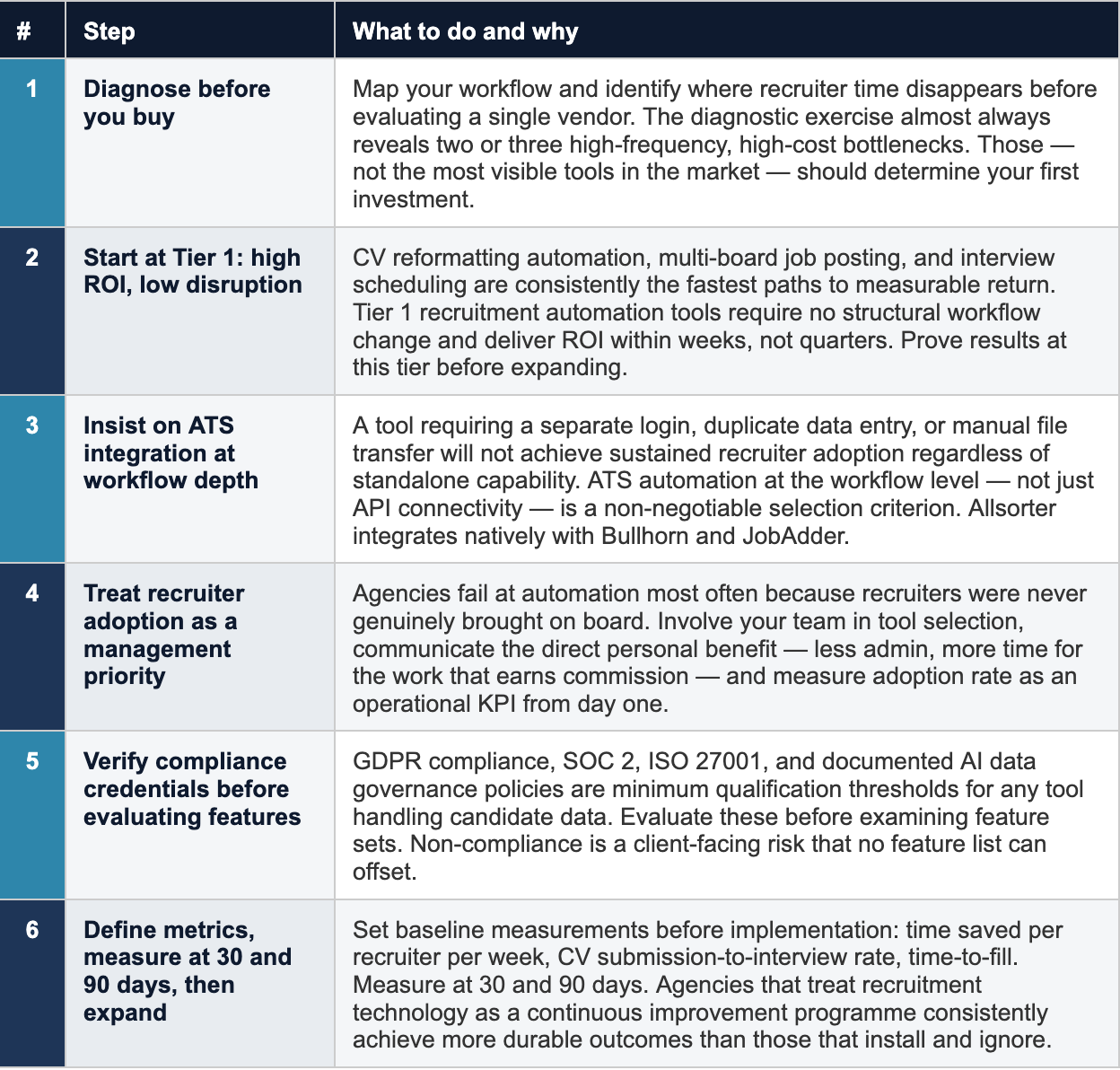
The overarching principle these steps share is that agencies with the best automation outcomes approach investment diagnostically, not reactively. They identify the bottleneck first, connect it to a measurable financial cost, choose a recruitment automation tool that integrates cleanly with their existing ATS automation layer, and measure results before expanding scope. The result is a compounding programme of continuous improvement rather than a series of costly false starts.
Conclusion: The Gap Is Already Opening
Recruitment automation is not a future-state investment to prepare for. It is a present competitive reality. Across the markets where Allsorter operates, working with agencies including Randstad, Michael Page, Addison Group, and 400+ firms globally, the performance gap between agencies with disciplined automation infrastructure and those relying on manual workflows is already measurable in placement rates, client retention, and recruiter output per head.
The agencies building that gap are not doing so by deploying the most sophisticated tools. They are doing so by solving clearly defined, high-frequency problems with well-integrated Tier 1 automation, and building from there. The window for building this advantage is open. It will not remain open indefinitely. As recruitment technology adoption accelerates and the best-equipped agencies compound their capability advantage, the competitive cost of falling behind grows each quarter.
The most effective starting point for the vast majority of agencies is the same: CV reformatting. It is the highest-frequency, most quantifiable, most immediately automatable bottleneck in the typical recruitment workflow, and it is where the ROI is fastest to prove and hardest to argue with.
