The Bottleneck Analysis
Manual vs Automated CV Formatting: Time, Cost and Placement Impact
There is a persistent assumption in recruitment operations that CV formatting is a finishing step, a minor administrative task that sits at the edge of the workflow. In reality, for most agencies, it sits squarely in the middle of it, consuming recruiter hours, creating pipeline delays, and generating costs that are rarely tracked with any precision.
When you analyse where recruiter time actually goes across a working week, CV formatting consistently emerges as one of the largest single drains on capacity, and one of the most underestimated risks to placement speed. The automated CV formatting time saving available to agencies today is not marginal. It is structural. And the agencies that have not yet quantified what manual formatting is costing them are absorbing a significant and entirely avoidable drag on revenue.
Why Manual CV Formatting Takes Far Longer Than It Should
The manual CV formatting process appears deceptively simple: take an incoming candidate document, apply a branded template, clean up the layout, remove identifying information, and produce a client-ready submission. In practice, the task involves considerably more cognitive effort and elapsed time than its apparent simplicity suggests.
Recruiters working manually must interpret inconsistently structured source documents, arriving across PDFs, Word files, multi-column layouts, and graphic-heavy designs, each requiring a different approach. They must manually extract and restructure information, cross-check for formatting errors, apply consistent typography and spacing, remove contact details to prevent candidate poaching, and review the final document before sending.
None of these steps require judgment in the strategic sense. All of them require concentration. And all of them displace time that could be spent building pipelines and closing placements.
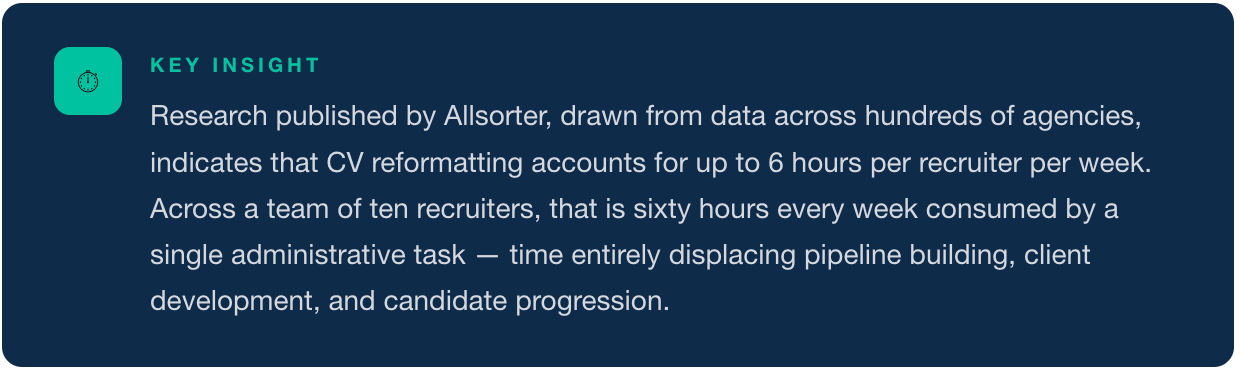
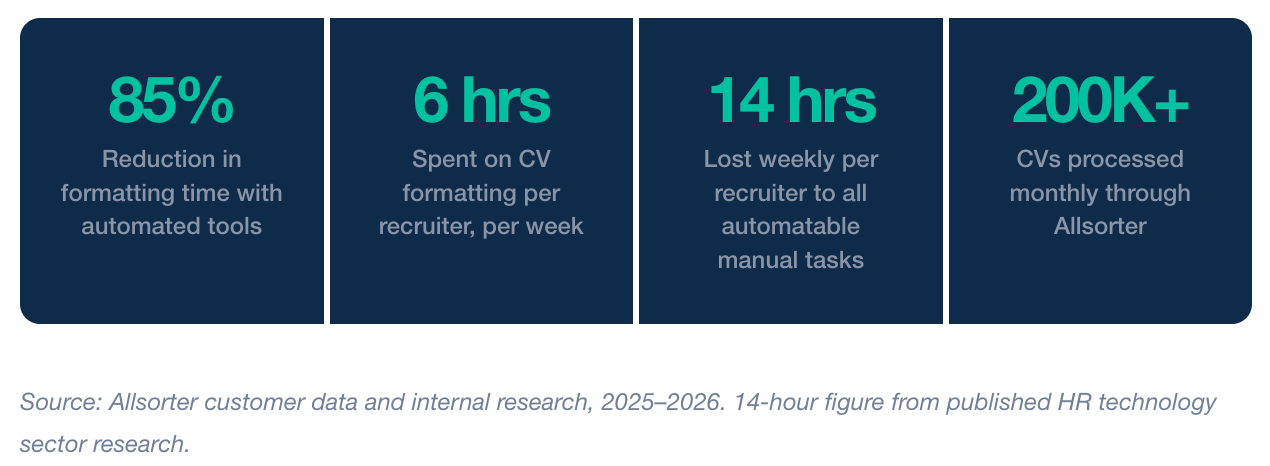
The broader picture compounds this. Industry research in the HR technology sector consistently indicates that recruitment professionals lose an average of fourteen hours per week to manual tasks that could be automated, more than a third of the working week consumed by activity that generates no measurable placement value. This is not an efficiency problem at the margins. It is a structural capacity problem at the centre of the workflow.
Calculating the True Cost: From Hours Lost to Revenue Displaced
To understand the business impact, the time loss must be translated into financial terms. Most agency operators measure recruiter cost in salary, but the more revealing metric is opportunity cost, the revenue activity displaced when a recruiter spends time on administration rather than billings.
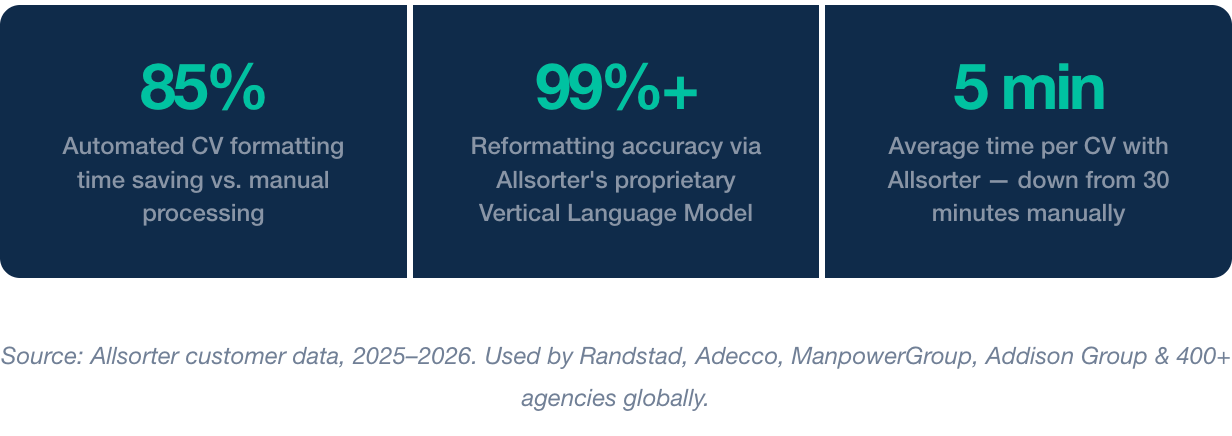
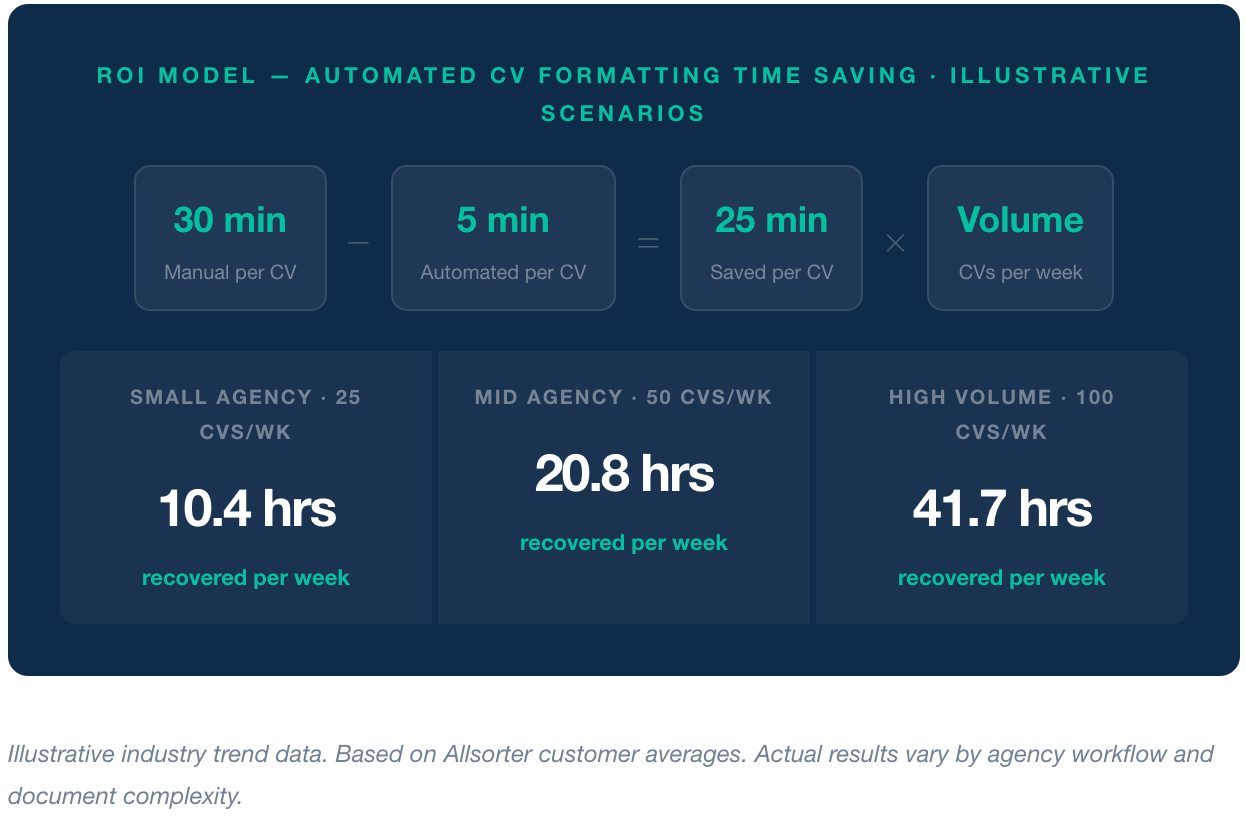
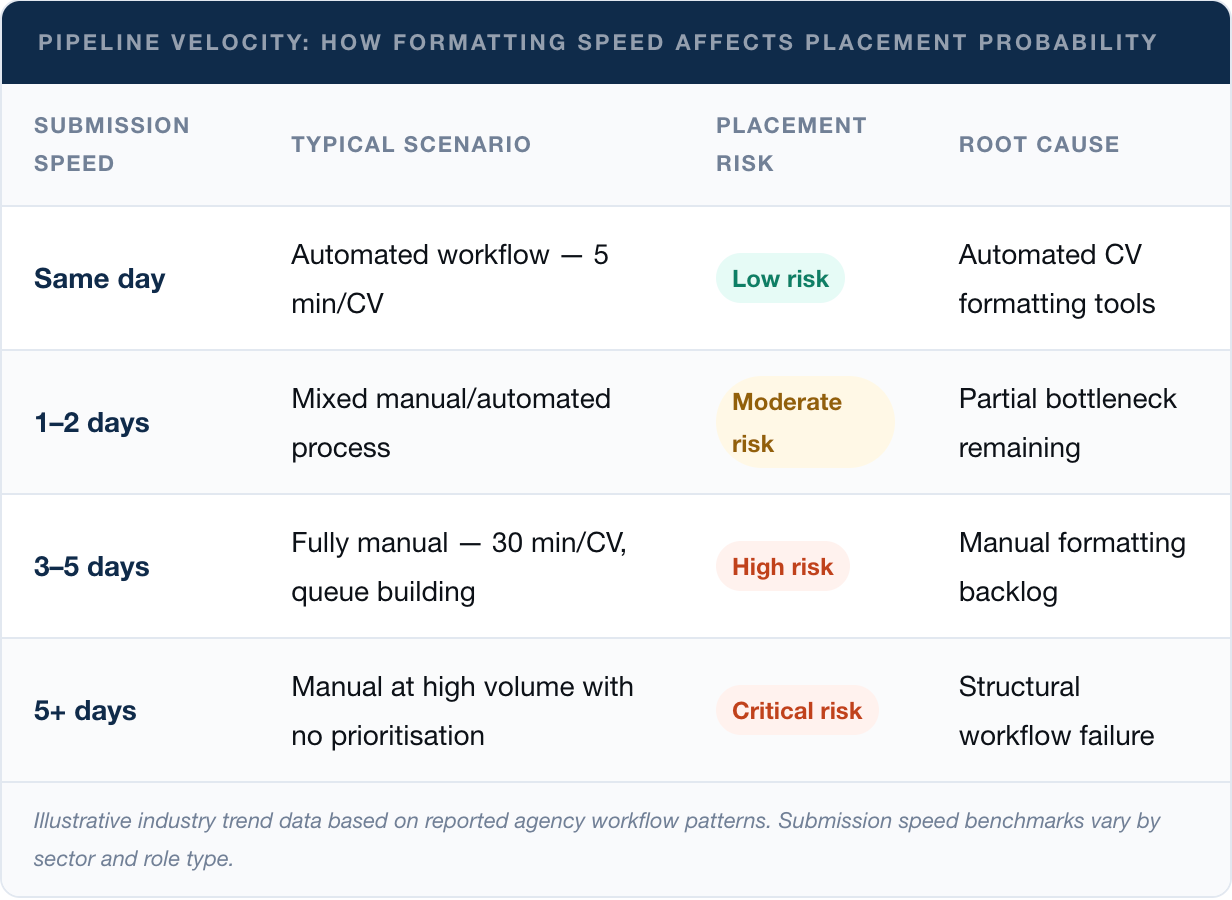
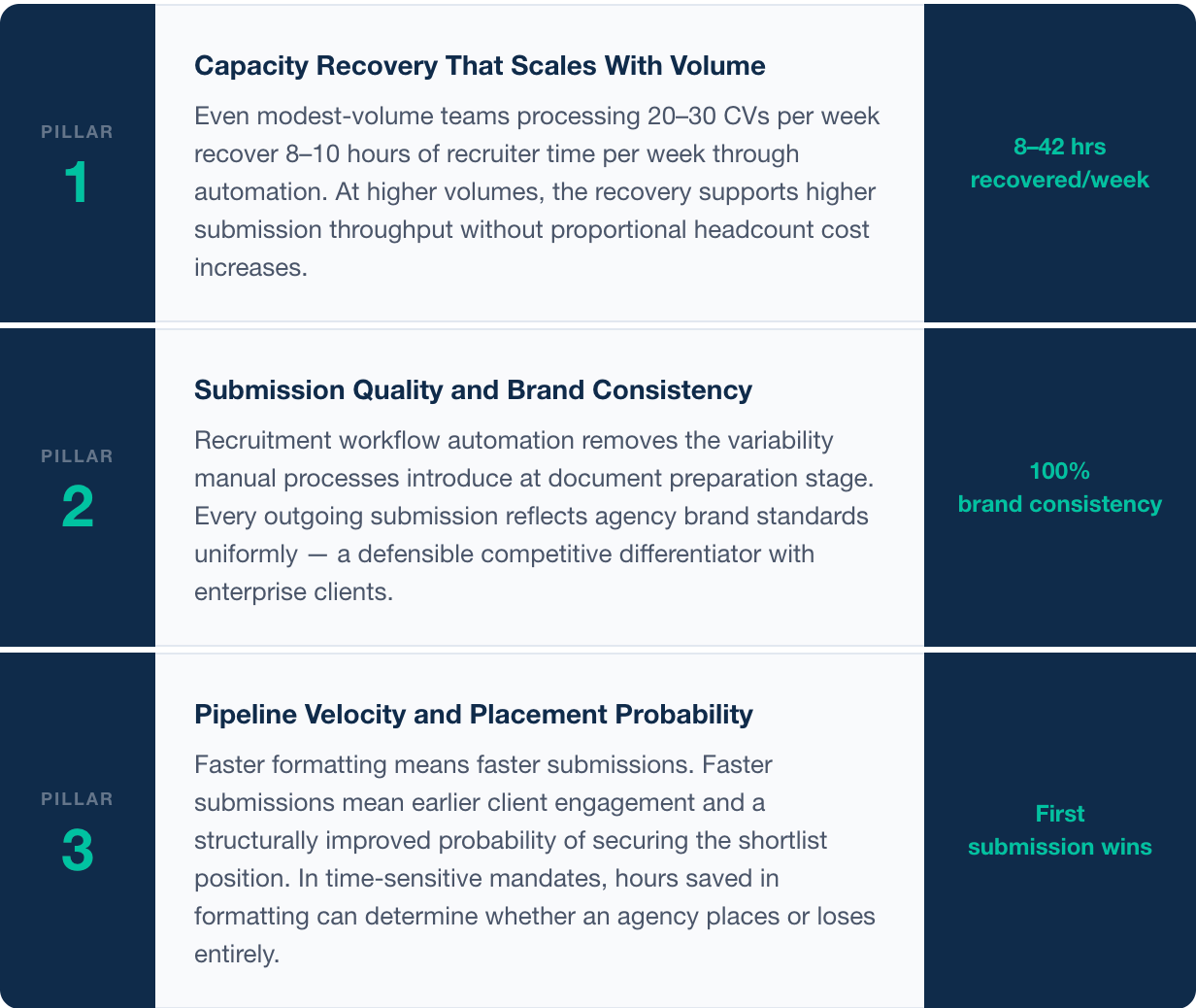
Based on Allsorter's customer data, manual CV formatting averages approximately thirty minutes per CV. The automated CV formatting time saving that purpose-built tools deliver reduces this to around five minutes, an up to 85% reduction. At scale, that compounds rapidly.
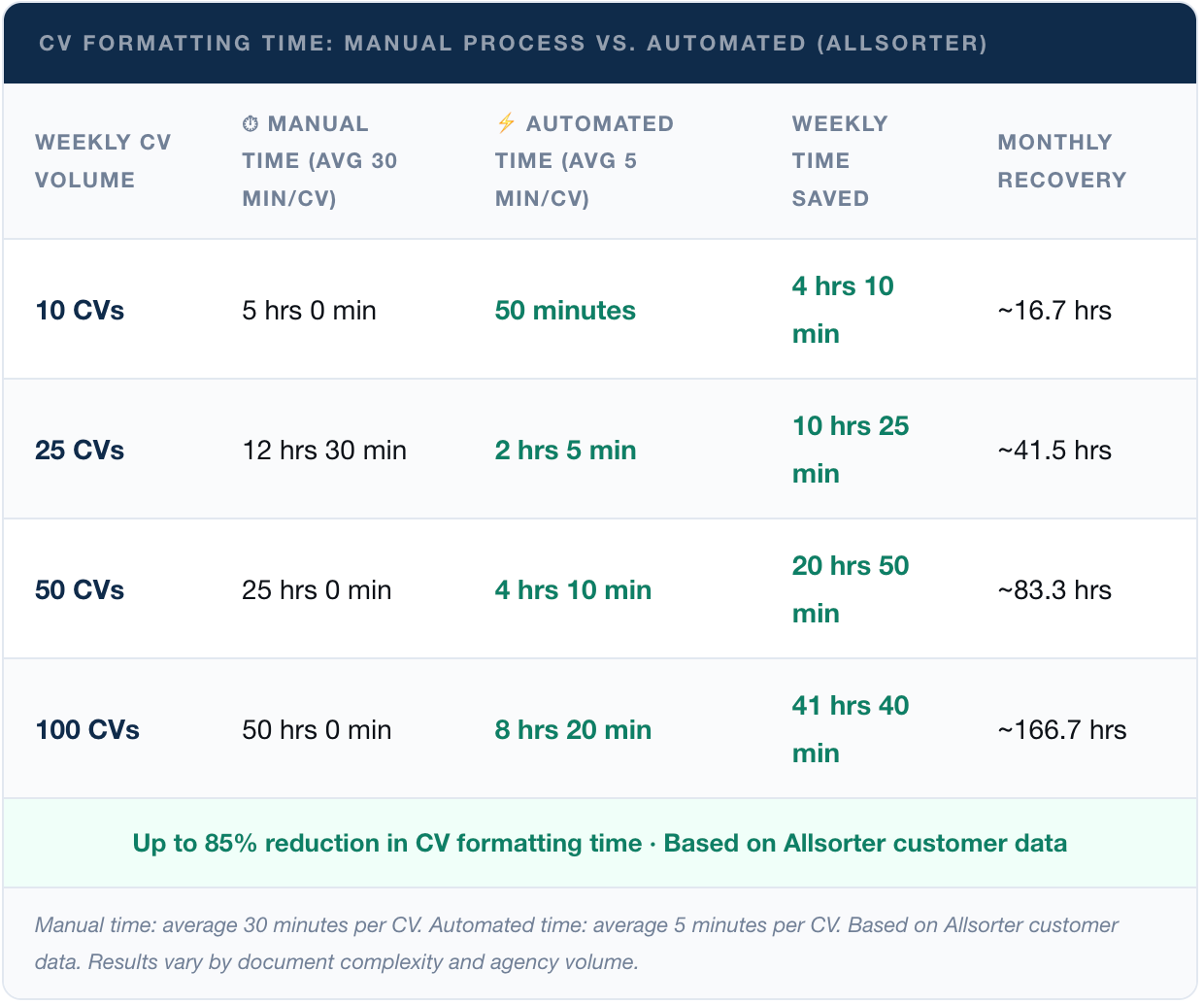
For a team processing fifty CVs per week, automated CV formatting tools return roughly twenty hours of recruiter capacity every week, approximately eighty hours per month, entirely redirectable toward revenue-generating activity. At one hundred CVs per week, the capacity recovery is substantial enough to influence headcount planning decisions altogether.
The Retention Cost Nobody Tracks
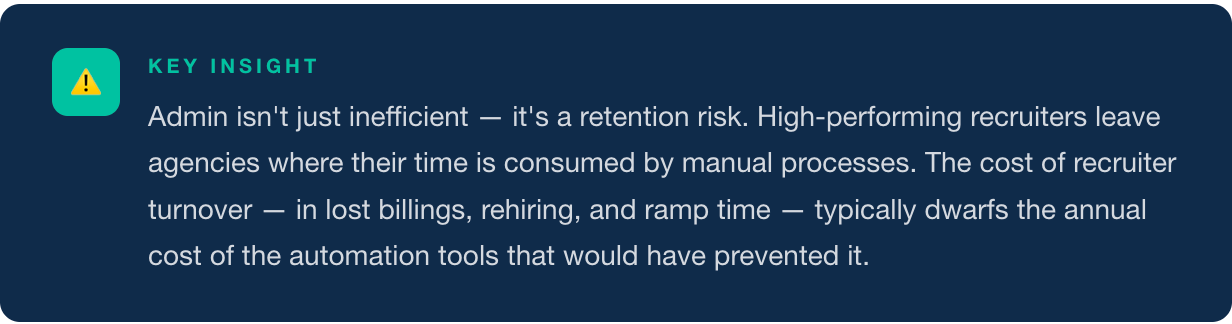
The compounding factor is recruiter retention. High-performing recruiters, those most capable of generating consistent billings — are also those most likely to disengage when a significant portion of their working time is consumed by repetitive, low-value administration. Administrative overload is a well-documented driver of recruiter attrition. When the cost of turnover is factored in, typically six to twelve months of salary in lost billings, rehiring costs, and ramp time, the financial argument for capturing the automated CV formatting time saving becomes significantly more urgent than a simple productivity calculation suggests.
What Automated CV Formatting Tools Actually Change
Recruitment automation tools built specifically for CV formatting replace the manual process with an AI-driven workflow: extracting candidate data from source documents regardless of their original format, applying agency-branded templates, standardising output structure, removing personal identifiers, and producing client-ready submissions in a fraction of the manual time.

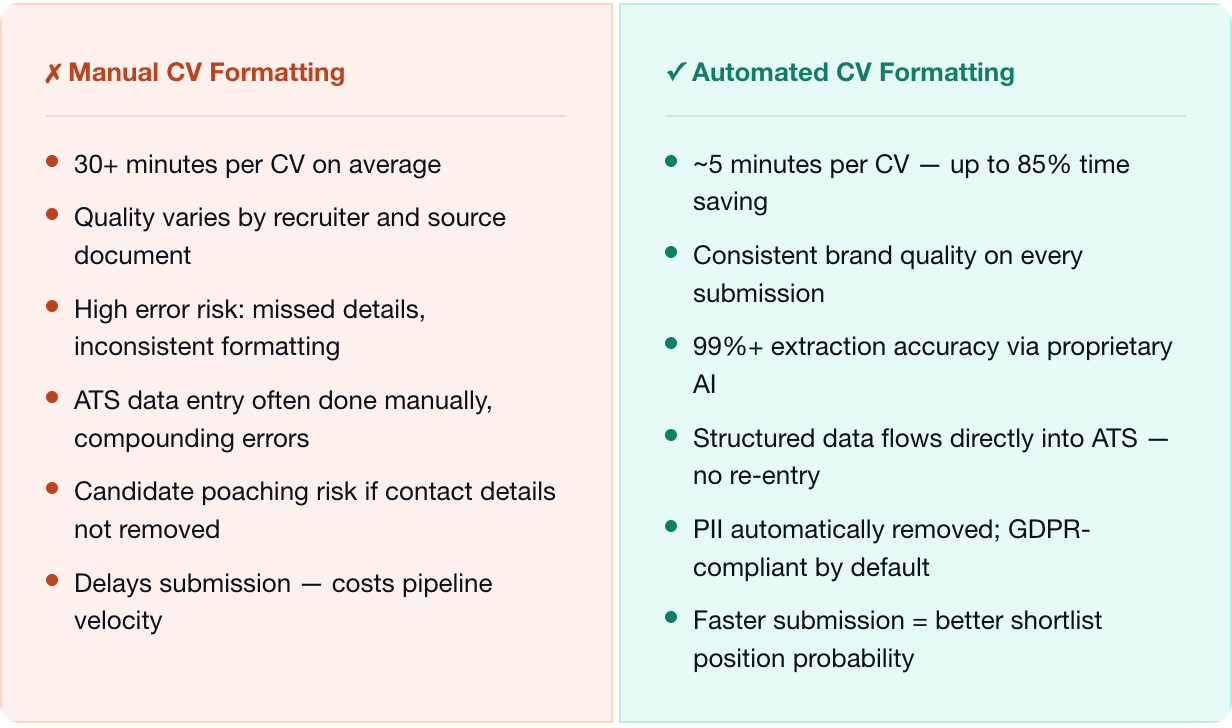
Agencies including Randstad, Adecco, ManpowerGroup, and Addison Group have adopted automated CV formatting as part of their recruitment workflow automation and report material reductions in document preparation time. Formatting tasks that previously consumed thirty minutes or more per CV now average five minutes, delivering up to 85% automated CV formatting time saving that compounds across every desk, every week.
The Data Quality Dimension
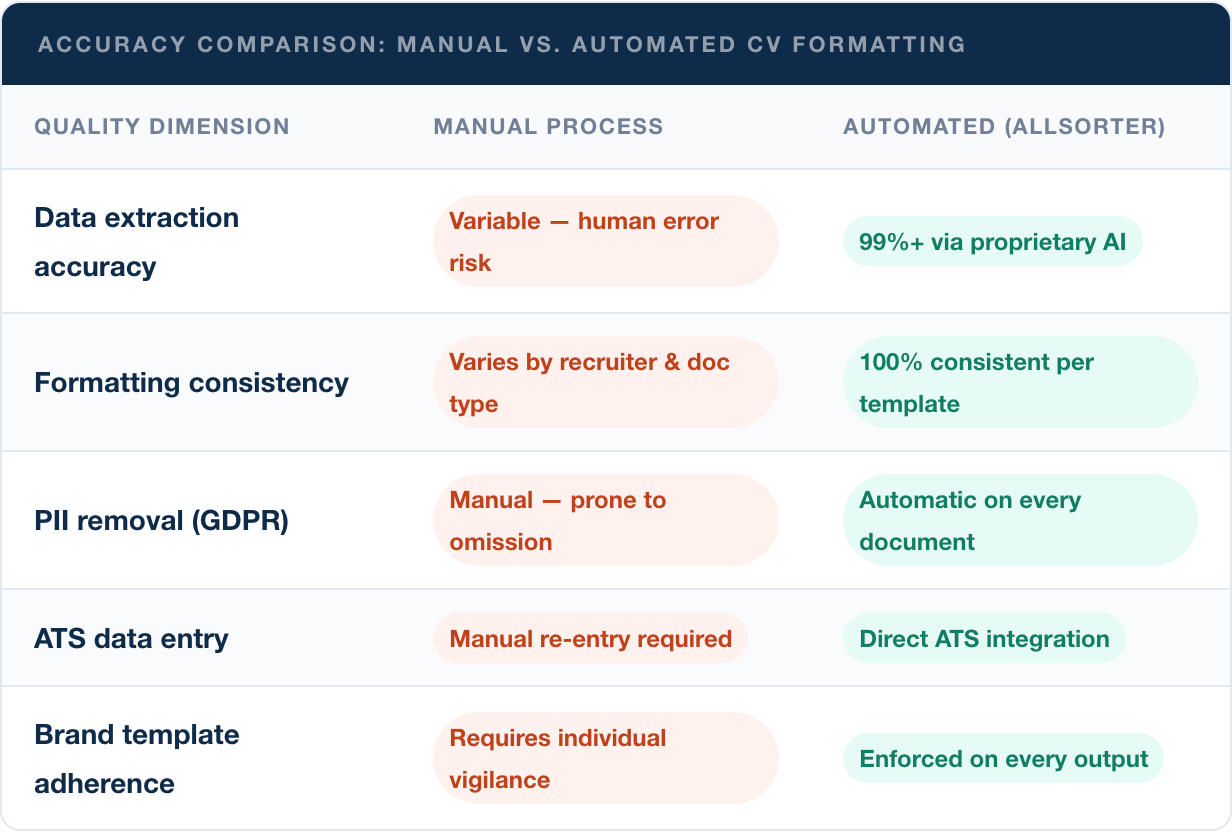
Beyond speed, automated CV formatting delivers a consistency impossible to achieve at volume through manual processes. Every candidate document is formatted to the same standard, identical typography, identical structure, identical branded presentation, regardless of which recruiter processed it. For clients reviewing multiple submissions simultaneously, this consistency reduces cognitive load, accelerates shortlisting, and directly improves the quality of the hiring experience.
There is also a data quality dimension frequently overlooked. Automated CV formatting tools that integrate with ATS platforms ensure candidate data is extracted and structured accurately at the point of entry, rather than relying on manual re-entry, which introduces errors that compound through every subsequent pipeline stage.
The Placement Impact: Why Formatting Speed Is a Competitive Variable
The connection between CV formatting speed and placement outcomes is commercially significant, and rarely discussed explicitly in operations reviews.
In competitive hiring markets, which characterise most mid-to-senior professional sectors, the agency that submits first carries a meaningful structural advantage. Hiring managers reviewing candidate pools are human: first submissions establish the reference point against which every subsequent candidate is evaluated. When agencies are delayed by manual formatting backlogs, that advantage transfers directly to competitors with faster internal workflows.
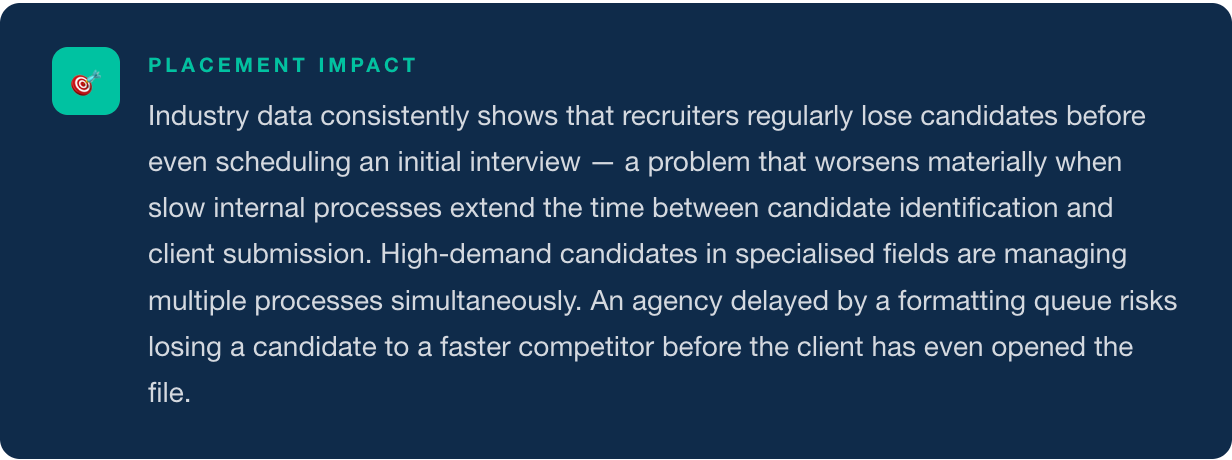
This is the placement impact that manual formatting bottlenecks create: invisible in dashboards, absent from performance reviews, but structurally present in every delayed submission and every candidate lost mid-process to a more agile competitor.
Rethinking Formatting as a Revenue and Operations Decision
For operations leaders evaluating their agency's workflow architecture, the manual versus automated CV formatting question is not primarily a technology decision. It is a capacity allocation decision with direct revenue implications.
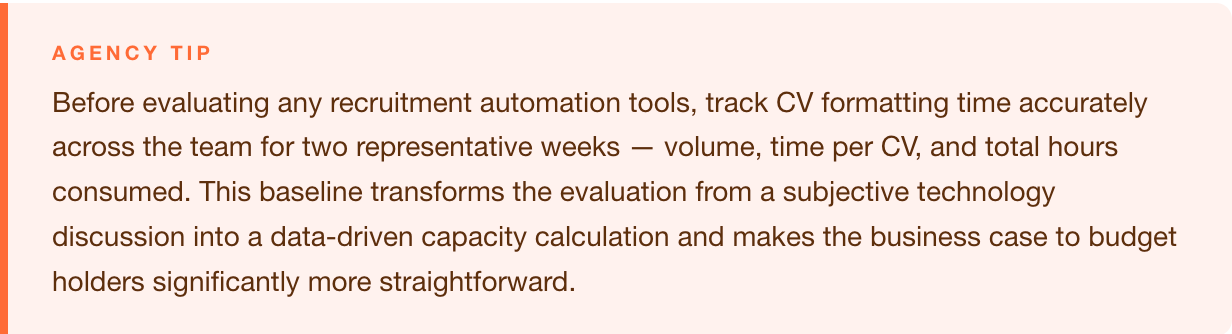
The diagnostic question is straightforward: how many hours per week is your team spending on formatting, and what would those hours produce if redirected to billing activity? Most agencies that conduct even a basic time-tracking exercise across a single week find that CV reformatting consistently surfaces as the largest single avoidable time sink in the entire workflow, ahead of interview coordination, manual data entry, and job board posting combined.
How to Implement Automated CV Formatting: Where to Start
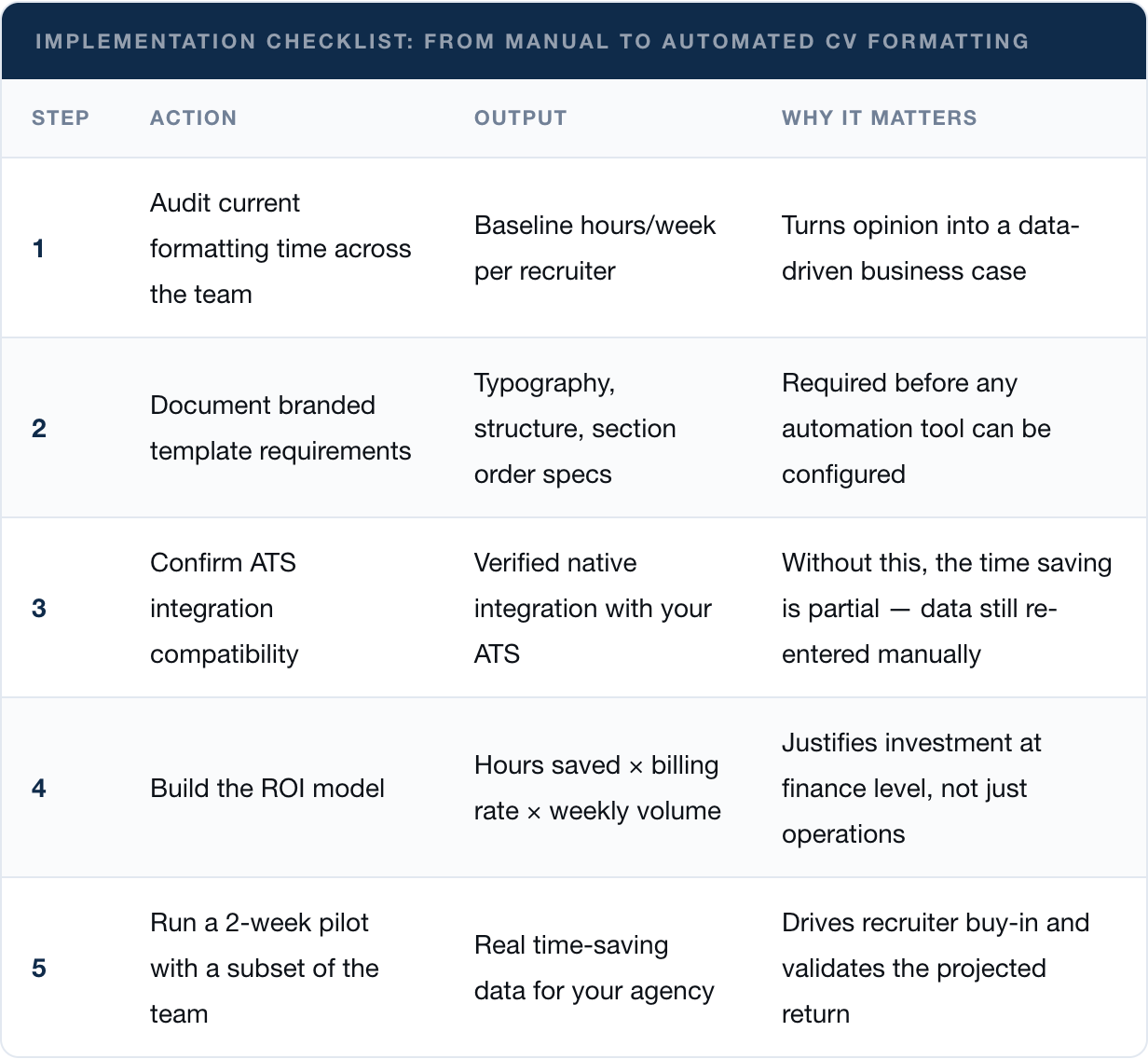
For agencies considering a transition from manual to automated CV formatting, the implementation path is considerably more straightforward than the scale of the ROI case might suggest.
Prioritise ATS Integration
The automated CV formatting time saving compounds when formatted CVs flow directly into existing ATS infrastructure without creating parallel processes or additional manual steps. Purpose-built platforms integrate with major ATS systems, including Bullhorn, Salesforce, Vincere, and JobAdder, meaning the formatted output becomes part of the existing recruitment workflow rather than a separate upload step requiring human intervention.
Automated CV Formatting Within a Wider Recruitment Workflow Automation Strategy
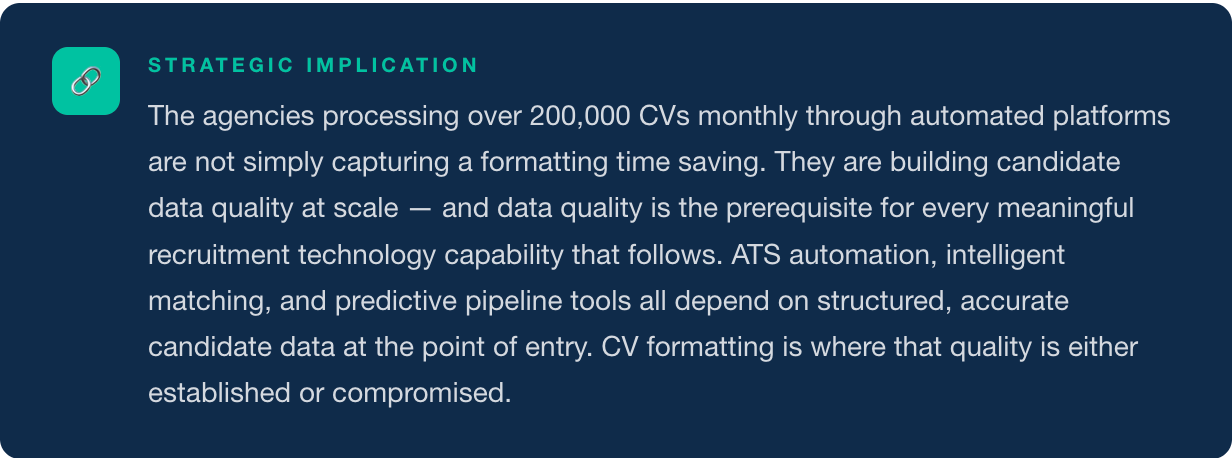
Automated CV formatting time saving should not be evaluated in isolation. CV formatting occupies a specific and structurally important position within a broader recruitment workflow automation architecture: it is the first high-volume, rule-based task in the candidate processing chain, and it sets the data quality standard for everything that follows.
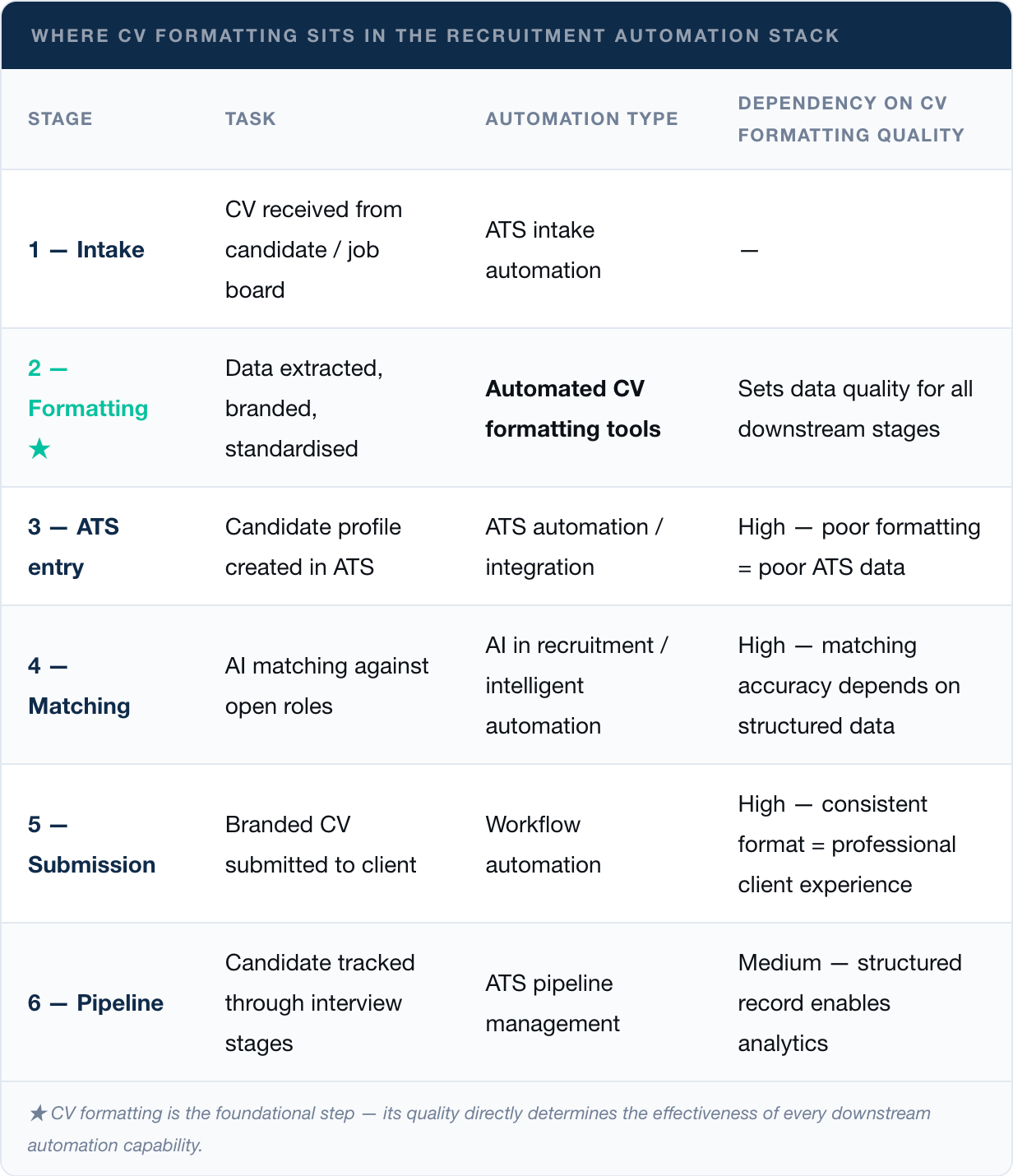
A CV formatted and parsed cleanly into an ATS improves data extraction accuracy at every subsequent pipeline stage. A consistently structured candidate profile makes AI in recruitment, matching algorithms, screening tools, pipeline analytics, substantially more effective. Agencies that establish discipline and automation at this earliest stage of the workflow build a foundation that reduces friction across the entire candidate-to-placement journey.
The Business Case Is Already Made
The framing of CV formatting as an administrative concern is the primary reason most agencies have not yet solved it. When reframed as a revenue question, how much placement capacity is this consuming, and what would that capacity be worth if redirected, the automated CV formatting time saving available through purpose-built tools makes an immediate and compelling case.
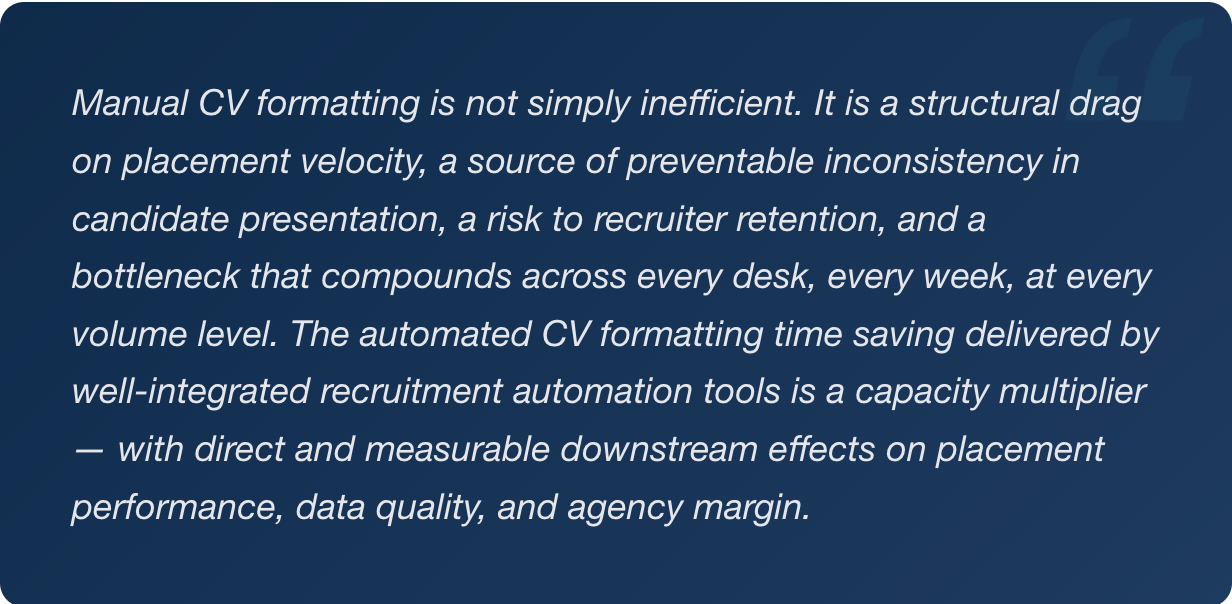
For recruitment operations leaders responsible for productivity, scalability, and revenue growth, the question is no longer whether to address this bottleneck. It is how quickly the decision can be made.