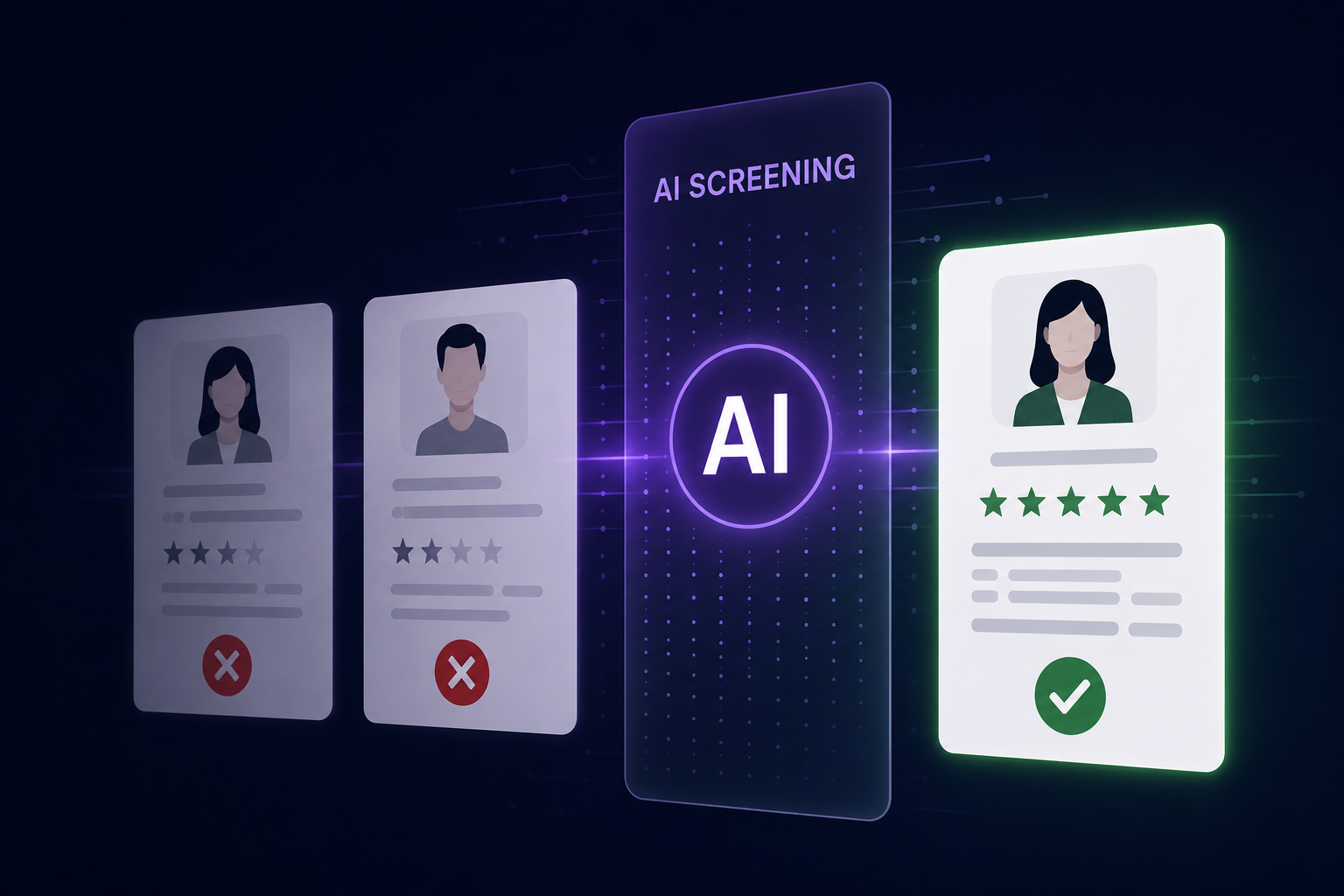
1 in 3 Recruiters Admit AI Is Filtering Out Top Talent. That's Not an AI Problem - It's a Workflow Problem
One in three recruiters now admit their own AI tools are filtering out strong candidates before a human ever sees them, according to research reported by onrec.com. It's a striking number on its own, but it turns out not to be an outlier. A University of Phoenix Career Institute study, cited by HR Dive in April 2026, found that half of hiring managers share the same worry, that their screening tools are quietly removing qualified people from the pipeline, and that only 37% of organizations using AI in hiring currently audit those tools for fairness at all.
Put those two findings together and a pattern emerges that's bigger than any single vendor or dataset. The tools built to make recruiting faster and more accurate are, in a meaningful share of cases, becoming the source of the very errors they were meant to eliminate. And the people running these processes are the first to say so.
This isn't really an argument about whether AI belongs in recruiting. Gartner's research on 2026 talent acquisition trends, presented at its HR Symposium in October 2025, takes that as a given: AI is already reshaping how high-volume recruiting works, and the firm's advice to TA leaders isn't to pull back, it's to stay close. Gartner puts it plainly: "hands-on monitoring is a must," with recruiting leaders expected to define the reasonable range of outcomes up front and watch closely for anything that drifts outside it. That's a very different posture than installing a screening tool and letting it run.
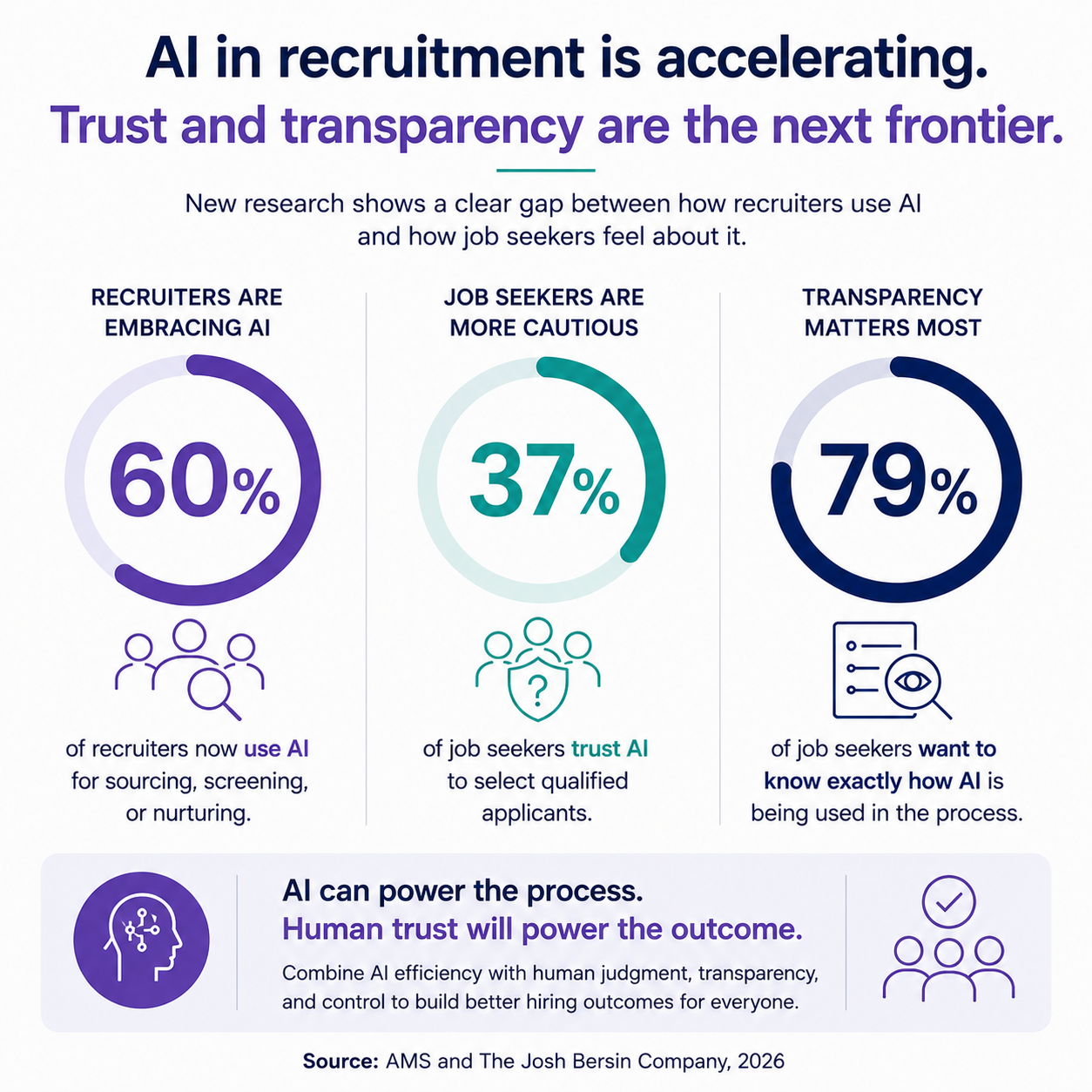
AMS and The Josh Bersin Company reached a similar conclusion in their 2026 playbook on the talent acquisition function, Navigating the Talent Acquisition Revolution. Their own research found that nearly 60% of recruiters now use AI for sourcing, screening, or nurturing, yet only 37% of job seekers trust AI to select qualified applicants, and 79% want to know exactly how AI is being used in the process. One of the five shifts they identify, moving from ad hoc hiring decisions to precision systems, calls for standardized decision criteria and AI augmentation that stays explicitly bounded by human review and feedback loops, not automation left to run unchecked.
You can see the same instinct playing out in an adjacent field. SIA's June 2026 report on IT staffing and digital transformation points to Stack Overflow's 2025 Developer Survey, which found that although the large majority of professional developers now use AI tools regularly, only 3% say they highly trust the output, and most don't plan to let AI near the highest-stakes steps in their own workflow, things like code review or deployment sign-off, for years yet. Recruiting is running into the same wall a lot of AI-adopting functions eventually hit: automation earns trust quickly at the edges of a process, and much more slowly at its centre.
That's the real distinction worth drawing. Screening, scoring, and shortlisting aren't edge tasks. They're the centre of the process, the point where a strong candidate either gets seen or doesn't, and where a firm's commercial outcomes are quietly made or lost. Treating that stage as a set-and-forget layer isn't efficiency, it's risk that hasn't been priced in yet.
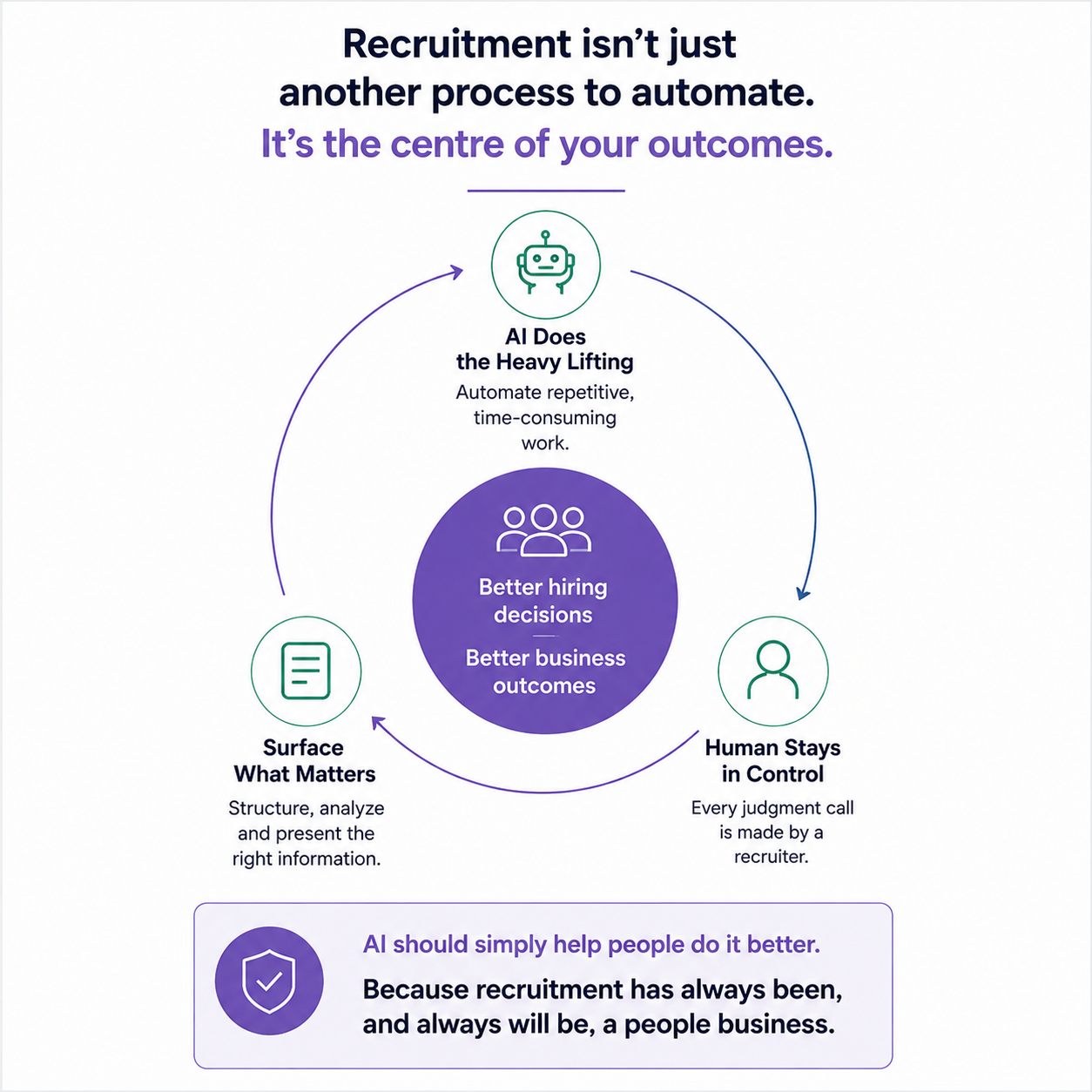
Whether it's automating candidate workflows, analysing fit, authenticating candidate information or preparing client-ready submissions, AI handles the repetitive work while recruiters remain in control at every decision point. The goal isn't to replace recruiter expertise, it's to remove the administrative burden that prevents them from using it. That principle underpins both Allsorter's existing platform and Nexus, our workflow orchestration platform for recruitment teams. AI does the heavy lifting on formatting, structuring, and surfacing information, and a human stays in control of every judgment call.
Because recruitment has always been, and always will be, a people business.
AI should simply help people do it better. So, if AI isn't the problem, what is?
See how Nexus helps recruitment teams solve the workflow challenges behind better hiring decisions.
Explore Nexus: allsorter.com/nexus