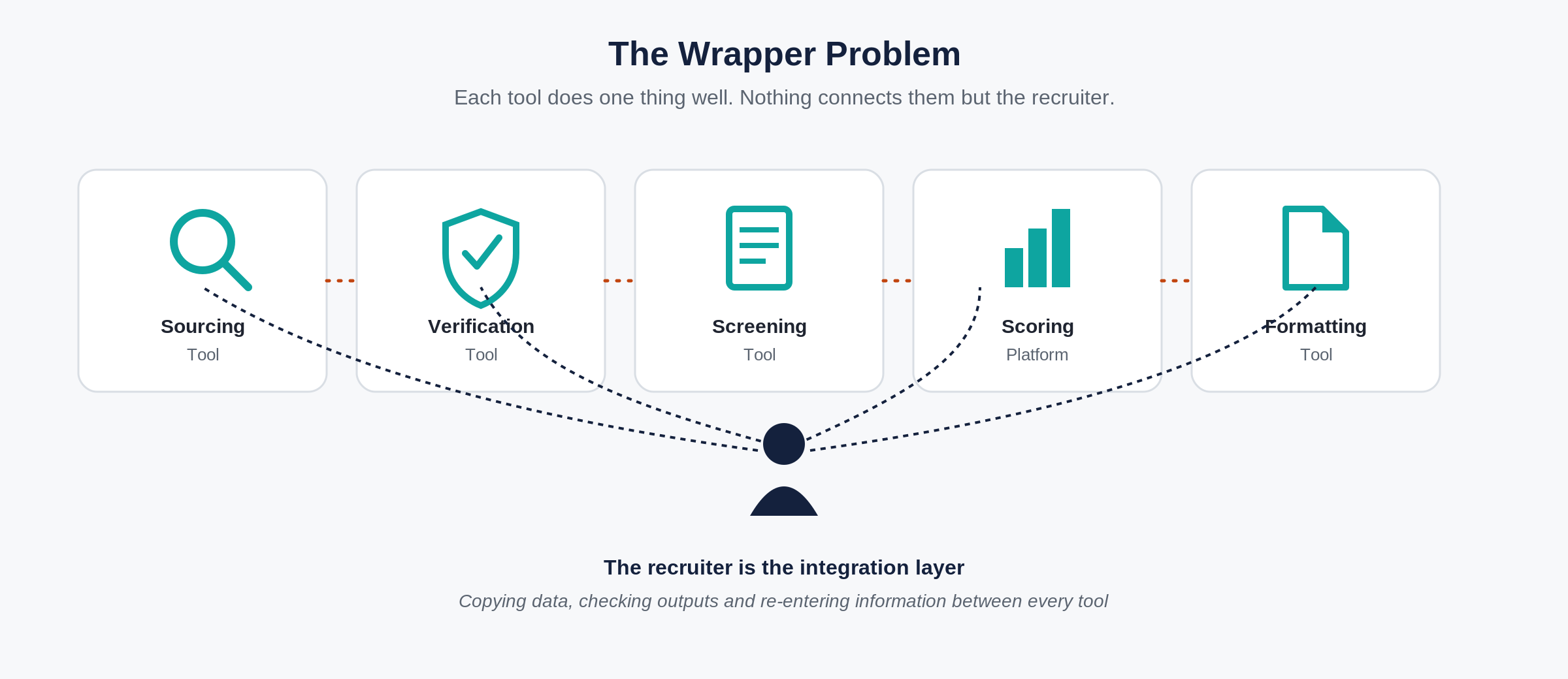
The Wrapper Problem: Why Most Staffing Firms Aren't Seeing ROI From AI Yet
Artificial intelligence has quickly become one of the biggest areas of investment across the staffing & talent acquisition industry. Recruitment teams are experimenting with AI sourcing assistants, résumé screening tools, candidate scoring platforms, profile generators and every new application promising to make recruiters faster, more productive and more profitable.
On paper, the logic is compelling. If AI can automate the repetitive tasks that slow recruiters down, firms should be able to increase placements, reduce operating costs and grow without continually increasing headcount.
Yet that isn't what many staffing leaders are experiencing.
Despite significant investment, recruiter productivity often hasn't improved in proportion to AI adoption. Consultants are still switching between multiple applications, copying information between systems, validating AI-generated outputs and manually filling the gaps between disconnected tools.
When we speak with recruitment leaders, we keep hearing the same question:
"We've invested in AI. Why aren't we seeing the return?"
We don't believe the problem is AI itself. We believe the industry has been solving the wrong problem.
AI Has Changed Individual Tasks - Not Recruitment Workflows
Over the last two years, the recruitment technology market has become flooded with AI-powered point solutions. There are tools that source candidates, others that verify credentials, platforms that summarise résumés, applications that score candidate fit, and software that formats professional client submissions.
Each of these products solves a specific problem remarkably well.
The challenge is that recruitment has never been a series of isolated tasks.
A recruiter doesn't simply screen a résumé. They source candidates, assess experience, compare profiles against a job specification, verify information, prepare submissions, communicate with hiring managers and update their Applicant Tracking System (ATS). Every step relies on the one before it.
Most AI tools optimise one of those activities. Very few optimise the journey between them.
As a result, recruiters often become the integration layer.
They move candidate information from one platform to another, check whether outputs are accurate, update systems manually and recreate context every time they switch applications. AI may have reduced the effort required for individual tasks, but it hasn't removed the friction from the overall recruitment process.
In many organisations, the workflow hasn't become simpler. It's simply become digital in more places.
The Wrapper Problem
This is what we call the wrapper problem.
Many of today's AI products are effectively wrappers around a single capability. They take an input, perform one task and return an output. Upload a résumé. Generate a summary. Paste a job description. Score candidate fit. Create a client profile.
There is absolutely nothing wrong with these products. Many deliver genuine value and save recruiters meaningful amounts of time.
The problem begins when organisations assume that connecting enough wrappers creates an intelligent recruitment operation.
It doesn't.
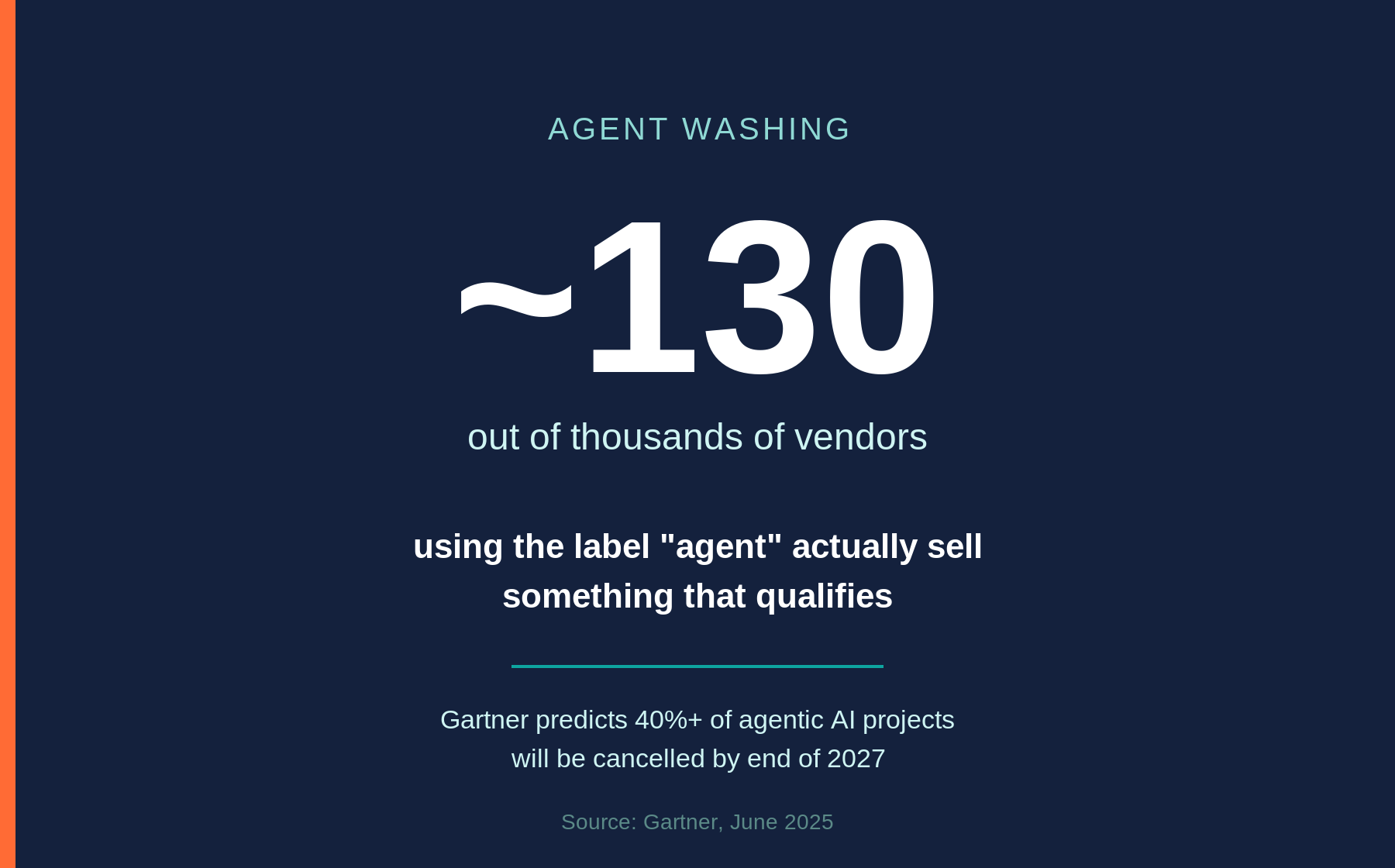
Gartner has independently arrived at almost the same diagnosis, under a different name. The firm calls it "agent washing": vendors rebranding existing AI assistants, robotic process automation and chatbots as "agents," without any of the underlying autonomy that word implies. Gartner estimates only around 130 of the thousands of vendors currently using the label "agent" are selling something that actually qualifies, and predicts that more than 40% of agentic AI projects will be cancelled by the end of 2027 due to escalating costs, unclear business value or risk controls that were never built in. The label has outpaced the capability. That's the wrapper problem, described in enterprise research language rather than ours.
Instead, every additional tool introduces another handoff, another review step and another opportunity for information to become inconsistent. Recruiters still need to validate outputs, transfer data and ensure every stage of the process remains aligned.
That's why many staffing firms struggle to demonstrate meaningful ROI despite increasing investment in AI.
The technology is working.
The workflow isn't.
The Hidden Cost Nobody Measures
Recruitment leaders often calculate the time AI saves on an individual task. Perhaps a summary that once took ten minutes now takes thirty seconds. A formatted résumé is created automatically instead of manually.
Those savings are real.
But they're only part of the picture.
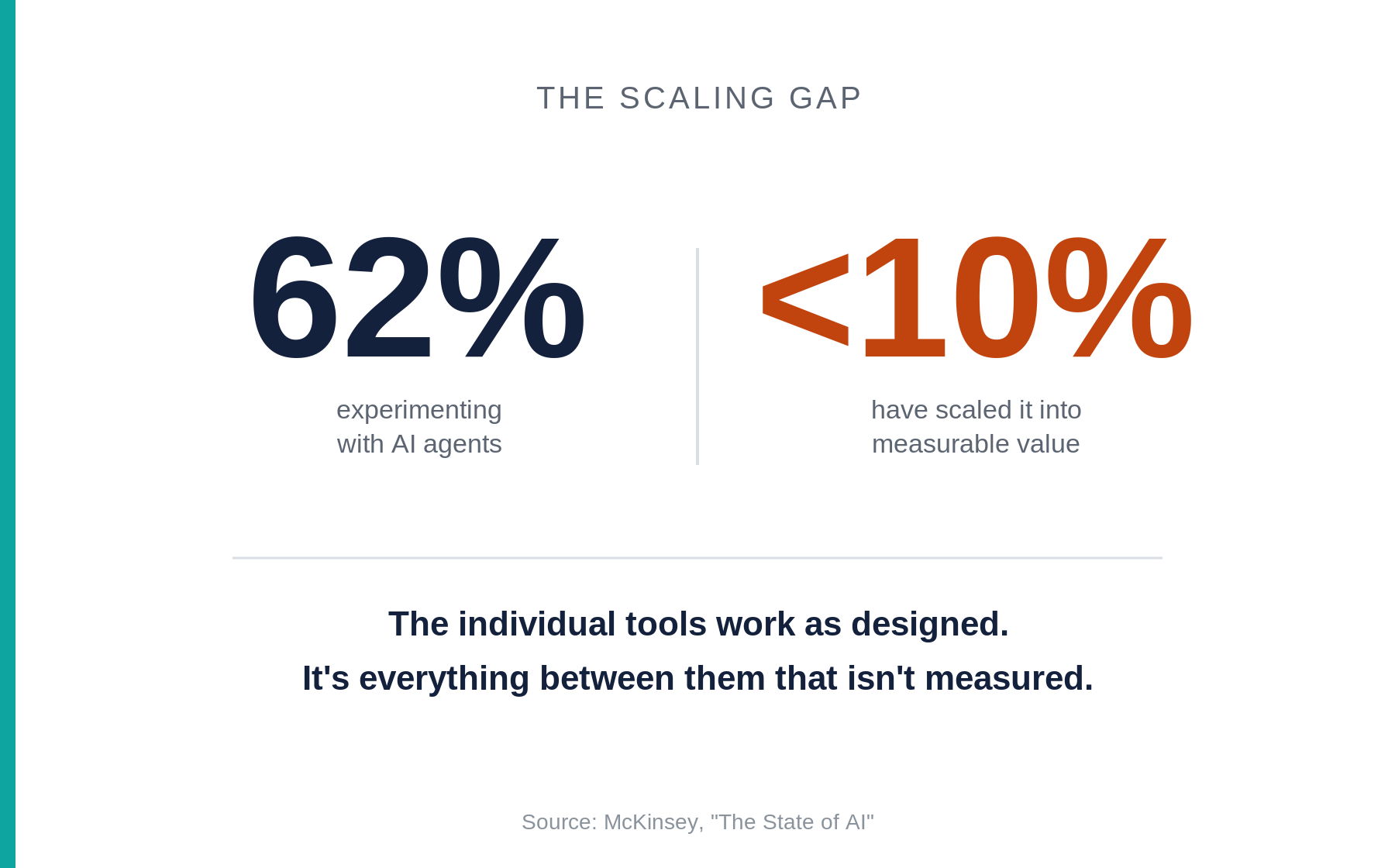
McKinsey's research on enterprise AI adoption bears this out at scale: 62% of companies are now experimenting with AI agents, yet fewer than 10% have scaled that experimentation into measurable value. Nearly 80% of companies deployed generative AI in some form in 2025, and roughly the same share reported it had no material effect on earnings, a pattern McKinsey calls the "gen AI paradox." The individual tools are working exactly as designed. It's everything happening between them that isn't being measured, or fixed.
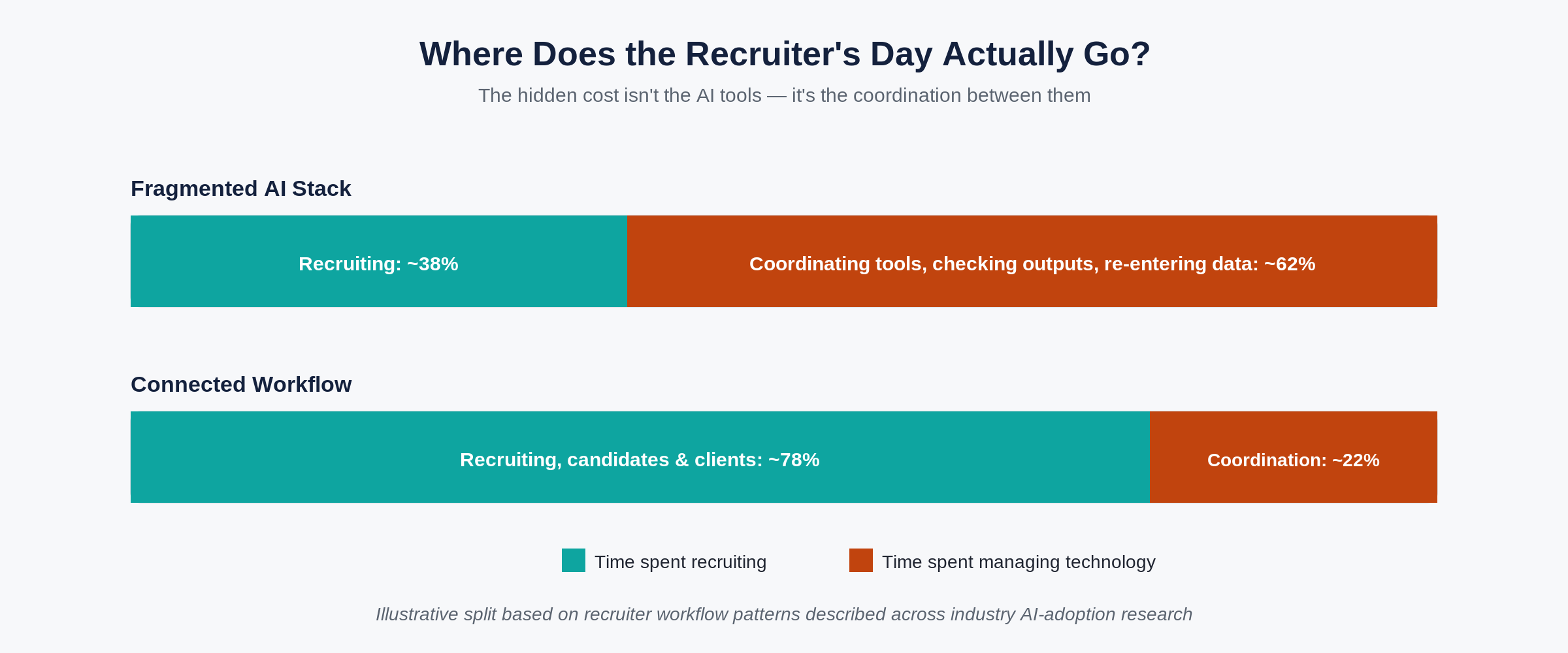
What's rarely measured is the time spent coordinating multiple AI tools.
Consider a recruiter managing several live vacancies. They source candidates through one platform, verify information using another, generate summaries with a large language model, score candidates elsewhere, format profiles using another application and finally update the ATS before preparing a client submission.
Individually, every tool performs exactly as intended.
Collectively, they create a fragmented process where recruiters spend much of their day managing technology rather than recruiting.
The biggest productivity challenge isn't writing another summary or formatting another profile.
It's everything that happens between those activities.
This is also why conversations about AI replacing recruiters miss the point entirely.
Recent industry research found that one in three recruiters believe AI tools are filtering out strong candidates before they ever reach human review.
That shouldn't be interpreted as evidence that AI doesn't work.
It highlights the importance of designing workflows where AI supports decision-making rather than replacing it.
Great recruiters don't create value because they can rewrite a résumé faster than a machine.
They create value because they recognise potential that algorithms might overlook. They understand nuance, build relationships, assess cultural fit and challenge assumptions that data alone cannot explain.
The goal of AI should never be to remove recruiters from the hiring process.
It should remove repetitive administration so recruiters can spend more time applying the judgement that clients actually pay for.
The firms achieving the greatest success with AI understand this distinction.
As AI becomes more accessible, individual capabilities will become increasingly commoditised. Candidate summaries, profile generation, document formatting and screening will become standard functionality rather than competitive advantages.
The real differentiator will be how well organisations connect those capabilities into a single workflow.
Instead of asking, "Which AI tool should we buy next?", staffing leaders should be asking a different question.
"How do we redesign our recruitment process so information flows seamlessly from sourcing through to client presentation, while keeping recruiters in control of the decisions that matter?"
That's a fundamentally different conversation.
It's no longer about adding more AI.
It's about building better operations.
When workflows are designed intelligently, candidate information moves automatically between stages. Data remains consistent across systems. Recruiters spend less time coordinating technology and more time engaging with candidates and clients. AI becomes part of the recruitment infrastructure rather than another application sitting beside it.
The productivity gains are no longer measured in minutes saved on individual tasks.
They're measured in faster placements, cleaner data, greater recruiter capacity and stronger commercial performance.
A Better Question for Staffing Leaders
AI adoption is no longer the challenge. Most staffing firms have already embraced it.
The question now is whether those investments are transforming how recruiters work or simply giving them more tools to manage.
Before investing in another AI solution, it's worth stepping back and asking:
Are we automating individual tasks or redesigning the entire recruitment workflow?
Where should AI accelerate decisions, and where should recruiters always remain in control?
How much time are our consultants spending moving information between systems rather than engaging with candidates?
Are our AI investments making recruitment simpler - or simply adding another layer of technology?
The answers to those questions will reveal far more about future productivity than any individual feature comparison ever will.
Over the next five years, the staffing firms that outperform the market won't necessarily be the ones using the most AI.
They'll be the ones using AI differently.
Rather than building a collection of disconnected tools, they'll build connected recruitment workflows where repetitive work happens automatically, information flows seamlessly between every stage of the process and recruiters remain focused on the decisions that genuinely require human expertise.
Because the future of recruitment isn't about replacing recruiters with artificial intelligence.
It's about giving recruiters a workflow that's intelligent enough to let them do what they do best.
Interested in what connected recruitment workflows look like in practice?
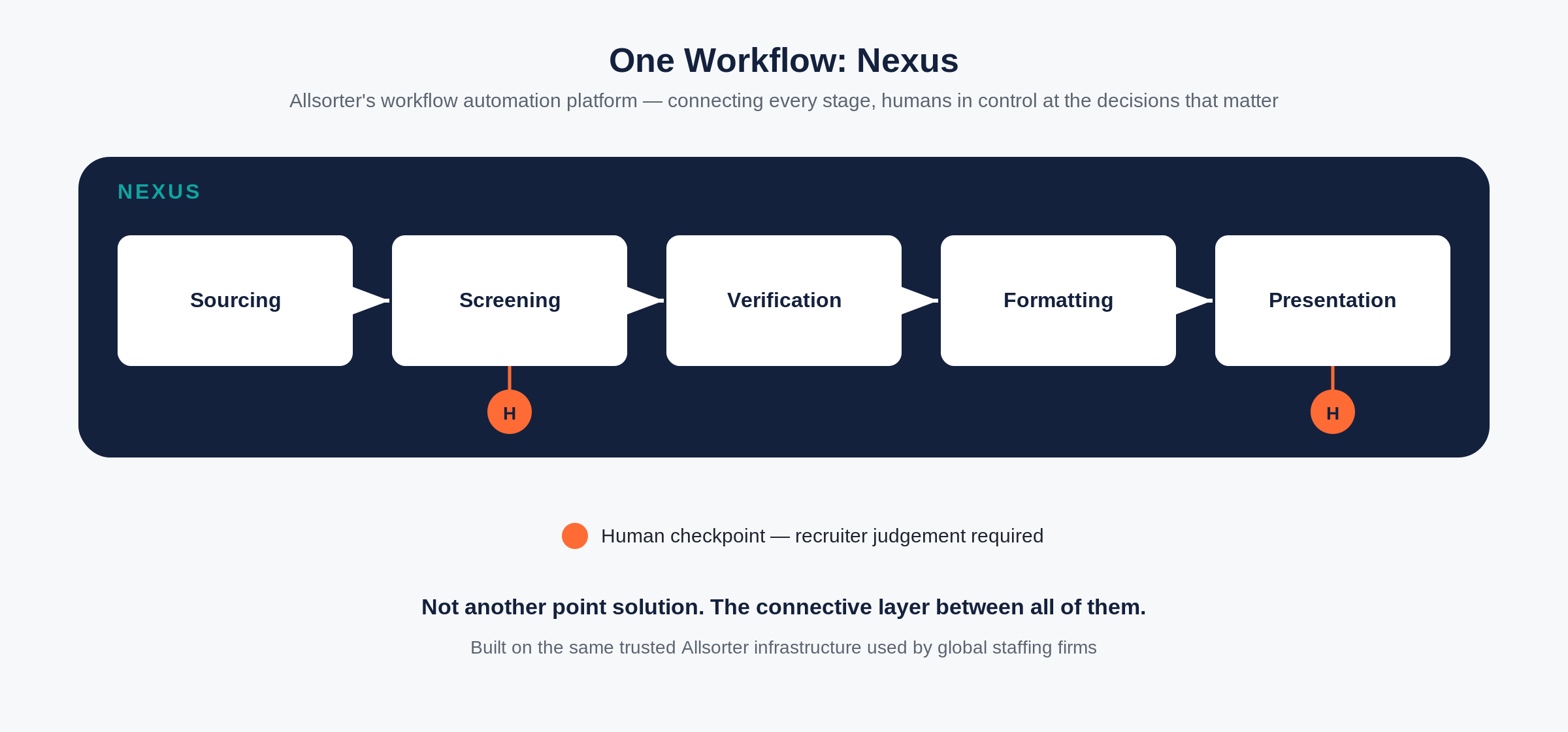
Nexus is Allsorter's workflow automation platform, designed to connect sourcing, screening, verification, formatting and candidate presentation into one intelligent recruitment workflow. Instead of recruiters stitching together multiple AI tools, Nexus orchestrates the process while keeping humans in control at every critical decision point. It's built on the same trusted Allsorter infrastructure used by global staffing firms and connects directly with your existing recruitment ecosystem. Learn more here.
The complete guide to lean staffing agency delivery
For most of the staffing industry's history, growth has had a simple and slightly unforgiving shape. More roles meant more recruiters, more recruiters…
Almost every recruitment agency redacts CVs, but surprisingly few have a redaction process. In most of the agencies we work with, the decision about w…
Best ChatGPT alternatives for CV formatting: how recruitment agencies should choose
ChatGPT has quietly become the default first stop for a lot of recruiters who need a CV cleaned up in a hurry. It's open in a browser tab already, it …
Practical ATS defenses against resume prompt injection
Every hiring stack that added AI to its screening step inherited a problem nobody put in the requirements document: the resume is no longer just conte…